Essay Rockfish Tackle
Trolling Umbrella Rigs for Chesapeake Bay Rockfish
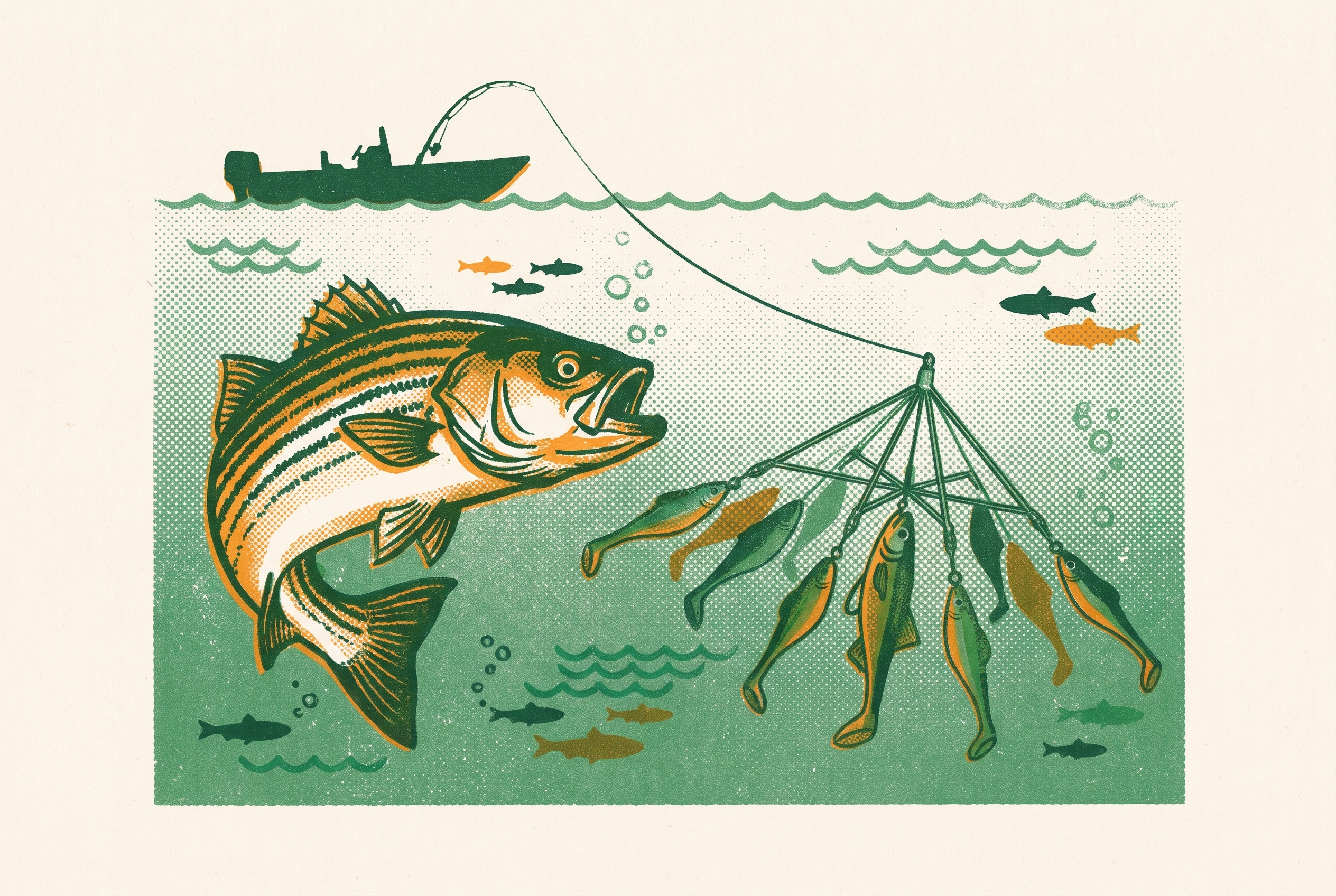
This rig covers depth and distance by balancing frame design with trailing bait placement.
Trolling umbrella rigs for Chesapeake Bay rockfish is a system of rig configuration, speed, depth, and bait placement. The frame draws attention, but the trailing lure must pass through the fish’s holding zone at a speed and depth that make it an accessible target.
Why umbrella rigs work on Chesapeake Bay rockfish
Large Chesapeake Bay striped bass are slow-moving predators that are unlikely to chase food very far. An umbrella rig suits the way they feed by putting a cluster of baitfish within reach. A trailing bait gives the predator a target just behind the group, where the rig directs the strike.
That presentation works only when it reaches the fish. Trolling takes what looks like a school through holding water and lets anglers search beyond the fish they see on the surface. This makes an umbrella rig both a feeding presentation and a way to cover water. Its effectiveness therefore depends as much on its path through the Bay as on its resemblance to baitfish.
What an umbrella rig is made of and how the parts connect
A standard Bay umbrella rig has a 4-arm, 15-inch frame, with wire crossbars that spread the arms to give the school its shape. Larger frames with more arms also exist. Tackle Cove builds its umbrella rigs on that standard frame with four teasers.
Snap swivels connect hookless shad bodies to the outer arms. Common Bay options include 6-inch swim shads and 8-inch swirl tails, with teaser size and style open to customization. A large bucktail or parachute jig runs well behind the frame on the center line. That trailer is the only hooked component in this configuration. Maryland rules prohibit stinger hooks and allow no more than two hook units per line, so a trailing lure must not be confused with an added trailing hook.
How trolling speed shapes what the rig does in the water
Standard Bay trolling speed for umbrella rigs, large bucktails, spoons, and plugs runs 2–4 knots. Within that range, speed controls how the rig moves and how deep it runs. Faster trolling pulls the rig shallower, while slower trolling lets it sink deeper. Line out cannot be treated as a fixed depth setting when the boat’s pace changes.
Current adds another variable to that relationship. Trolling into the current and trolling with it produce different effective speeds through the water, even at the same throttle setting. Line diameter, rod length, rod position, and lure type also affect how deep the rig runs.
The practical sequence is to set speed first so the rig swims properly, then adjust line out and weight to reach the target depth. Reversing that order makes depth harder to control because the later speed adjustment changes where the rig runs. Consistency is the basis for a useful adjustment. Once the presentation is moving correctly, line and weight become the tools for placing it in front of fish.
Getting the rig to the right depth with wire line or braid and drails
Wire line and braided line with drails provide two different ways to reach fish well below the surface. Wire offers precise depth control, less drag through the water column, and direct feel for the rig. It also needs a sturdy boat rod with special carbide guides because wire damages standard guides. The rod must suit the line system. Heavy trophy-season tackle is appropriate for the 30–50 lb class of fish, rather than a universal requirement for every Bay umbrella-rig application.
At typical trolling speeds, the wire-line estimate is roughly one foot of depth for every ten feet of wire in the water. To reach the productive Middle Bay channel-edge depth of about 30 feet, that rule puts roughly 300 feet of wire out at speed. Changes in current, speed, and the other running-depth variables still affect the rig’s position.
Wire also imposes greater handling costs than braid, as it can cut fingers on a strike and fail suddenly from a kink. Availability is another distinction, because braid is more widely available.
Braid with inline drails handles more safely, with less cut risk, and reaches adequate depths for most Bay channel-edge fishing. Its depth control is less precise than wire’s, however, and deep fall fish can require heavy inline weights. Fish at the Bay Bridge may hold in 25–50 feet during fall trophy season. Bay trollers disagree over which system is best because each has trade-offs in how closely anglers can control depth, how they handle the line, and how they manage the spread.
Deploying the umbrella rig without tangling the spread
Daybreak Fishing describes the umbrella rig as “difficult to launch” and recommends running it well back, up to 300 feet behind the boat. Deployment begins by laying the rig in the current, then slowly dropping it back to trolling depth. The frame needs room to settle into its presentation. A controlled launch prevents tangles before the rig joins the rest of the spread.
That long run-back must be understood in relation to the other lines. In a classic 6-rod Bay spread without planers or outriggers, the two outside rods run umbrella rigs deeper and at a shorter distance behind the boat. The two middle rods run tandem rigs farther back and a little shallower. The remaining inside or middle rods run single lures or spoons farthest back and shallowest.
The boat can make controlled turns without lines crossing and fouling as long as the rigs keep their places in the layered spread. An umbrella can therefore run a substantial distance astern while still being the shorter line in the layout. The distinction is between an individual rig’s setback and its position relative to neighboring presentations.
Taking time to put the rig out saves fishing time and protects gear. The umbrella’s size and weight make a poor launch especially disruptive, and experienced Bay trollers describe it as “temperamental.” The Mann’s Stretch 30 is another deep-diving lure that can be hard to put out. For the umbrella, the useful response is the deliberate sequence of current first, controlled drop-back second.
Trolling takes what looks like a school through holding water and lets anglers search beyond the fish they see on the surface.
Where on the Bay to run umbrella rigs by season
Spring fishing in April–May centers much of the effort on shipping channels, with heavier gear trolled higher in the water column than in the deep fall approach. Channel edges are still good places to fish an umbrella rig. In the Middle Bay, named locations include the Bloody Point edges, the Buoy 83 edge, and the False Channel. Maryland DNR’s May 2026 report described umbrella rigs or tandem bucktails trolled along channel edges at about 30 feet as productive and “a great way to cover a lot of water when in search of striped bass.”
Summer changes both the depth demand and the operating conditions. Fish move deeper, lighter gear takes over, and umbrella rigs remain effective where they can reach the holding zone. Bluefish also become much more of a threat during this period. Maryland’s 2026 August closure prohibits targeting and keeping striped bass in the Chesapeake Bay and its tidal tributaries. The summer pattern therefore does not imply an uninterrupted trolling season.
In fall, anglers focus on running rigs deeper and finding fish that have gathered together. Bay Bridge charter boats anchor up-current of the piers near the 30-foot dropoff on the eastern side, with trolling and drifting also producing in the bridge fishery. The agency’s October 2026 reports describe umbrella rigs behind heavy inline weights getting down to striped bass in the middle and lower Bay. Eastern Bay and the mouth of the Choptank River are named fall locations.
Around 60°F in mid-to-late October, baitfish move from rivers into open Bay water, drawing striped bass toward river mouths and channel edges. Schools become more predictable around structure. Across seasons, the useful features include ballast stone piles, submerged riprap, artificial reefs, piers, and prominent points. The location principle is to target channel edges, moving water, and structure transitions rather than open, featureless bottom.
The bluefish problem and what it costs umbrella rig anglers
Bluefish are the largest practical threat to an otherwise correctly fished umbrella rig. Fish of almost any size can tear through the soft plastic shads, and a school can shred a full rig in a single pass. The outer-arm teasers are particularly vulnerable to that damage. A spread that looks ready to catch fish can cost a lot within minutes.
Umbrella rigs are among the more costly trolling presentations, so repeated replacement of shads becomes a real operating expense. Tackle Cove uses quality frames and rigging components for rigs built to be trolled on the Bay again and again. Even with quality components, bluefish can still tear up the soft plastics.
The practical response is to monitor bluefish activity before deploying expensive rigs and consider a substitution when blues are thick. Wire-leader rigs or tandem bucktails provide alternatives that are less vulnerable than a spread of soft plastics. This is a reason to judge whether umbrellas’ attraction to rockfish still justifies the replacement cost under the conditions at hand. When repeated damage degrades that cost-to-catch ratio, changing presentations is the better use of the spread.
Catch-and-release practice for oversized fish under current Bay regulations
Large striped bass are a particular strength of the umbrella presentation, but Maryland’s 2026 slot limit means trophy-class fish typically must be released. The harvest season opens May 1, with one fish per person per day allowed within the slot. April 2026 also brought back catch-and-release fishing for the first time since 2019 under Maryland rules. Umbrella-rig trolling is a legal method during that window. Release preparation is therefore part of the fishing method.
Those Maryland provisions do not establish the rules for every jurisdiction an angler may fish. Virginia requirements and the Potomac River Fisheries Commission’s separately managed regulations should be verified directly. Federal waters from 3 to 200 nautical miles remain closed to all commercial and recreational fishing for Atlantic striped bass. A Bay regulation cannot be assumed to apply beyond its jurisdiction.
The Atlantic striped bass stock remains overfished, although overfishing is not currently occurring. Maryland’s young-of-year index improved in 2026, but juvenile numbers have remained below the long-term average for eight consecutive years. Poor reproduction in the Chesapeake and Hudson River, which together account for the vast majority of the coastal population, signals a likely decrease in catchable fish beginning around 2030.
Umbrella rigs target the adult fish that keep that population going while recruitment is weak. The practical response is to minimize air exposure, support fish horizontally, and revive them beside the boat in moving water before release. Heavy fall trophy fish need extra care after a hard fight on wire-line gear.
Notes
- Fishing for Chesapeake Bay Trophy Striped Bass (Rockfish)
Provided the description of the umbrella rig as difficult to launch and the recommendation to run it up to 300 feet behind the boat.
- Striper Umbrella Rigs for Trolling
Provided details on umbrella rig construction, frame size, teaser options, and the use of quality components for Bay trolling.
- Striper Bucktails & Trolling Rigs
Provided context on standard Bay trolling speeds and the range of lures used alongside umbrella rigs.