Essay Fishing Regulations
Chesapeake Bay Rockfish Catch-and-Release Best Practices
How anglers handle released striped bass determines whether they live or die.
Catch-and-release has long carried a reputation as the responsible choice, the thing a careful angler does to protect a fish population under pressure. That reputation deserves a second look, because the act of releasing a striped bass carries its own death toll, and that toll has grown large enough to shape the entire management picture for the Chesapeake Bay stock. From 2022 through 2023, recreational release mortality made up roughly 40% of total removals, a structural share of the damage done to the stock. More than 90% of all striped bass caught in the Bay and along the Atlantic coast get released rather than kept, so the quality of that release, how a fish is hooked, how long it fights, how it's handled and revived, has become the single largest lever anglers hold over the fishery's health.
The backdrop makes that lever more consequential, not less. The stock is overfished and overfishing is still happening, and the Chesapeake Bay Foundation has pointed out that the Atlantic States Marine Fisheries Commission is required to rebuild the species by 2029, a deadline the commission's own status-quo vote in October 2025 all but conceded would slip. Every preventable death at the release point lands harder on a population that isn't replenishing itself the way it used to. The sections that follow unpack what actually kills a released fish, why the official mortality estimate likely understates the problem, and what an angler can do, starting the moment a fish is hooked, to change the odds.
What Kills a Released Rockfish
Post-release mortality isn't a fixed cost of catching a fish. It moves, sometimes by a factor of twenty or more, depending on three variables that an angler can read, anticipate, and in most cases influence: water temperature, where the hook lands, and how the fish is handled between the strike and the release. None of these operates alone. A fish hooked deep in warm water and fought too long on light tackle doesn't face three separate risks stacked on top of each other. It faces one compounded event, and that compounding is what turns survival into death.
Temperature sets the baseline. In water at or below 59°F, released striped bass die at a rate of roughly 1.6%, a number low enough that cool-season catch-and-release looks close to what anglers assume it to be: low-impact and largely safe. Once air temperature climbs past 95°F, that mortality rate jumps above 17%. The Chesapeake Bay Foundation notes that striped bass caught and released in warm water with low oxygen, the exact condition found in the upper Bay's hypoxic zones each summer, face a meaningfully higher chance of dying, because warm, oxygen-poor water leaves a stressed fish with almost no physiological cushion.
Hooking location is the single largest multiplier in the whole equation. A deeply hooked fish is more than 15 times more likely to die than one hooked in the lip or jaw. Research from Maryland DNR (Lukacovic, 2000) put real numbers on the two extremes: striped bass hooked shallow in high-salinity water from June through October died at about 3.5%, while fish deeply hooked on J-style bait hooks died at a rate above 53%. That gap, more than fifteenfold at the extremes, exists before temperature or handling even enter the picture.
Handling closes the loop. A fish that swims off strong at boatside can still be dead by nightfall. That compressed window is why in-water revival and minimal handling stress change survival odds regardless of whether a released fish "looked fine" on the way back in.
Why the 9% flat mortality rate used in federal stock assessments understates the real damage
The Atlantic States Marine Fisheries Commission builds its striped bass stock assessments around a constant post-release mortality rate of 9%, a figure that traces back to a study now roughly 30 years old. Given what the temperature and hooking data above show, that single flat number almost certainly understates what's actually happening on the water across a wide range of real conditions. A number built from research three decades old can't easily capture a 30% to 40% mortality rate in summer heat, or a 53% mortality rate among deeply hooked fish on J-hooks, because it was never designed to vary by season or gear.
Researchers are already working to close that gap. A final report prepared for NOAA by T. Reid Nelson and colleagues at George Mason University, funded by the American Saltwater Guides Association, set out in 2025 to build mortality estimates from realistic catch-and-release interactions and to measure how temperature drives seasonal swings in survival. The project exists precisely because the static 9% rate is likely wrong across many of the conditions anglers actually fish in. The Maryland DNR figures discussed above, 30% to 40% mortality in summer warm water, suggest that if stock assessments caught up to real conditions, the apparent conservation value of catch-and-release fishing would need real revision, especially for the summer months.
Anglers don't have the luxury of waiting for that revision to work its way into the next stock assessment cycle. The temperature-stratified mortality picture that already exists, built from Maryland DNR's own research, tells any angler paying attention when their fishing carries elevated risk, regardless of what the official model assumes. If the flat rate undersells the actual damage, then the practices described in the rest of this piece, hook choice, fight time, temperature awareness, and revival technique, carry more conservation weight than the official 9% figure would suggest on its own.
Hook choice, the single gear decision with the largest effect on whether a released fish lives
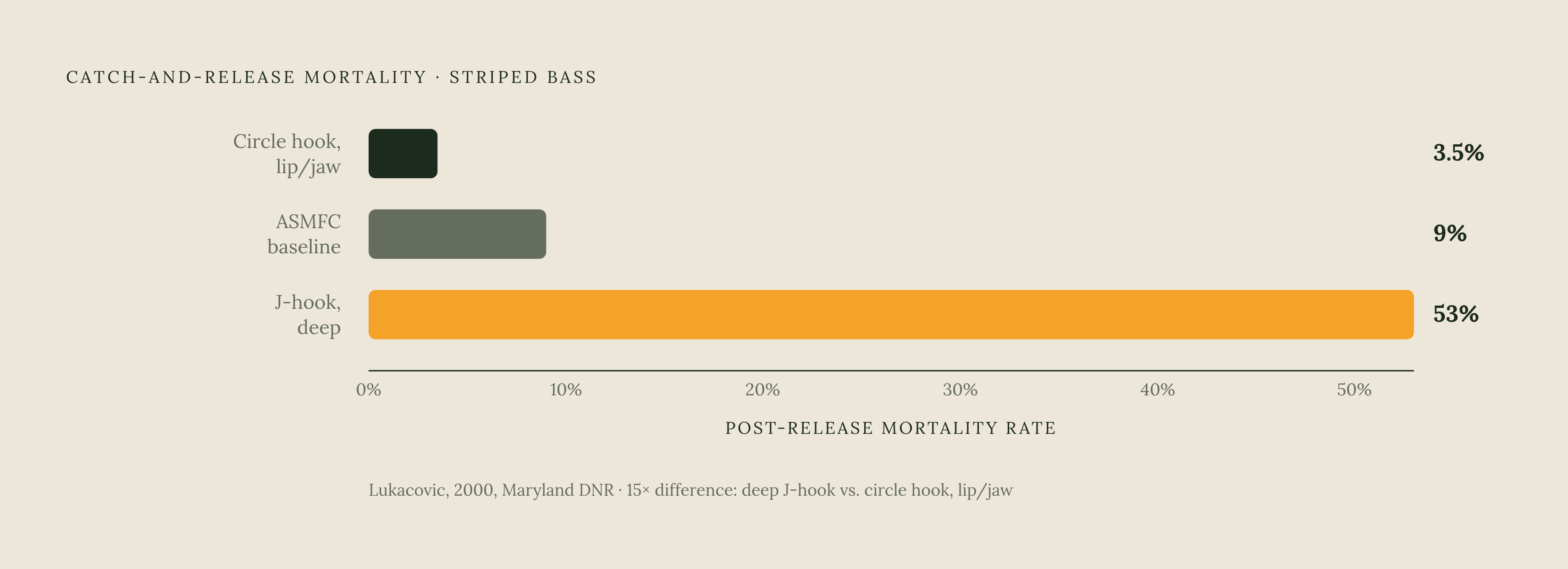
Among every decision an angler makes, switching from J-hooks to non-offset, inline circle hooks when fishing bait produces the largest measurable change in survival odds for a Chesapeake Bay rockfish. Deep hooking alone multiplies mortality by more than 15 times, and J-hooks deep-hook fish at four times the rate of non-offset circle hooks (Lukacovic, 2000, Maryland DNR). Multiplying those two effects together makes the case for circle hooks when bait fishing about as strong as any single piece of gear advice in recreational fishing gets.
Virginia has already written this science into law: non-offset, inline circle hooks are required for anyone fishing bait for striped bass in the Virginia portion of the Chesapeake Bay. Maryland pairs that rule with others built on the same logic: barbless hooks are required when trolling, and stinger, or trailing, hooks are banned outright, during the March 1 through May 15 window, cutting down on tissue damage and deep-hooking risk during the spring catch-and-release period.
Lure anglers have a parallel move available even though circle-hook rules target bait fishing specifically. But the relevant comparison is how many of those fish swim away alive, and on that measure, the case for circle hooks holds.
Post-release mortality isn't a fixed cost of catching a fish.
Fight time, landing gear, and the two-minute window that the Striped Bass Initiative research team used as their upper limit
Hook choice determines a lot before the fish is ever in hand, but what happens between the strike and the release matters just as much. Using gear heavy enough to shorten the fight, landing the fish in a rubber net rather than letting it thrash against nylon or a gaff, and keeping total boatside handling time short together determine how much stress a fish is carrying by the time it goes back in the water. Adequate tackle to limit fight time is listed explicitly among the actions known to raise survival rates for released striped bass, because undersized gear drags out the fight, and a prolonged fight adds exhaustion and metabolic stress on top of whatever temperature and hooking risk the fish already faces.
The clearest working example of this principle comes from a research operation, not a weekend trip. Every one of those twenty fish went back in the water within two minutes of reaching the boat, and the fastest full cycle, hook removal, measurement on a bump board, and tag application included, took one minute and five seconds. That benchmark says something important: a two-minute ceiling on total handling time is achievable even during a scientific operation that requires far more steps than a typical release.
Landing gear plays its own role. Maryland's 2026 regulations back this logic with a hard legal line: removing a striped bass from the water with a gaff or a cast net is already illegal in the state, a rule aimed squarely at preventing the tissue damage and added stress those tools cause at the moment of landing.
Reading water temperature and knowing when C&R fishing carries elevated mortality risk
Every practice described so far, hook choice, fight time, landing gear, sits inside an environmental condition the angler doesn't control but has to read: the water's temperature. The same handling routine that produces close to 1.6% mortality in cool spring water can still leave 30% to 40% of released fish dead in the heat of summer, and no amount of careful technique closes that gap. Good practice narrows the distance between the cool-water outcome and the warm-water outcome. It cannot erase it.
Maryland's 2026 season restructuring was built around that exact curve. Spawning rivers and the Upper Bay spawning area stay closed to targeting altogether from March 1 through May 31, and during the March 1 through April 30 window specifically, stinger hooks are banned, barbless hooks are required while trolling, no more than six lines can be run at once while trolling, and eels can't be used as bait.
Virginia runs on its own version of the same logic, closing its harvest season on June 15 and reopening it on October 4, a boundary set by the same warm-water risk even though the exact dates differ from Maryland's. Reading the thermometer, in other words, is as much a part of responsible fishing as reading the regulation calendar.
Reviving a fish before release in warm conditions
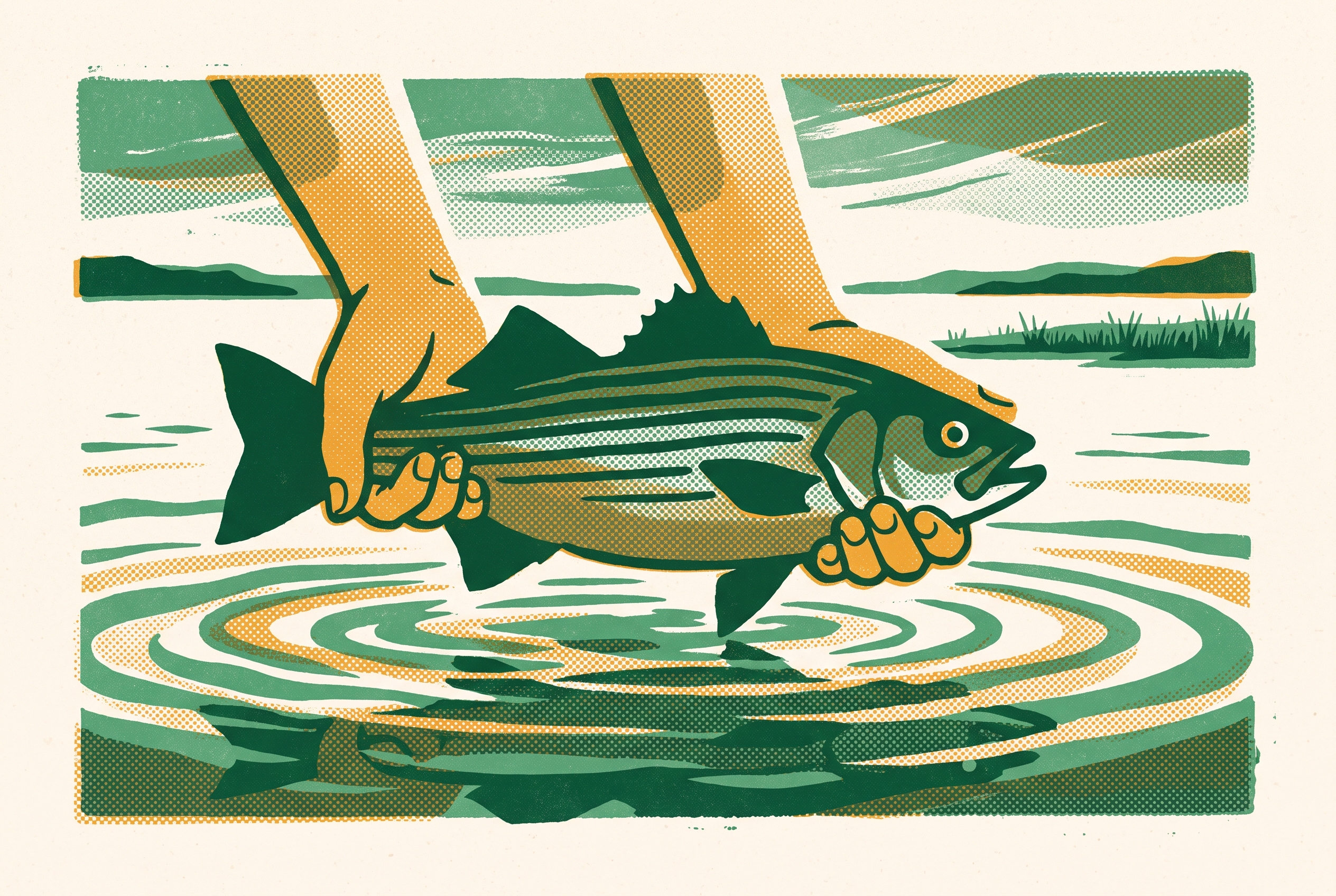
Because most post-release deaths happen within six hours and nearly all within 48, a fish that swims off looking strong may already be caught in a window that ends in its death, particularly if it was fought hard in warm, low-oxygen water. Active revival at the water's surface is the last point at which an angler can do anything to shift that outcome. The right approach is straightforward: hold the fish horizontally in the water, facing into any current, or move it gently forward and back by hand so oxygenated water passes over its gills, and don't let go until the fish kicks away under its own power with visible strength in its tail and body.
None of that works if the fish spent too long out of the water beforehand. The Striped Bass Initiative's own protocol, a two-minute total handling ceiling, eyes covered with a wet chamois, processing done on a bump board, and release always completed in the water, shows that careful data collection and release-ready handling aren't in conflict. Removing barbs from hooks, or using the barbless hooks Maryland already requires during spring trolling, speeds up the unhooking step specifically, which shortens the out-of-water interval that comes right before the fish needs to recover.
The mycobacteriosis background and C&R survival
A disease called mycobacteriosis complicates the picture in a way that honest guidance about catch-and-release can't skip past. First documented in Chesapeake striped bass in 1997, the disease has persisted ever since, and more than half of the striped bass living year-round in the Bay now carry it. Among fish age three and older, yearly incidence runs at 89% of the adult resident population, and mortality among diseased fish is severe, approaching roughly 80% in bad years. That overlap means diseased fish are concentrated in exactly the water where C&R risk already runs highest.
Current stock assessment models, including ASMFC's, don't fully account for mycobacteriosis as a factor in post-release mortality, which gives the flat 9% rate one more reason to run low. The honest reading for anglers is this: a fish released with perfect technique in August, back when August was still open to fishing, could still die from the added stress of a disease it was already carrying, and that possibility doesn't make good technique pointless. It raises the value of every stressor an angler can remove, because a diseased fish starts the fight with less physiological reserve than a healthy one, and every extra minute of fight time or every unnecessary minute out of the water costs that fish more than it would cost a healthy one.
The ASMFC's October 2025 Vote and GMU Research
In October 2025, the ASMFC's Striped Bass Management Board chose to hold the current rules in place rather than cut the striped bass catch by 12% in 2026, opting instead to form a work group studying recruitment in the Chesapeake Bay and other systems, biological reference points, hatchery programs, and the broader factors shaping stock productivity, with its sights set on management beyond 2029. Reid Nelson at George Mason University is actively building the temperature- and salinity-stratified mortality estimates that could eventually replace the flat 9% figure, but that work hasn't been folded into any stock assessment yet. The University of Chicago's Striped Bass Initiative tagging project, running in the Bay through late March 2026, is generating behavioral data on large fish after release and working toward an answer to a question that remains genuinely open: whether spring catch-and-release disrupts spawning behavior in ways nobody has yet measured.
Maryland's 2026 season restructuring, opening April to catch-and-release and closing August outright, stands as the clearest current example of a management body building its rules around the temperature-mortality relationship described throughout this piece. The current trajectory, seven years of poor recruitment, a missed rebuilding deadline, a mortality estimate that likely runs low, risks repeating that collapse. In the space between what policy currently requires and what the science already shows is needed, the specific choices anglers make at the moment of release, the hook, the fight, the net, the two minutes, the revival, are not a courtesy extended to a fish. They are a measurable reduction in the mortality burden this stock is carrying, at a moment when that burden is not getting any lighter on its own.
Notes
- Maryland Set to Adopt Changes to Chesapeake Bay Recreational Striped Bass Season
Provided details on Maryland's 2026 season restructuring, including closures, gear restrictions, and the broader regulatory context for catch-and-release periods.
- STRIPED BASS REGULATIONS MAPS
Provided regulatory map details referenced for specific date boundaries in Maryland's striped bass season rules.
- Striped Bass (Rockfish) • Chesapeake Bay Foundation
Provided information on the ASMFC's 2029 rebuilding deadline and the elevated mortality risk striped bass face in warm, low-oxygen Bay waters.
- Maryland Fishing - Striped Bass
Provided Maryland regulatory details including the gaff prohibition and the spring gear restriction window cited in the article.