Essay Features
Maryland Rockfish Size and Bag Limits for the Current Year
New limits and a redrawn calendar protect vulnerable young rockfish through spring and summer.
Maryland's 2026 rockfish season runs on a rewritten calendar, and anglers who fished the Bay under the old rules need to relearn the year before opening day. The state approved a new season structure on March 11, 2026, through the General Assembly's Joint Committee on Administrative, Executive, and Legislative Review, published it in the Maryland Register on March 20, and put it into effect ten days later. The headline changes: catch-and-release fishing returns in April, August closes completely, and the 19 to 24 inch slot with a one-fish bag limit stays exactly where it's been. This piece walks through every rule that applies to the 2026 season, from the calendar itself down to hook types and licensing.
The full 2026 Chesapeake Bay season calendar, period by period
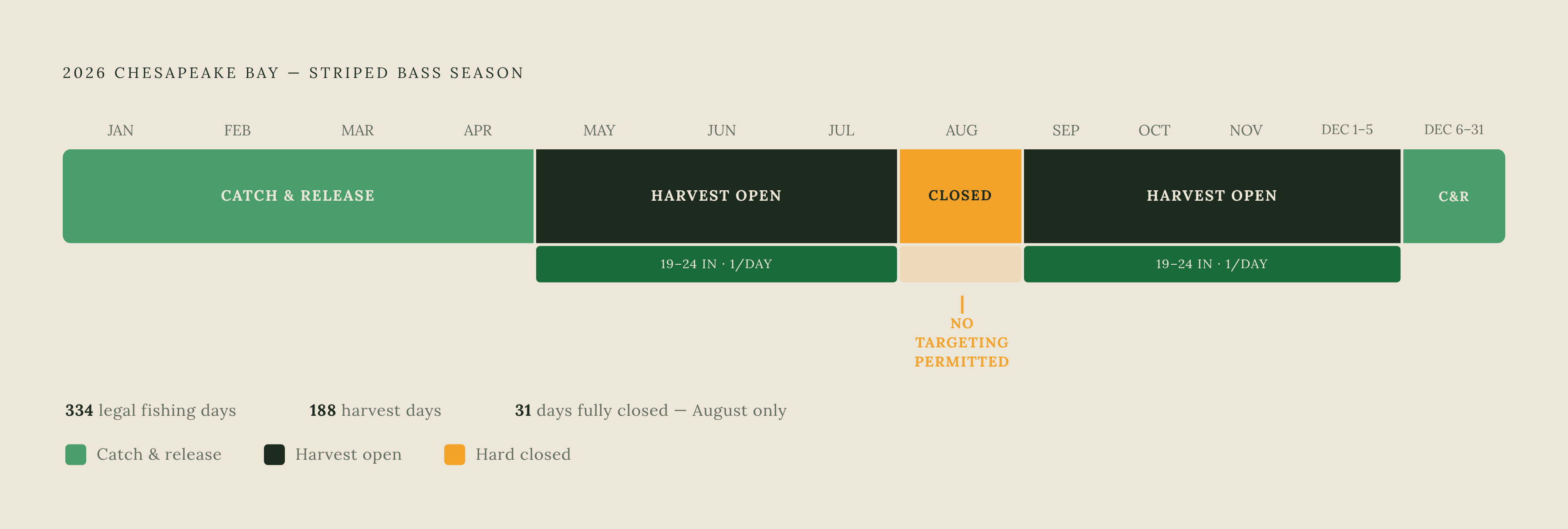
From January 1 through April 30, the Bay is catch-and-release only. Every striped bass caught in that window goes back in the water immediately, no exceptions.
May 1 through July 31 opens harvest season: one fish per person per day, with a 19 to 24 inch slot limit. Then August shuts down entirely, all 31 days, and no one can target striped bass at all, not for harvest and not for catch-and-release. Harvest resumes September 1 and runs through December 5, still one fish per day inside that same 19 to 24 inch slot. The final stretch, December 6 through the end of the year, goes back to catch-and-release only.
Harvest days total 188 in 2026, down five from the 193 days available in 2025. But total days anglers can legally be on the water targeting rockfish, whether keeping or releasing, comes to 334, a real gain in access driven almost entirely by the return of spring catch-and-release. The August closure is a hard stop, not a slot restriction or a catch-and-release grace period. It's a hard stop. Anglers should confirm applicable rules for their specific vessel type and waters before heading out.
Size and bag limits
During the two Bay harvest windows, May 1 through July 31 and September 1 through December 5, the slot limit is 19 to 24 inches total length. A fish has to hit at least 19 inches and can't exceed 24 to go in the cooler. Anything shorter or longer gets released, no matter how healthy it looks or how hard it fought. The bag limit is one fish per person per day, full stop.
Ocean and coastal waters run a different set of numbers year-round: a 28 to 31 inch slot and a coastwide bag limit of one fish per angler per day. The ocean fishery never closes seasonally the way the Bay does.
The 2026 season maintains a 19 to 24 inch slot with a one-fish daily bag limit for Bay harvest windows, and a 28 to 31 inch slot with a one-fish daily limit for ocean waters. What's different in 2026 is the calendar around them. Anglers should still bring a tape measure they trust: DNR enforces both ends of the slot, and a fish that's a half-inch over 24 inches is just as illegal to keep as one that's undersized.
Where the spawning tributary closures apply
Seven Bay tributaries close to all striped bass targeting from March 1 through May 31, regardless of what the main stem rules say. Those rivers are the Choptank, Chester, Manokin, Nanticoke, Patuxent, Transquaking, and Wicomico, along with the Upper Bay spawning area that includes the Susquehanna Flats.
This creates a real trap for anglers who only skim the calendar. In April, the main stem of the Chesapeake is open for catch-and-release fishing under the new rules. But none of the named tributaries follow that main-stem calendar. Anglers can't target striped bass in the Choptank or the Nanticoke, or anywhere on the Flats, until June 1, even while boats a few miles away on open Bay water are legally fishing catch-and-release. Susquehanna Flats regulars in particular need to hold off: that water stays closed through May 31 even as the surrounding main stem opens up in April.
River names only get you so far here. The actual closure boundaries have geographic detail that a list of names can't capture, so anyone fishing near a tributary mouth should pull up DNR's striped bass regulation maps before heading out. And none of this touches the Potomac. The main stem of that river falls under the Potomac River Fisheries Commission, a separate body with its own rulebook, and anglers fishing there need to check that agency's regulations directly rather than assume Maryland's Bay calendar applies.
Gear rules that apply during catch-and-release periods and year-round bait restrictions
A set of gear restrictions that used to apply only in March now extends through May 15, covering the new April catch-and-release window and bleeding into the early weeks of harvest season. Stinger hooks are prohibited. Trolling is capped at six rods. Barbless hooks are required for anyone trolling.
Separately, and year-round, non-offset circle hooks are mandatory whenever anglers use natural bait, meaning fish, crabs, worms, or processed bait, to target striped bass anywhere in the Chesapeake Bay and its tidal tributaries. Treble hooks are banned outright when natural bait is in play. This rule doesn't pause for catch-and-release months: it applies in January just as much as it applies in June.
DNR emphasizes careful handling during release to keep mortality low. That emphasis ties directly to the low mortality numbers that led DNR to reopen April. Circle hooks and the trolling limits are enforceable rules, while net type and glove use are conservation best practices DNR is asking anglers to adopt voluntarily.
Why August is closed and April was reopened
August closes because warm water kills fish that anglers think they're releasing safely. Once water temperatures climb, younger resident striped bass get stressed to the point where even careful catch-and-release handling results in high mortality. According to the most recent stock assessment data, published in 2022, recreational dead discards, fish that die after being caught and released, accounted for 21% of all fishing-related striped bass deaths. August is the peak of that mortality curve, and DNR designed the closure to hit that single window hardest, protecting younger resident fish long enough for them to grow and eventually join the coastal spawning stock.
April tells the opposite story. Research cited in HdG Beacon's 2026 season guide puts the mortality rate for released fish caught in water at or below 59°F at just 1.6%. That's a low enough number that regulators felt confident reopening spring catch-and-release carried minimal risk to the population, even while August activity carries outsized risk.
The trade becomes clear when the numbers are run together: 188 harvest days, five fewer than 2025, against 334 total days on the water. DNR's own framing is that the changes aim to maintain or potentially reduce overall fishing mortality while shifting the conservation focus toward the younger, more vulnerable fish that make up the Bay's resident population.
Then August shuts down entirely, all 31 days, and no one can target striped bass at all, not for harvest and not for catch-and-release.
The recruitment crisis that makes these conservation rules matter
None of this matters without the numbers behind it, and the numbers are bad. Maryland's annual young-of-year survey has now logged seven consecutive years of below-average juvenile striped bass recruitment. The 2025 index came in at 4.0, far below the long-term average of 11, the Southern Maryland Chronicle reported. That's most of a decade of weak reproduction.
The Hudson River, the Chesapeake's counterpart as a major spawning ground, isn't offering relief either. Poor reproductive success in the Hudson River has also been reported for multiple consecutive years.
The adult population, for now, looks fine on paper. Maryland DNR estimated spawning female biomass at roughly 80,000 metric tons in 2024. Scientists tracking the fishery warn that the effects of years of weak juvenile classes become visible only once those thin cohorts reach spawning age themselves. Researchers tracking the fishery note that poor recruitment appears to stem from multiple compounding factors rather than any single cause.
The Atlantic States Marine Fisheries Commission's Striped Bass Board actually considered a 12% cut to fishery removals through Draft Addendum III. After public comment came back sharply divided, the Board held at status quo and didn't move forward with the reduction. That leaves Maryland's 2026 season structure doing conservation work inside a fishery where the adults are holding steady but the next generation is thin.
What the August closure means for charter captains
Charter operators are the ones who feel a closure like this first, and Maryland's recreational fishing and boating economy isn't small: 2024 federal Bureau of Economic Analysis figures, cited by Maryland DNR, put statewide value-added economic activity from the sector at roughly $701.5 million. Southern Maryland counties, Calvert, Charles, and St. Mary's especially, lean hard on charter trips, marinas, bait shops, and the restaurants that feed all of it.
The path to these rules wasn't friction-free. A delegate representing the Upper Shore, from one of the major political parties, pushed for a pause on implementation over concerns about both the economic hit and the biological reasoning behind it. That hold eventually lifted, the Southern Maryland Chronicle reported.
For August itself, DNR is steering anglers toward species that don't carry striped bass's conservation baggage. Invasive blue catfish and northern snakehead, sometimes called Chesapeake Channa, both carry no size limit and no bag limit, and DNR frames harvesting them as good for Bay ecosystem health rather than a consolation prize. Red drum also show up in the Bay in August and get explicit mention in the state's regulatory rationale as a viable alternative target.
The calendar redesign also reflects a business argument. The old system stacked closures awkwardly, an April 1 to May 15 closure, a separate one from July 16 to 31, plus a scattering of tributary-specific rules layered on top. Charter captains had to explain that patchwork to every client booking a trip. One clean August closure is easier to sell, easier to plan around, and should cut down on the kind of last-minute cancellations that come from a customer misreading a complicated calendar. Spring bookings get a boost too: harvest season now opens May 1, fifteen days earlier than the May 16 opener that previously applied.
Best catch-and-release practices DNR recommends for the spring and winter seasons
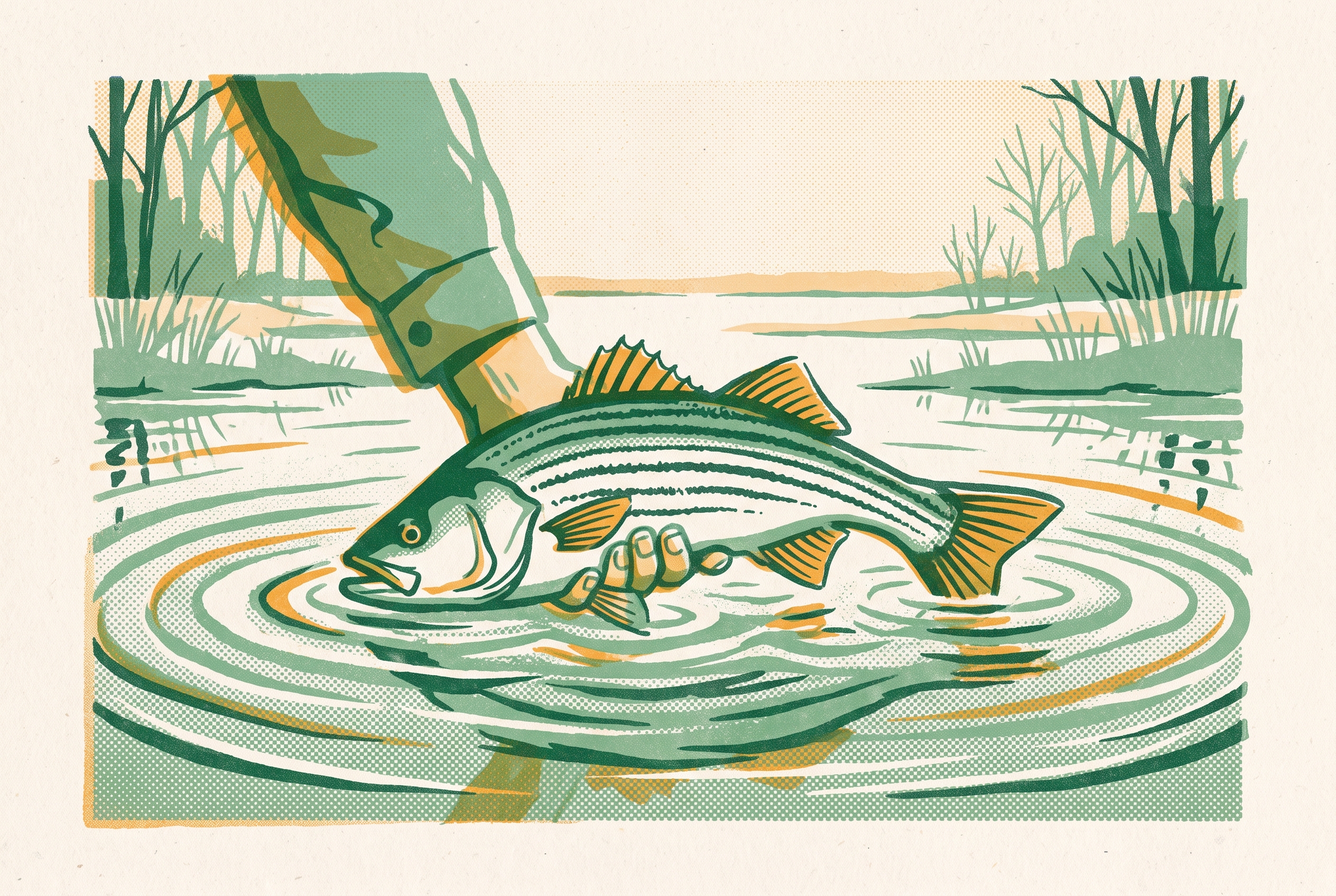
DNR's guidance for catch-and-release fishing during the spring and winter windows is specific and mechanical, not just a general call to be careful. Use non-offset circle hooks, which is mandatory anyway when fishing natural bait and strongly recommended even when it isn't. Where possible, de-hook fish while they're still in the water rather than lifting them aboard first. Keep handling to a minimum, lean on rubber-mesh nets and wet gloves rather than dry hands or hard nets, and hold air exposure under one minute. Never land a fish on a hard deck surface if there's an alternative.
The gear restrictions running through May 15, no stinger hooks, barbless trolling hooks required, a six-rod cap on trolling, stay in force through May 15.
None of this is arbitrary politeness toward fish. The April reopening exists because low water temperatures combined with careful handling keep mortality down near 1.6%. That figure is the entire justification regulators used to bring spring catch-and-release back. If handling practices slip and release mortality climbs, that's exactly the kind of data point that gives future rulemaking a reason to close the window again. Anglers fishing April in 2026 aren't just following a rule. They're producing the survival data that decides whether this window exists in future seasons.
Ocean and coastal regulations for anglers fishing outside the Bay
Ocean waters run on a separate rulebook with no seasonal closure at all: the fishery stays open year-round. The slot limit out there is 28 to 31 inches, noticeably larger than the Bay's 19 to 24 inch window, and the bag limit is one fish per person per day, applied coastwide.
The contrast with Bay rules isn't a technicality. Larger fish, no closed season, no August shutdown: these reflect a different population under different pressure than the Bay's resident striped bass. Anglers fishing ocean waters, whether on private or charter vessels, should verify which rules apply to their specific situation.
Anyone running a trip that crosses from Bay water into ocean water in the same day needs to track which rule set applies to which fish in the cooler. Mixing up a 22-inch fish legal within the Bay with a fish caught outside the 28 to 31 inch ocean slot is a minor paperwork error in appearance only. It's the kind of mistake a boarding officer catches immediately.
Licensing requirements for Maryland rockfish
A valid Maryland fishing license is required to fish for striped bass, and that requirement doesn't relax during catch-and-release months. Releasing every fish you catch doesn't exempt anyone from carrying a license. Licenses are available online through MD Outdoors, at DNR service centers, and through authorized sport license agents around the state.
For anyone trying to nail down exact tributary closure boundaries, DNR's Fishing and Boating Service website carries maps far more precise than any written list of river names can be. Given how tightly the Susquehanna Flats and the seven named tributaries are drawn, a map is worth more than a paragraph.
These rules can shift mid-season, and the 2026 season is proof of how fast that can happen: the final regulations weren't locked in until just days before April 1. Anglers heading out should check with DNR ahead of any trip rather than working off memory from a previous year. Useful places to keep bookmarked include Maryland DNR's official press release from March 31, 2026, announcing the season opening, the Atlantic States Marine Fisheries Commission's Atlantic striped bass page, DNR's striped bass regulation maps for the spawning closures, and the Potomac River Fisheries Commission for anyone fishing that river's main stem. The rules exist because a fragile stock needs them to. Knowing them cold separates a legal trip from an expensive lesson from a natural resources officer.
Notes
- Maryland’s 2026 Striped Bass Season Opens for Catch-and-Release Fishing in April
Provided the official announcement of the 2026 season opening and the regulatory framework for catch-and-release fishing in April.
- Chesapeake Bay Angler Red Alert: New 2026 Rockfish Regs | FishTalk Magazine
Provided detailed reporting on the new 2026 rockfish regulations including the August closure and season structure changes.
- August Ban, April Fishing: Rockfish Regs Advance
Reported on the legislative hold attempt and economic concerns raised by a delegate representing the Upper Shore.
- Maryland Set to Adopt Changes to Chesapeake Bay Recreational Striped Bass Season
Provided the official DNR announcement with key figures including the 21% dead discard statistic, seven consecutive years of below-average recruitment, and the $701.5 million economic activity figure.
- 2026 Maryland Rockfish Season: Dates, Regulations & Slot Limits
Provided the 1.6% catch-and-release mortality rate at cold water temperatures, the 188 harvest days figure, and the 80,000 metric ton spawning female biomass estimate.
- https://southernmarylandchronicle.com/2026/03/30/maryland-implements-new-striped-bass-seasons-starting-april-1/
Reported the 2025 young-of-year index of 4.0 against the long-term average of 11.
- DNR-FS-2025-3 Striped Bass - Recreational Seasons - UPDATED 3-31-2026.docx
Provided the official regulatory document detailing season dates, slot limits, gear restrictions, and tributary closure rules.
- https://news.maryland.gov/dnr/2025/10/15/chesapeake-bay-2025-young-of-year-striped-bass-survey-results/
Provided the official 2025 young-of-year striped bass survey results showing seven consecutive years of below-average juvenile recruitment.