Essay Fishing Regulations
Virginia Striped Bass Regulations on the Chesapeake
Seven years of weak spawning threaten the entire Atlantic coast's striped bass population.
Virginia's striped bass regulations only make sense once you understand what the Chesapeake Bay actually is to this fish: not one habitat among several, but the primary spawning nursery for the entire Atlantic coast migratory stock. Most striped bass caught from Maine down to North Carolina trace their origin back to the Bay. That single fact is the reason a size limit set in Virginia's capital or a closure date set in another state's capital carries weight for anglers who have never set foot in Virginia.
The work of spawning happens in specific places, and biologists know exactly where to look: the upper Bay, the Choptank, the Nanticoke, and the Potomac on the Maryland side, and a set of tidal rivers on the Virginia side. These tributaries are where eggs are laid, where larvae either survive their first fragile weeks or don't, and where state agencies run the annual surveys that tell everyone else in the fishery what to expect years down the line. A juvenile striped bass spawned in the Bay needs three to four years to grow into a fish anyone can legally keep. So a single bad spawning year doesn't just disappoint anglers the following spring: it produces a thin year class that works its way through the population for nearly half a decade, shaping catch rates and regulatory debates long after the water that produced it has warmed and cooled several times over.
That delay is why an angler fishing Virginia's tidal rivers in October isn't simply following a local rulebook. The fish in that water, and the fish that will replace them, are part of a shared coastal resource that every Atlantic state depends on and every state's regulators watch closely.
Seven Consecutive Years of Below-Average Spawning and the 2025 Survey Data
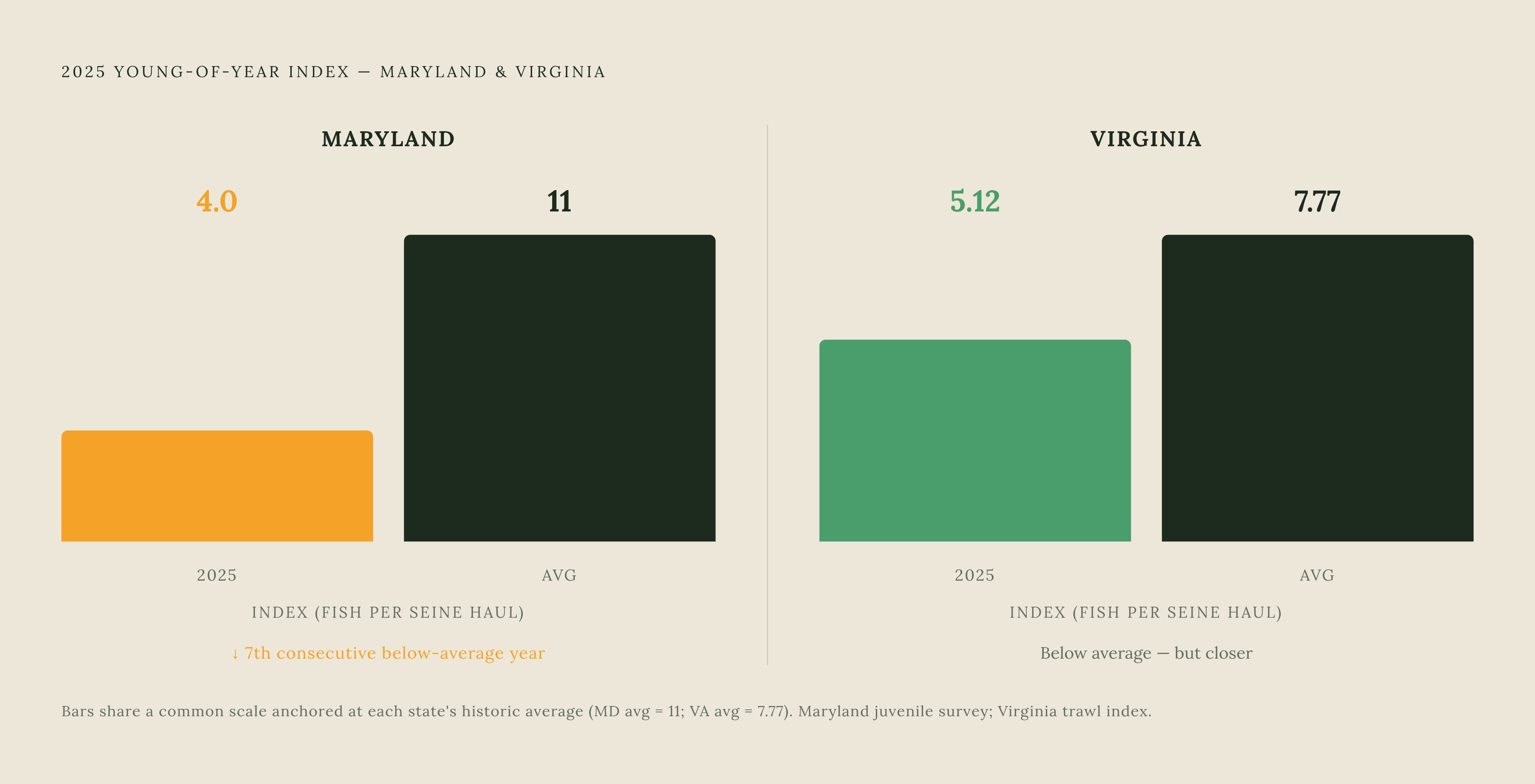
The pressure behind every striped bass rule on the books right now traces back to one persistent problem: not enough juvenile fish are surviving to adulthood, even though the adult spawning population itself has not collapsed. Maryland's Department of Natural Resources ran its 2025 juvenile striped bass survey, and it recorded a young-of-year index of 4.0. That's an improvement over the dismal readings of the prior two years, but it still sits well below the long-term survey average of 11, and it marks the seventh consecutive year of below-average spawning success in Maryland's portion of the Bay.
Virginia's result told a slightly different story. A state seine survey recorded a mean of 5.12 fish per seine haul in 2025, a figure much closer to Virginia's own historic average of 7.77. That doesn't erase the broader pattern: the stock assessment that governs management decisions treats the Chesapeake as a coastwide system, not a patchwork of individual state results, and a single stronger year in Virginia's tributaries does nothing to break the seven-year run of weak recruitment across the Bay as a whole. But the divergence still matters politically. Virginia regulators now have a local data point to point to when critics push for uniform, Bay-wide emergency measures, and that gives Virginia room to argue its own house is in somewhat better order than Maryland's.
Compounding causes drive the pattern. Warmer water temperatures, reduced food availability for larvae, and invasive blue catfish preying on young fish are all suppressing survival in the nurseries that matter most. Drought conditions and warm winters add another layer of stress, because striped bass eggs and larvae are acutely sensitive to water conditions during their first weeks of life. The damage isn't confined to one species, either: Maryland DNR also recorded below-average reproduction in 2025 for white perch, blueback herring, and American shad, all anadromous fish that spawn in the same tributary systems. Recruitment failure this sustained hasn't occurred since the 1980s, when the fishery was in poor enough shape that states imposed harvest moratoria, and the stock eventually rebuilt from that low point over the following decade. Virginia's brighter 2025 number describes fish that won't be legally catchable for three or four years. Its value to the fishery is prospective, something anglers or regulators cannot bank on today.
The federal management framework Virginia operates within: ASMFC, Amendment 7, and the 2029 deadline
Virginia's season dates and size limits don't originate in a vacuum. They operate underneath a coastwide rebuilding plan administered by an interstate fisheries management body, and that plan sets hard deadlines every member state, Virginia included, has agreed to work toward. Atlantic striped bass were declared officially overfished in 2019, and that triggered Amendment 7 to the Interstate Fishery Management Plan for Atlantic Striped Bass. Amendment 7 requires the spawning stock biomass to be rebuilt to its target level by 2029, and every state's recreational and commercial rules are supposed to add up to that outcome coastwide.
The math isn't currently working. ASMFC's own Technical Committee has projected that, under the management measures currently in place, the population is very unlikely to hit the 2029 target. Given that warning, the management board overseeing the plan met on October 29, 2025, in Dewey Beach, Delaware, and faced a straightforward choice: cut harvest further now, or hold steady and hope recent trends continue. The board, made up of 16 members, voted 13 to 3 to maintain status quo management rather than impose a coastwide reduction in fishery removals. Only Maine, Massachusetts, Rhode Island, Connecticut, and North Carolina voted in favor of the cut. The board leaned on preliminary 2025 recreational catch data through June that came in lower than expected, and that led many members to think earlier projections may have overstated how much additional reduction was needed.
The same October meeting approved Addendum III, a narrower set of changes: it modifies commercial tagging program requirements, it establishes a standard method for measuring total length against size limits, and it gives Maryland room to adjust its Chesapeake Bay recreational season baseline. Addendum III does not touch quotas or bag limits in any state. Alongside it, the body formed a Working Group tasked with producing a white paper on the future of striped bass management, with a mandate that specifically includes recruitment patterns in the Chesapeake Bay and other spawning systems, biological reference points, hatchery programs, and the broader set of factors driving stock productivity. The practical effect of the October vote is to push any coastwide mandatory reduction to the next benchmark stock assessment cycle in 2027 at the earliest. That leaves very little runway before 2029, and it leaves the rebuilding deadline looking difficult to meet on the current trajectory.
Virginia's Current Recreational Regulations by Season
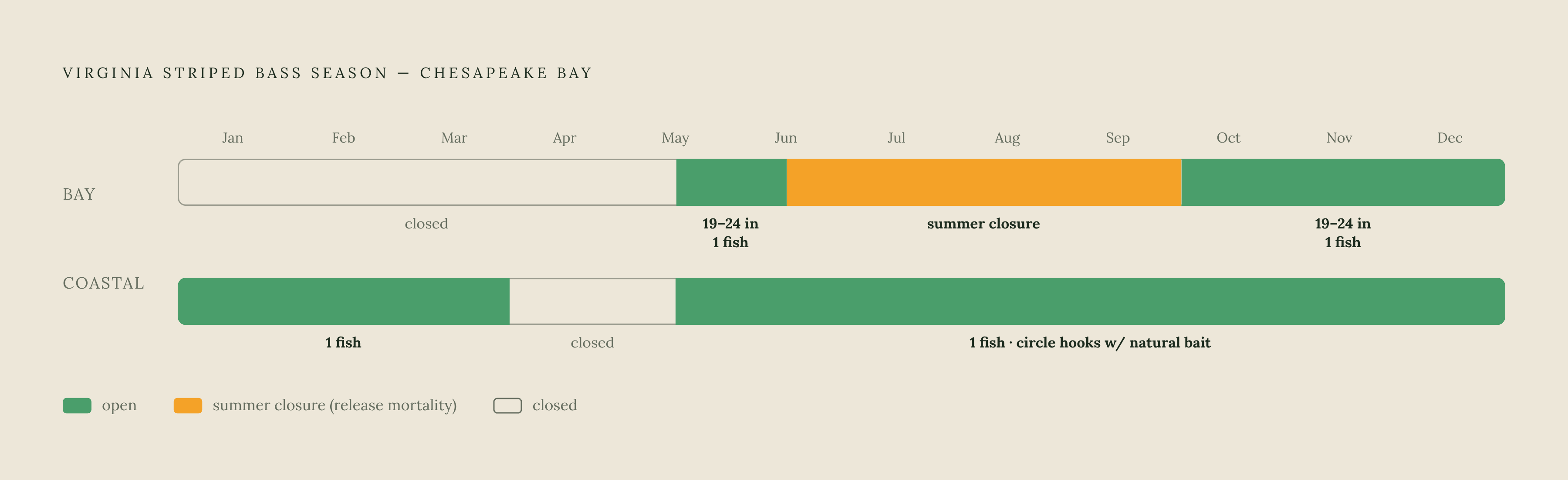
Virginia manages its Chesapeake Bay striped bass fishery through a calendar of open windows, closures, and size restrictions, and the rules are specific enough that getting a date or a measurement wrong amounts to a legal violation, not a technicality. The spring and early summer season runs from May 16 through June 15 in the Bay and its tributaries. During that window, the minimum size is 19 inches total length, and the maximum is 24 inches: anything over 24 inches falls outside the legal slot and must go back in the water. You can keep just one fish per person each day during this period.
From roughly July through early fall, Virginia closes striped bass targeting in the Bay. This closure lines up with the period when water temperatures are highest and when fish caught and released are most likely to die from the stress of the encounter, even if handled carefully.
The fall season reopens October 4 and runs through December 31, and 4VAC20-252-90 governs it. The size rules carry over unchanged from spring: 19 inches minimum, 24 inches maximum, one fish per person per day.
Virginia's coastal waters, the Atlantic Ocean side along with the coastal bays and their tributaries, run on a separate and stricter structure. That fishery is open January 1 through March 31 and again May 16 through December 31, with a daily bag limit of one fish under a slot distinct from the Bay's rules. Anglers fishing with bait in these waters must use non-offset circle hooks, a requirement that effectively rules out treble hooks on bait rigs under 4VAC20-252-50, and this applies across all tidal waters. Circle hooks are required year-round, January 1 through December 31, whenever anglers fish with natural bait such as fish, crabs, worms, or processed bait.
Virginia's commercial striped bass fishery operates on its own track. A state regulatory agency set the commercial Chesapeake area quota at 914,555 pounds to bring the state into compliance with the coastwide plan's Addendum II, and commercial participation requires registration, a striped bass permit, and an active quota allocation for the current year. Recreational anglers should treat VMRC and the Virginia administrative code as the only reliable source for any rule that shifts mid-season, since in-season adjustments are possible and the dates above reflect the structure currently in place.
That delay is why an angler fishing Virginia's tidal rivers in October isn't simply following a local rulebook.
The Slot Limit and One-Fish Bag Limit
The 19-to-24-inch slot limit and the one-fish daily bag are built to protect the two ends of the population that matter most for rebuilding the stock: the large, older females above the slot, and the juveniles still growing beneath the minimum size. By closing off both ends and funneling legal harvest into a narrow middle band, Virginia's rule concentrates fishing pressure on fish that have already had at least one chance to spawn, while shielding the fish with the greatest reproductive value and the fish that haven't reproduced at all yet.
The logic of the slot is specific. Fish above 24 inches tend to be older females, and older female striped bass are disproportionately fecund compared to smaller fish, so protecting them does more for the overall spawning potential of the population than protecting an equivalent number of smaller fish would. That's a different strategy from simply setting a minimum size and calling it conservation. A minimum size alone lets anglers keep the biggest, most productive fish in the population. A slot limit specifically prevents that.
The one-fish daily limit does separate work. It caps total removals from the fishery without closing the season outright, which matters because recreational fishing supports guides, tackle shops, and marina economies that depend on anglers being able to get on the water. But the slot's protective value depends heavily on what happens to fish that get released rather than kept, and that's where the picture gets more complicated. The most recent coastwide stock assessment found that fish that die after being caught and released make up a substantial share of all fishing-related striped bass deaths in the Bay, and that mortality rate climbs sharply when water temperatures rise. A fish released in cool spring water has a meaningfully better chance of surviving than the same fish released in the heat of July or August. That relationship justifies Virginia's summer closure: if release mortality spikes once the water warms, then keeping anglers off the water during the hottest months protects fish that a slot limit alone cannot.
The slot system also demands precision from the people enforcing and following it. Anglers need to measure fish accurately against both the 19-inch floor and the 24-inch ceiling, and inconsistent measurement methods across states had been a real problem for enforcement. So Addendum III standardized the method for measuring total length against size limits, closing a gap that had made slot compliance harder to verify consistently.
Virginia's Summer Closure vs. Maryland's 2026 August No-Targeting Rule
Virginia and Maryland manage opposite shores of the same nursery, and for years their summer rules haven't matched. Virginia has closed striped bass targeting during the hottest stretch of summer for several seasons already. Maryland held off on a comparable measure until 2026, when it adopted a full no-targeting closure for the entire month of August across the Chesapeake Bay and its tidal tributaries. Under Maryland's 2026 rule, you can't legally even attempt to catch striped bass during August, and no exceptions are carved out. The closure runs from August 1 through August 31 and covers the Bay and tidal tributaries broadly, but the Susquehanna Flats, the Lower Susquehanna River, and the Northeast River fall under a separate regulatory regime, so they aren't named as part of the August closure itself.
Maryland settled on August specifically because it aligns with the period of peak warm-water temperatures, when catch-and-release mortality runs highest, and because it offers better protection to younger resident striped bass that are especially vulnerable to dying after release in hot conditions. The choice isn't free of cost. Maryland DNR fisheries assessment manager Mike Luisi has acknowledged publicly that no-targeting closures push anglers off the water entirely during that stretch, and that this has a direct economic effect on tackle shops and on fishing guides who depend on summer business. That cost has come up repeatedly in public comment, and it's a real tradeoff regulators have had to weigh against the conservation benefit.
What the 2026 alignment does not do is guarantee a near-term improvement in the stock. The fish that would benefit most from an August closure, the current juvenile year class, won't reach legal size for another three to four years regardless of how well-timed the closure is. Virginia's comparatively stronger 2025 juvenile numbers sharpen an awkward asymmetry here too: Virginia-side regulators can point to better local recruitment data even while the Bay-wide numbers Maryland is working from remain troubling, which makes it harder to build the case for identical measures applied uniformly across both states' waters.
The fault lines in the management debate and the choices ahead for Virginia anglers and charter operators
The disagreement playing out at ASMFC meetings and in Virginia's own regulatory process isn't really about whether the striped bass fishery needs help. Nearly every party involved agrees recruitment has been weak for seven straight years and that the 2029 rebuilding deadline is now in serious jeopardy. The disagreement is over timing and distribution: whether to act harder now, while the adult population is still relatively healthy, or whether to wait for the 2027 benchmark assessment and let recent, somewhat encouraging catch data inform a more targeted response.
Virginia's position in that argument is shaped directly by its 2025 survey result. A juvenile index closer to Virginia's historic average gives state regulators a defensible reason to resist being lumped into the same emergency measures that Maryland's weaker numbers might otherwise justify. That's a reasonable position for Virginia to hold, but it runs up against the basic structure of the stock assessment, which evaluates the Chesapeake as one interconnected system rather than crediting one state's tributaries in isolation from the other's.
For anglers and charter operators working Virginia's waters, the stakes hit their wallets and their schedules directly. Every rule covered here, the May 16 to June 15 window, the October 4 to December 31 fall season, the 19-to-24-inch slot, the one-fish bag, the summer closure, exists because the Bay's role as the dominant spawning nursery for the whole coast leaves no room for loose enforcement or casual compliance. A charter operator planning a season around these dates is also planning around a coastwide rebuilding deadline that currently looks out of reach on the numbers ASMFC itself has published. Whether the 2027 assessment brings tighter rules, a continuation of the current approach, or something built out of the Working Group's upcoming white paper, Virginia's anglers will be fishing inside whatever framework that process produces, in a Bay that the entire Atlantic striped bass fishery still depends on to replace the fish it loses every year.
Notes
- 4VAC20-252-90. Chesapeake Bay and its tributaries fall striped bass recreational fishery.
Provided the specific regulatory text for Virginia's Chesapeake Bay fall striped bass recreational season, including the 19-to-24-inch slot limit, one-fish bag limit, and October 4 to December 31 dates.
- Chesapeake Bay Stripers Regulations 2026 - CatchRules
Provided details on Maryland's 2026 August no-targeting closure for striped bass in the Chesapeake Bay and its tidal tributaries.
- Chesapeake Bay 2025 Young-of-Year Striped Bass Survey Results
Provided the 2025 Maryland young-of-year striped bass index of 4.0 and data on below-average reproduction in other anadromous species.
- Atlantic Striped Bass - Atlantic States Marine Fisheries Commission
Provided background on the ASMFC's management of Atlantic striped bass, including the coastwide rebuilding plan and Amendment 7.
- Fishery Management Plan for Atlantic Striped Bass
Provided details on Amendment 7 to the Interstate Fishery Management Plan, including the 2029 rebuilding deadline and the coastwide management framework Virginia operates within.
- Atlantic Striped Bass Board Approves Addendum III for Public Comment - Atlantic States Marine Fisheries Commission
Provided details on Addendum III, including the October 2025 board vote, the changes to commercial tagging and length measurement standards, and the formation of the Working Group.
- 4VAC20-252-80. Chesapeake Bay and its tributaries spring/summer striped bass recreational fishery.
Provided regulatory text for Virginia's Chesapeake Bay spring/summer striped bass recreational season, including the May 16 to June 15 open window and size restrictions.
- Maryland’s Summer Closure of Chesapeake Bay Striped Bass Fishing Begins August 1
Provided details on Maryland's 2026 August striped bass closure, including the August 1–31 dates and the rationale of protecting fish during peak warm-water temperatures.