Essay Rockfish Seasons
Fall Striper Migration in the Chesapeake
Water temperature and menhaden movement dictate where migratory stripers will be and when.
The fall striper migration in the Chesapeake isn't random. The fall striper migration in the Chesapeake follows a predictable biological logic, driven by water temperature, forage availability, and differential movement patterns by age and size, and understanding that logic tells anglers exactly when and where fish will be.
Why the Chesapeake Bay sits at the center of striper biology
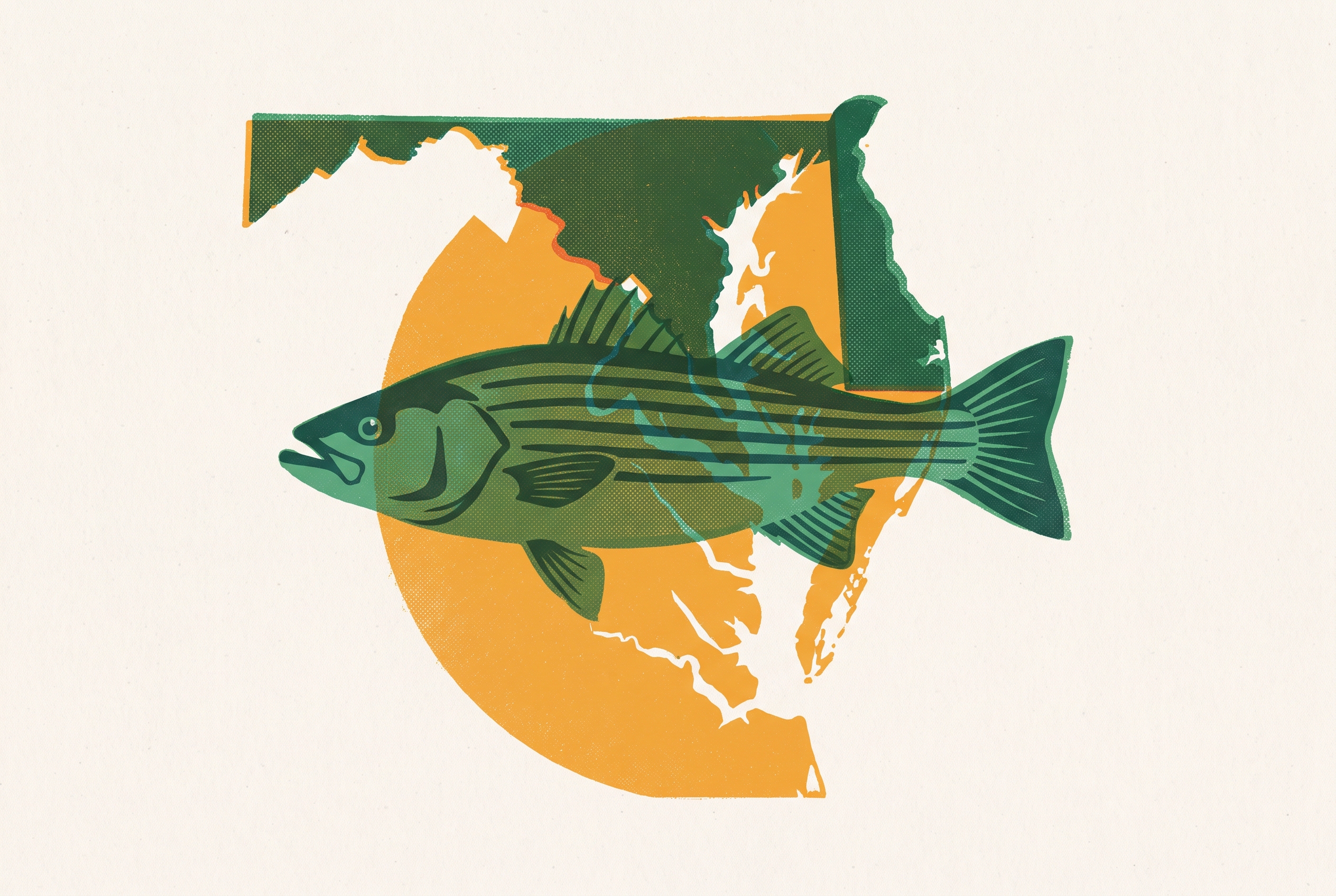
The Chesapeake is the largest estuary in the country, and its scale matters here for a reason that goes beyond geography. Tagging studies and genetic sampling put roughly 80 percent of the coastwide striped bass population's origin inside this one system pmc.ncbi.nlm.nih.gov. The health of a fishery stretching from the Carolinas up into New England traces back to what happens in a single estuary pmc.ncbi.nlm.nih.gov. Striped bass are anadromous: they spawn in fresh and brackish river water each spring, juveniles stay put in the Bay until they're near maturity, and only then do they join the coastal population out in the ocean. That dependency on the Bay as a nursery is what makes the fall migration more than a seasonal changeover. It's the return leg of a coastwide circuit that begins and ends in the Bay.
Why size determines who migrates in the two-contingent population
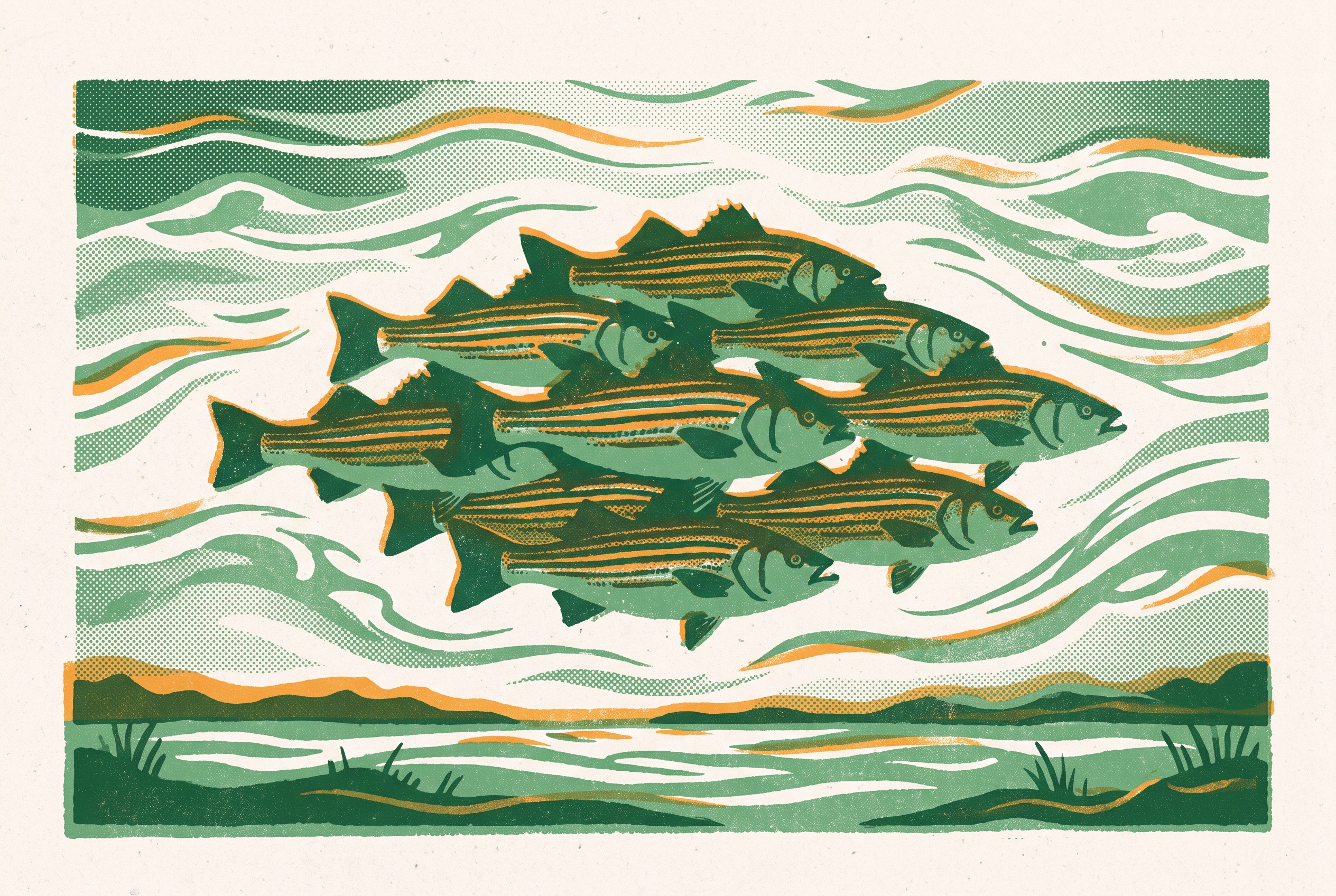
Fish in the Bay don't move as a single unit come fall. The population splits into two contingents that behave nothing alike and end up with very different odds of survival. Smaller resident fish stay put in the Bay year-round, while larger fish head out onto the coastal shelf and make the run up to New England. The split isn't vague. Fish making that exit used both the Chesapeake Bay mouth and the Chesapeake and Delaware Canal into Delaware Bay, with the Bay mouth the favored path. All large fish tracked in that study migrated to Massachusetts shelf waters, and in subsequent years repeatedly returned to regions within Massachusetts and Cape Cod Bays, a consistent, site-faithful pattern.
The stakes of staying versus leaving turn out to be enormous. Resident fish that remained in the Bay saw annual loss rates near 70 percent, compared to 37 percent for the fish that emigrated to the coastal shelf, nearly double the mortality for staying home pmc.ncbi.nlm.nih.gov. That gap stands as a central finding, not a footnote. It's the foundation of the current ASMFC stock assessment and management structure for the species. For anglers, the takeaway is straightforward: fish arriving in the Bay from offshore in fall skew large and are adults from that migratory contingent, while the fish encountered in the Bay through the rest of the year tend to run smaller, the residents that never left. In a 2020 study published in PLOS ONE, a generalized linear mixed model predicted that ≥ 50% of both males and females depart the Chesapeake Bay at sizes greater than 80 cm total length pmc.ncbi.nlm.nih.gov.
What water temperature controls, and the sequence it sets in motion
Temperature doesn't just flip a switch. It works in both directions, first punishing fish with summer heat, then relieving that stress as the water cools and kicking feeding back into gear. Livable water becomes a narrow slice, and fish have nowhere comfortable to sit.
Fall breaks that squeeze from both ends at once. Surface temperatures fall back under the stress line, and oxygen recovers through the water column. The seasonal arc through the Bay follows a fairly consistent pattern year to year, in fishing.digital's Bay reports: October typically runs 58 to 68°F, the heart of peak feeding conditions, and November drops to 48 to 58°F, the range that triggers southward movement of larger migratory fish fishing.digital. The distinction matters for how anglers should read the calendar. Mild cooling keeps the resident fish comfortable and feeding hard, but a sharp cold snap is what actually triggers the big Atlantic fish to start their earlier push into the Bay. The temperature curve, in other words, doesn't just affect how fish feed. It dictates where they'll be standing, shallow early in the fall and progressively deeper and farther south as the season wears on. In late November 2025, fish pushed into deeper water, 40 feet or more, as temperatures continued to fall content.buoybay.noaa.gov.
How menhaden movement choreographs the striper bite
None of the temperature logic matters much without the forage to back it up. Menhaden are the calorie-dense bait that stripers key on heading into winter, not a side dish but the entire reason fall feeding turns aggressive. As the water cools, menhaden move up toward the surface, which puts them in range of surface-feeding stripers and, just as important for anglers, makes them visible through bird activity working the schools. The same cooling that pulls menhaden out of the tidal rivers also sends them down the Bay, and stripers trail along the identical corridor, on close to the same timetable.
Fall 2025 had bait to spare fishing.digital fishing.digital. On the Water's November planner for the Chesapeake documented peanut bunker, adult bunker, and silversides showing up in real numbers starting in early November. This forage density explains a pattern that appears whenever bait is thick, and the middle and upper Bay can keep holding fish deep into November, because the fish simply stay wherever the food is, regardless of what the calendar says they're supposed to do.
Fall 2025 Conditions and Fish Arrival Timing and Location
Fall 2025 was cooler than average, especially in the southern Bay in September, with surface water temperatures dropping from the mid-70s°F to about 50°F across the fall, and September readings running below the 2009–2024 average. That cool stretch didn't come out of nowhere. August air temperatures across Maryland ranked among the lowest recorded since 1895, so the cooler fall was really an extension of an unusually cold late summer. The summer itself hadn't been brutal on oxygen either. Early August 2025 hypoxic volume measured 1.85 cubic miles, the 29th highest out of 38 years analyzed, a moderate reading, and conditions improved markedly by late August and September, relieving the habitat squeeze earlier than in bad years southernmarylandchronicle.com.
NOAA issued a La Niña advisory in October 2025, with the cool phase confirmed and expected to hold through winter, and the pieces start lining up in the fishery's favor. Cold winters and cool, wet springs tend to correlate with stronger year classes down the road, so the sharp November cold fronts that came with this La Niña pattern may end up mattering for the 2026 spawn. Salinity told its own story: parts of the Bay, including at the Gooses Reef buoy, ran several practical salinity units above average all season, a byproduct of rainfall that came in well below normal, with southern Maryland recording its third-lowest precipitation total since 2007. Cooler water, oxygen that recovered early, strong bait numbers, and stress relief that arrived ahead of schedule combined to make fall 2025 read as a genuinely good season for striper activity. That effect appeared in the geographic data too. On the Water's November planner tracked a real northward shift, with migratory fish concentrating near Cape Charles and the Chesapeake Bay Bridge-Tunnel, around the mouth of the Potomac, and as far north as Chesapeake Beach, while big migratory stripers pushed bunker schools into stretches of the Upper Bay that hadn't seen a real run in years.
The population splits into two contingents that behave nothing alike and end up with very different odds of survival.
The seasonal progression of where fish are, from October through December
October opens the season with water in the mid-to-upper 50s, close to ideal for aggressive feeding, and the shallow bite turns on hardest in the middle and lower Bay. Reports from late October described full-on blitzes on peanut bunker in the middle Bay, with diving birds marking the fish from a distance. The Chesapeake Bay Bridge-Tunnel, sitting near the Bay mouth, is a dependable early-season stop, since its structure and current concentrate bait and hold fish tight to it, and the pilings under the Bay Bridge produce in this same window.
As the season moves into its middle stretch, fish push north and settle onto mid-Bay structure. Tangier Sound, the rips off Smith Point, Eastern Bay, and the mouth of the Choptank all start producing as bait schools stack up in those spots. In 2025 specifically, the stretch from the Patuxent River down to just south of Annapolis, along with Eastern Bay, fished better than it had in recent memory, a direct result of the record bait numbers sitting in the middle and upper Bay.
Late November into December is when the big fish show up in force. On the Water's November planner called this stretch the prime window for targeting striped bass in the region now. The first wave of large migratory adults, the ocean contingent, typically arrives in early November, and more waves keep coming through December. Through the cold months, the water from Chesapeake Beach south to the mouth of the Potomac has been the most reliable spot for big migratory stripers working bunker schools in open water, a pattern that's held for two seasons running, as On the Water's playbook noted. Fish had already dropped into 40 feet of water or deeper by late November 2025 as temperatures kept sliding, and bait, peanut bunker, adult bunker, silversides, stuck around from early November on, which kept the bite going longer than it might have otherwise content.buoybay.noaa.gov.
Matching fishing tactics to the fall migration's progression
Early fall, when fish are shallow and actively blitzing, rewards topwater plugs, since surface strikes during an active blitz are about as explosive as this fishery gets. Bird activity remains the best locator; a school of gulls working over bait is about as clear a signal as an angler gets. Weather can flip the preference fast, though.
Once fish settle onto structure in the mid-Bay stretch, jigging takes over as the more consistent method. Seven- to eight-inch paddletails on 1.5- to 2-ounce jigheads have become the standard presentation for open-water fish keyed on bunker, and Eastern Bay along with the mouth of the Choptank are the spots most associated with that technique. When fish hold tight to bottom structure instead, trolling umbrella rigs behind heavy inline weights along channel edges tends to out-produce jigging.
FishTalk magazine reports that trolling in general earns its reputation as the go-to method once fish scatter and start prowling higher in the water column. Planer boards run with a large spread, tandem rigs, umbrella rigs, and #21 spoons make up the standard fall trolling setup, and this approach pays off especially in the open water of the southern Bay when big migratory fish are around but not showing themselves on the surface.
Depth is really the variable that ties all of this together. As November cooling pushes fish down toward 40 feet or beyond, topwater and shallow presentations stop working simply because they can't reach the fish anymore, and jigging or trolling with weighted rigs becomes the only way to get baits in front of them content.buoybay.noaa.gov. Wind, cold fronts, and where the bait happens to be sitting on a given day will all shift the specific bite, but the underlying rule doesn't change: find the bait, then match the depth to wherever the temperature has pushed the fish that week. An October 16, 2025 fishing report noted that after strong wind events, fish sometimes shift preference to low-profile soft plastics (specifically 4-inch paddletails on light jigheads) even when they had been taking topwater before the weather changed.
What the recruitment numbers mean for the fall fishery going forward
Every fish caught this fall is a product of a spawning class from years past, and recruitment data isn't background noise but a leading indicator for what the fishery looks like years out content.buoybay.noaa.gov buoybay.noaa.gov. Virginia's picture matches it: the VIMS survey came in below its historic average of 7.77 fish per seine haul for the fourth consecutive year. The pattern is consistent across both states: recruitment has been persistently weak, and the strong fall fishing that anglers experienced in 2025 rests on adult fish from earlier, better year classes.
There's a reason for cautious optimism looking ahead, though it shouldn't be mistaken for certainty. Fall 2025's cooler temperatures and the La Niña-associated cold fronts in November may have created more favorable conditions for the 2025 spawn, since NOAA Chesapeake Bay Office notes cold winters and cool wet springs are historically the best indicators for strong year classes. Whether the 2025 spawn actually benefited won't be clear until the young-of-year surveys come back in a few years fishing.digital fishing.digital.
In the meantime, the regulations reflect how much rides on protecting the right fish at the right moment. Anglers who understand that biology aren't just better positioned to find fish. They're better equipped to fish inside the regulations with some sense of why those rules exist, and to read next year's Maryland DNR and ASMFC updates with real context instead of guesswork. Maryland DNR's 2025 Young-of-Year index registered 4.0 fish per sample (an improvement over the prior year's index of 2.0, but significantly below the long-term average of 11.0), and representing the seventh consecutive year of below-average spawning success in Maryland news.maryland.gov cbf.org. Current Maryland regulations in force for 2025 set a Bay recreational slot limit of 19–24 inches at one fish per person per day, an ocean slot of 28–31 inches with a coastwide daily limit of one fish, and closures to targeting striped bass in the Chesapeake Bay from April 1–May 15 and July 16–31, designed to protect fish during their most vulnerable migrations. The differential migration science is directly relevant here: protecting the large coastal migrants (the fish above 80 cm that survive at nearly twice the rate of residents) has outsized importance for maintaining the ocean contingent that produces the fall fishery's most sought-after fish pmc.ncbi.nlm.nih.gov. SOURCE PAGES, what the pages behind the outline's links say.
Notes
- 2026 Playbook for Chesapeake Bay Stripers, Bluefish, & Red Drum
Provided the seasonal location patterns for migratory stripers, including the Chesapeake Beach-to-Potomac corridor and the November–December prime window.
- NCBO Fall 2025 Seasonal Summary.docx
Supplied fall 2025 water temperature data, hypoxia readings, salinity figures, and the observation that fish pushed into 40-foot-plus depths by late November.
- Differential migration in Chesapeake Bay striped bass
Provided the core differential migration findings: the two-contingent population structure, mortality rates of 70% for residents vs. 37% for migrants, and the 80 cm departure threshold.
- https://onthewater.com/fishing-reports/2025/10/maryland-and-chesapeake-bay-fishing-report-october-30-2025
Described late-October blitzes on peanut bunker in the middle Bay with diving birds marking the fish.
- https://onthewater.com/chesapeake-bay-fishing-planner-for-november-2025
Documented peanut bunker, adult bunker, and silversides appearing in real numbers in early November and tracked migratory fish concentrating near Cape Charles and the Bay Bridge-Tunnel.
- https://journals.plos.org/plosone/article?id=10.1371%2Fjournal.pone.0233103
Provided the PLOS ONE 2020 generalized linear mixed model finding that ≥50% of striped bass depart the Chesapeake Bay at sizes greater than 80 cm total length.
- https://onthewater.com/fishing-reports/2025/10/maryland-and-chesapeake-bay-fishing-report-october-16-2025
Provided the October 16, 2025 report noting that after wind events, fish shifted preference to low-profile 4-inch paddletails on light jigheads.
- https://www.fishtalkmag.com/fishing-report/way-south-chesapeake-bay-fishing-report-october-2025
Sourced the FishTalk description of trolling as the go-to method with umbrella rigs, tandem rigs, planer boards, and #21 spoons for migratory fish.