Essay Rockfish Tackle
Fly Fishing for Striped Bass in the Chesapeake
Match flies, lines, and retrieves to Maryland's seasonal rules.
Fly fishing for striped bass in the Chesapeake rewards a seasonal approach. The strongest opportunities come when flies, lines, retrieves, and locations match fish behavior, bait, water temperature, and Maryland’s regulatory calendar. Understanding those connections makes the Bay more accessible while helping anglers protect a stock whose future depends on more than compliance with harvest limits.
Why the Chesapeake Bay is a distinctive fly-fishing destination for striped bass
The Chesapeake Bay is the largest estuary in the United States and produces the overwhelming majority of the coastwide striped bass population. Its role extends far beyond a local fishery. Recruitment and the state of the habitat here affect striped bass along the Atlantic coast, so the Bay is both a major place to fish and a key place to protect the stock.
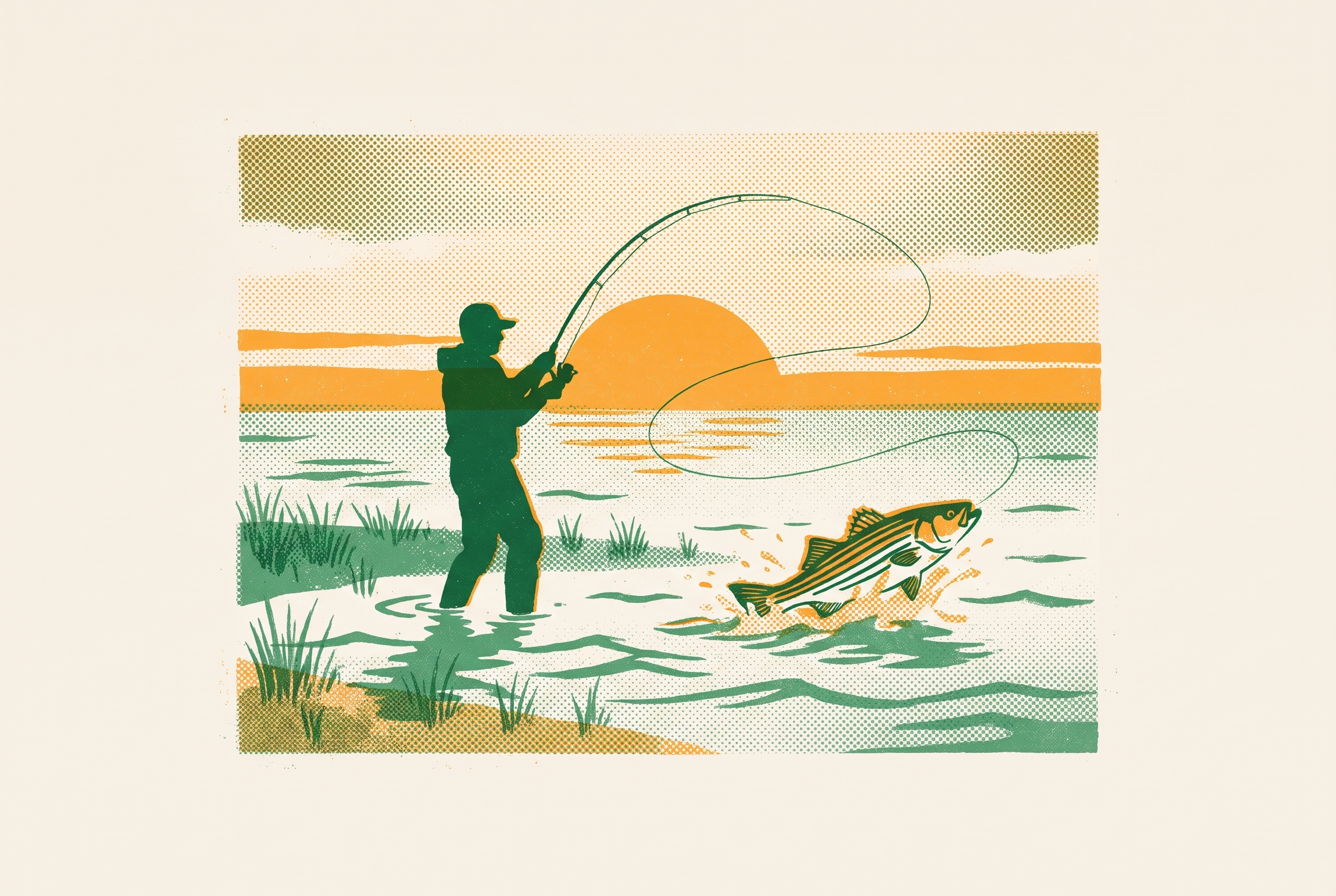
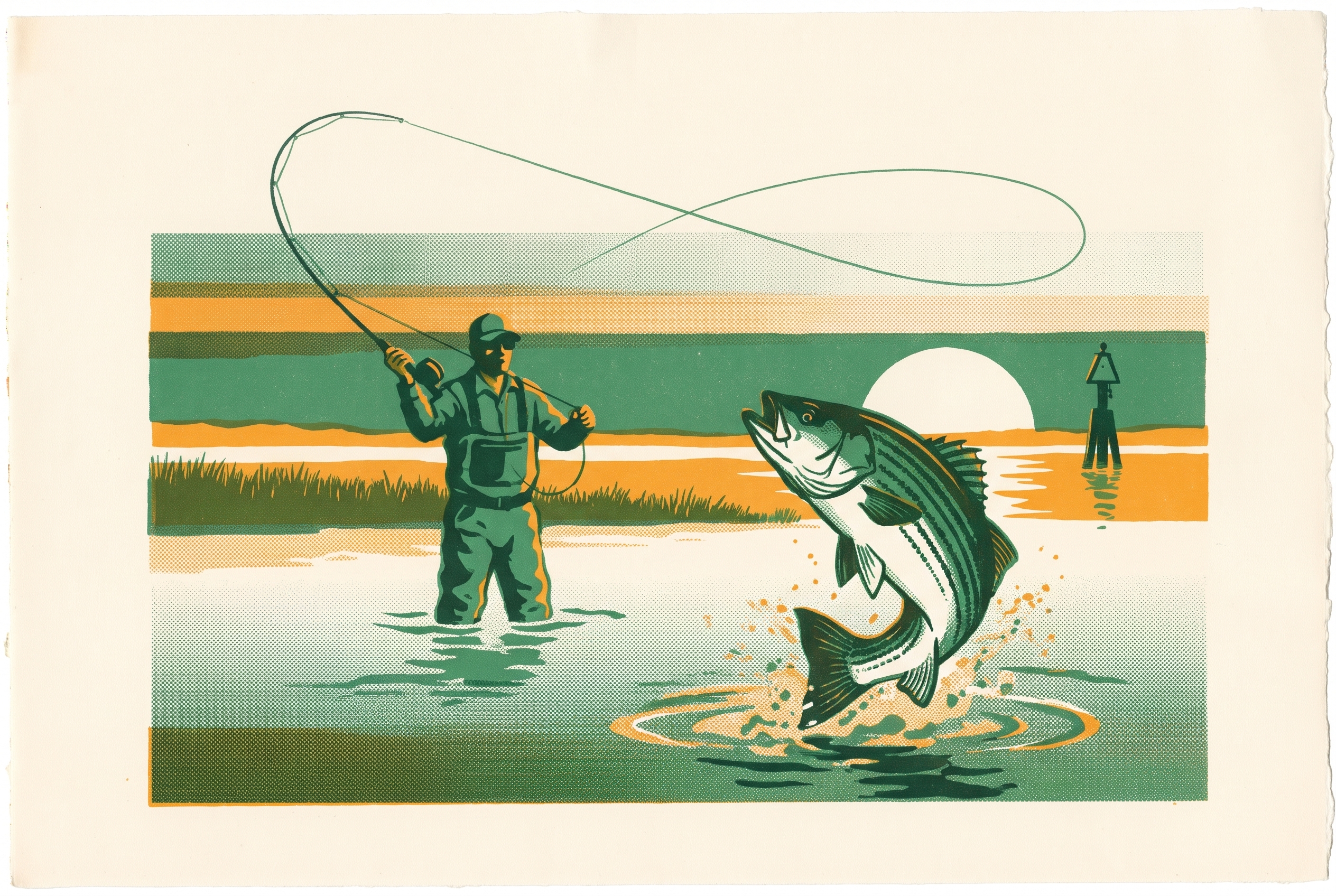
For fly anglers, the attraction includes shallow-water stripers that can be sight-cast to. The Orvis Greater Chesapeake Bay outlook reports that anglers can catch 50–60 fish in a four-hour trip during the fall transition. Such reports illustrate the Bay’s potential for exceptional catches. Opportunities across multiple seasons also make Maryland’s waters more than a spring destination, although year-round planning must account for a complete August closure.
How the Bay's seasonal windows are defined — fish behavior, bait, water temperature, and legal structure together
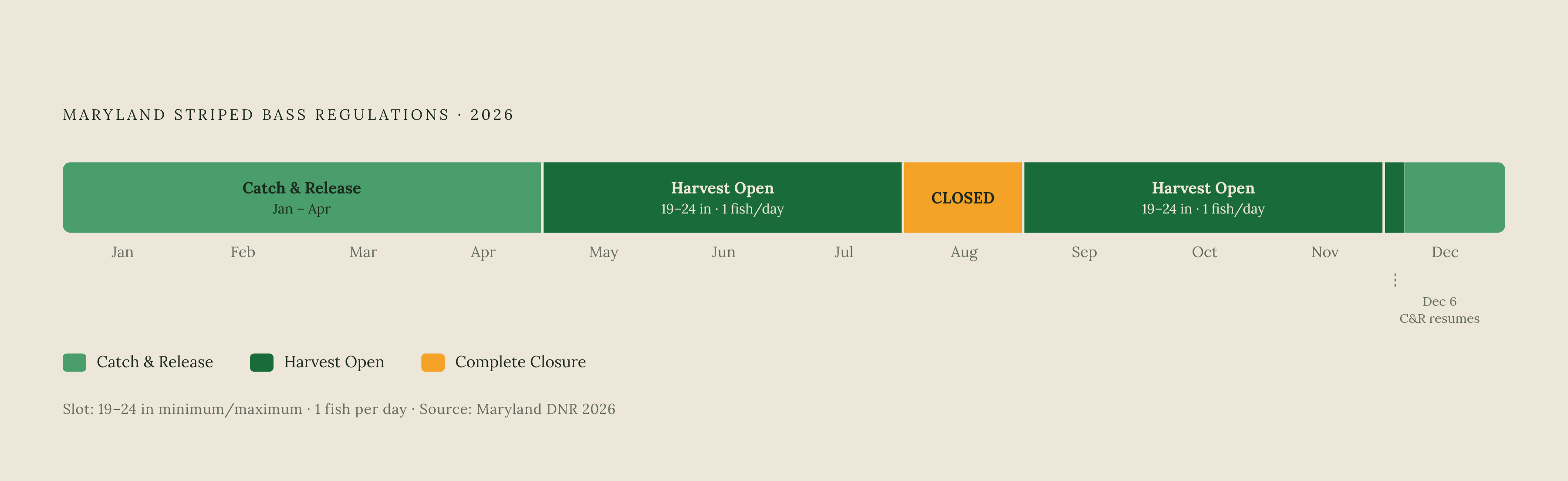
As the water warms in spring, striped bass move into the Bay and spawning rivers. After spawning, fish drop back toward the main stem and head south toward the coast, giving anglers a chance to catch them along the way. Summer then compresses their suitable habitat. Hot water and low dissolved oxygen drive fish deeper and put them at greater risk of catch-and-release mortality. Fall cooling reverses the fishing pattern, renewing surface and shallow-water feeding as fish gather around bait before their southward migration.
Maryland’s 2026 rules follow those biological transitions. Catch-and-release is open from January through April, anglers can harvest fish from May through July, and all fishing is closed in August. Harvest resumes in September and continues through December 5, followed by catch-and-release for the rest of December. Geography adds another layer to that calendar. Spawning-area closures and separate management jurisdictions mean that an open season does not make every river or reach available. For trip planning, the calendar is therefore both a legal framework and a guide to when fishing is biologically sound.
Spring fishing: catch-and-release in April and the spawning-river closure that shapes where you can go
April is the strongest starting point for a first Bay fly-fishing trip. The water is still cool, and post-spawn fish feed well as they leave the rivers. Maryland DNR restored April catch-and-release in 2026 for the first time since 2019, explaining that cooler April water generally makes release fishing safe for the breeding stock. The opportunity comes with firm geographic boundaries. January–February allows catch-and-release in all areas, but March 1–April 30 restricts it to the Bay downstream from the Abbey Point–Worton Point line to the Virginia line, including Tangier and Pocomoke Sounds.
Maryland’s 2026 rules prohibit targeting striped bass in spawning rivers from March 1–May 31. The closure covers the Choptank, Chester, Manokin, Nanticoke, Patuxent, Transquaking, and Wicomico rivers, plus the Upper Bay spawning area. Catch-and-release is not an exception to that prohibition. The Susquehanna Flats and Lower Susquehanna River have a separate schedule in DNR’s regulation maps, including an April 1–May 31 closure to all targeting. Those mapped boundaries and schedules govern access, rather than the presence of fish or the intention to release them.
Fly anglers can fish the main-stem edges and channel mouths that are open, where fish leaving the rivers move toward open Bay water. Spring gear rules prohibit stinger or trailing hooks and the use of eels as bait, while circle hook rules apply. Trolling requires barbless hooks and permits no more than six lines. Harvest begins May 1 with one fish per person per day in the 19–24 inch slot, but access remains restricted. Rules for these areas change after May 15 and ease further during May 16–31, so anglers need DNR’s regulation maps to choose a tributary or a place to launch.
Flies and presentation for spring Bay stripers: matching the baitfish, working the transition zones
A Clouser Minnow and a second baitfish pattern provide a focused spring starting kit. Their usefulness depends on presentation as much as selection. An aggressive short strip followed by pauses suits a Clouser imitating fleeing or stunned baitfish, while faster, more consistent strips with fewer pauses suit the second baitfish pattern. That distinction gives anglers two ways to present a baitfish imitation along the same transition water without turning fly selection into an exhaustive catalogue.
Relatively cool spring water often allows a floating or intermediate line to cover channel edges and transition zones. A sinking line becomes more useful as summer approaches. The Orvis outlook recommends a 9-foot, 20-lb fluorocarbon leader for shallow or topwater work and a 4-foot, 20-lb fluorocarbon leader with sinking lines deeper down. Depth determines which setup belongs in use. The spring approach is to match the line to where fish are holding, then give the selected pattern the retrieve that suits it.
For fly anglers, the attraction includes shallow-water stripers that can be sight-cast to.
Why August is completely closed and what that means for fly anglers who want to protect fish year-round
August is the Bay’s highest-risk month for catch-and-release fishing. Maryland DNR’s summer closure announcement prohibits all targeting of striped bass in the Chesapeake Bay and tidal tributaries during that month. Attempting to catch them is illegal, even when release is intended. Hot water and air temperatures increase the likelihood that a released fish will die, making recreational dead discards the specific mortality pathway the closure addresses. DNR reports that those discards accounted for 21 percent of total fishing-related striped bass mortality in the Bay in the most recent stock assessment data from 2022.
The closure has existed in some form since 2020. For 2026, Maryland brought its scattered midsummer restrictions together into a full calendar month, so anglers know just when to stop. DNR encourages targeting invasive blue catfish and snakehead, also called Chesapeake Channa, during August instead. Neither has a bag or size limit, and their harvest contributes to a healthier Bay ecosystem. Outside August, DNR advises against striped bass fishing after 10 a.m. when the forecast air temperature is 95°F or higher and publishes a Striped Bass Summer Fishing Advisory Forecast identifying “red flag” conditions.
A marine fisheries agency project found that single-hook fly rigs cause much less post-release mortality than two-treble-hook rigs. That finding supports the use of single-hook flies throughout open seasons. It does not justify fishing through dangerous conditions or a closure. Anglers need to consider both how and when they fish, because even with a lower-risk rig, thermal stress makes summer releases risky.
The state of the striped bass stock and what it means for how anglers should fish now
Striped bass are currently classified as overfished, and the Atlantic States Marine Fisheries Commission is required to rebuild the species by 2029. Adult fish remain available, but weak recruitment threatens the supply of catchable fish in later years. Maryland DNR recorded its eighth consecutive below-average young-of-year index in 2026. Although that index was the highest since 2018, it remained well below average.
Some managers regard recruitment variation and cyclical recovery as legitimate parts of the population picture. But Eight weak years in a row cast doubt on that explanation. Warming water, low dissolved oxygen that reduces summer habitat, and invasive blue catfish preying on juvenile stripers in spawning rivers further weaken recruitment. With recruitment still weak, there will likely be fewer catchable fish starting around 2030. The distinction is between fish available today and the young fish needed to replace them.
The commission passed Addendum III in 2025 without further harvest reductions. A comprehensive benchmark stock assessment is underway, with peer review expected in spring 2027 and the possibility of significant management changes afterward. Anglers need not resolve that management debate to respond responsibly. The practical course is to fish open seasons, use single-hook fly rigs, observe the summer closure strictly, and treat each release as consequential to the future fishery.
Fall fishing: the best fly-fishing window on the Bay and how to work it
Fall has the Bay’s best fly-fishing conditions and a long season for keeping fish. Cooler temperatures stabilize fish behavior, concentrated bait draws larger stripers, and fish become available to both floating and sinking lines. Maryland’s season runs September 1–December 5, when anglers can keep one fish per person per day with a 19-inch minimum and 24-inch maximum. Larger fish remain release fish. From December 6, the fishery returns to catch-and-release only.
The Orvis outlook, as of November 8, 2026, reports active feeding in Maryland waters from the shallows through deeper parts of the water column, with bluefish mixed into bait schools. These reports describe this season, and conditions can change from year to year. Across Maryland waters, schools of menhaden and working birds are the main signs of where to find fish. The reported afternoon shallow-water bite includes 24–30 inch rockfish pushing bait into water accessible with floating lines. Because fall conditions change from week to week, anglers need to check a live report before they leave.
For those shallow fish, the recommended setup is a floating line with a 9-foot, 20-lb fluorocarbon leader and either a Blados Crease Fly or Mylar Popping Fly. Presentation should remain direct and controlled. The report calls for keeping the rod tip low and pointed toward the fly, taking up slack right away, and retrieving with fast 1–2 foot strips. The shallow-water opportunity is a reason not to reach automatically for a sinking line, even when deeper water is nearby.
When surface activity fades, the report recommends switching depth to find fish that may still be present. A sinking line, 4-foot, 20-lb fluorocarbon leader, and 3-inch Clouser Minnow form the deeper setup. The fly is counted down before a fast 1–2 foot strip retrieve begins. Bluefish require another adjustment when they enter the same schools. Quick, aggressive retrieves suit them, while wire or heavy fluorocarbon tippet addresses their teeth. Sea trout around deeper structure in the lower Bay call for the opposite pace, with slower, methodical presentations.
The outlook lists a 9-weight 9-foot fly rod, Saltwater All-Rounder WF floating line, and Class V Sink Tip line as the main gear for fall. That combination covers the reported shallow and deeper opportunities. Named fall locations include the Choptank River, Poplar Island, Patapsco River, Eastern Bay, and mid-Bay waters south toward the Virginia line. These are places to start looking, though schools of fish may be elsewhere. Within them, bait, birds, and the depth of active feeding guide the choice between the floating and sinking setups.
Winter catch-and-release and reading the full-year calendar as a planning tool
Maryland’s regulation maps show all areas open to catch-and-release only during December 6–31 and January 1–February 28, with no harvest, circle hook rules applying, and eels prohibited as bait. Cooler water puts fish under less thermal stress than summer water does, which is also why April reopened. Gear discipline still applies. Maryland’s 2026 rules also explicitly prohibit using striped bass as bait, an addition from 2025.
For planning, April offers the most approachable introduction, while fall provides the broadest range of fly-fishing opportunities. May–July adds harvest access as area restrictions ease, but rising summer temperatures require greater restraint before August’s full stop. Winter supplies a cooler-water release option. The Potomac River mainstem is managed separately by the Potomac River Fisheries Commission, so trips there require following the commission’s rules, which are separate from Maryland’s general Bay calendar. Anglers planning across several years should also watch for updates following the 2027 benchmark assessment, which may meaningfully change the windows available.
Notes
- Maryland’s Summer Closure of Chesapeake Bay Striped Bass Fishing Begins August 1
Provided the August closure rationale, the dead-discard mortality figure, and the heat advisory guidance.
- STRIPED BASS REGULATIONS MAPS
Provided the area-by-area season schedules, spawning-river closures, and slot limits used in the regulation sections.
- Greater Chesapeake Bay & Tributaries
Provided the fall fly, line, leader, and retrieve recommendations plus the named locations and catch reports.
- Maryland’s 2026 Striped Bass Season Opens for Catch-and-Release Fishing in April
Supplied the details on April 2026 catch-and-release reopening, the first since 2019, and the reasoning about cooler water.
- Maryland Fishing - Striped Bass
Covered the 2026 gear rules, including circle hooks, barbless trolling hooks, stinger hook and eel bait prohibitions, and the ban on using striped bass as bait.
- Striped Bass (Rockfish) • Chesapeake Bay Foundation
Contributed the background on the Bay's role in coastwide striped bass production and threats like warming water, low oxygen, and blue catfish.