Essay Rockfish Tackle
Jigging for Rockfish Under Chesapeake Bay Bridges
How tide, depth, and piling shape decide where and how to jig.
Jigging for rockfish under Chesapeake Bay bridges depends on reading the structure before choosing the presentation. Depth, piling geometry, tide phase, and current direction determine where striped bass hold and how a jig reaches them. The effective approach is to locate that holding position, match the lure’s path to it, and adjust as conditions change.
Why bridge pilings hold rockfish and what that means for how you fish them
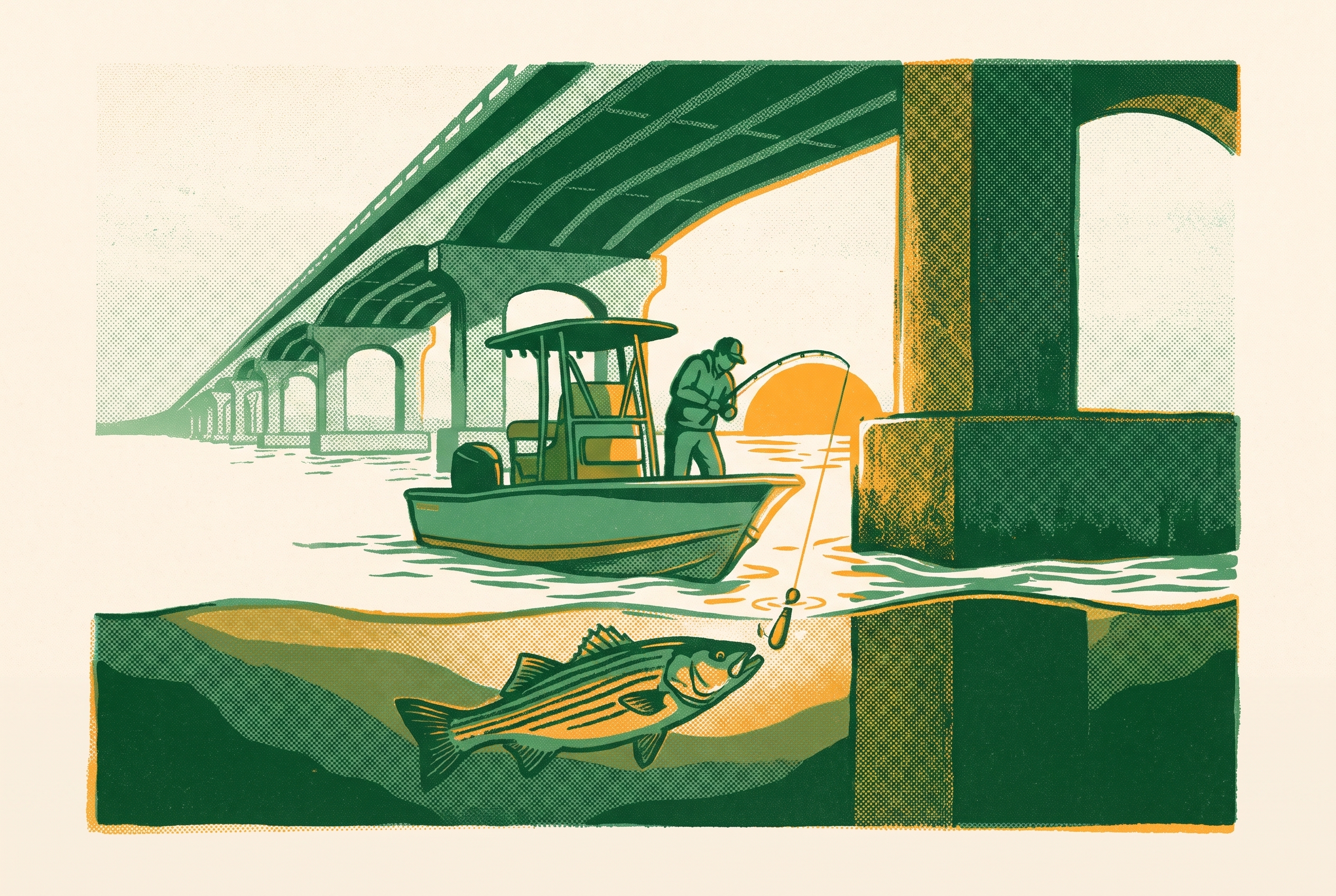
Bridge pilings function as artificial reef, concentrating baitfish and the striped bass that feed on them. Rockfish use the structure as cover to ambush prey swept past by tidal current. The Bay Bridge near Annapolis amplifies that effect. As the Chesapeake Bay’s dominant cross-Bay structure, it forms a giant obstruction in what is effectively a tidal river system, with current accelerating around and between pilings.
An H-piling has a crossbar approximately 10 feet down, creating a ledge where large rockfish can stage and hide even without baitfish above them and offering a different target from a round piling. Depth and position relative to current further change how fish orient, so neighboring pilings are not interchangeable. Fish the parts of each support where fish hold, and vary the cast to suit them.
How tide phase and current direction determine where fish are on the structure at any given moment
Tide phase is the most important variable in locating rockfish on bridge pilings. Before choosing a starting piling or jig weight, assess current direction and speed. On an outgoing tide, stripers stack on the down-current face, using the piling as cover while bait washes past. Start with that face, but examine the corners. The angle of flow can put more fish on one corner than the other, so test both sides before moving.
Stronger flow demands heavier jigs to maintain bottom contact when fishing bottom and to control the presentation angle. In lighter current, lighter presentations can work and fall more slowly. Slack water is generally the least productive period. Without current concentrating bait against the pilings, fish may disperse or become inactive, so a quiet piling at slack tide does not provide the same evidence as an unproductive piling during moving water.
How depth and season shift where in the water column fish are holding
Fish depth changes with water temperature, so shallow pilings matter more in spring and deeper structure matters more in summer and fall/winter. Use that seasonal pattern to choose where to start looking, then use electronics to find where fish are holding. Even at a promising piling, the fish may be near bottom, suspended, or holding by a crossbar.
Large fish stage beneath the H-piling crossbar in fall and winter, making it a key place to fish then. At those pilings, a vertical presentation past the crossbar roughly 10 feet down deliberately targets the ledge. Its depth can define the presentation even over deeper water. Fish marked near bottom, meanwhile, need a presentation that reaches them there.
Navigating the Bay Bridge specifically: which pilings to start on and why mobility beats anchoring
Under the eastbound span on the west side, pilings 16, 18, 19, 20, and 21 are productive starting points. On the east side, pilings 42, 43, 47, 50, and 51 are reliable targets. In May 2026, anglers found good action on both sides, with fish mostly shallower than 25 feet but also present at deeper pilings.
Mobility is an operational requirement at this bridge. Fish are unevenly distributed, and moving among pilings until active fish are located consistently outperforms anchoring at one spot. Pressure also belongs in the location decision. Boats crowding pilings at sunrise on a busy Saturday morning in May can depress the bite, while arriving early or fishing mid-week changes that variable. Access need not require a large boat, either, as a reported kayak outing produced around a half-dozen rockfish jigging pilings in 15 to 20 feet of water.
Casting versus vertical jigging: choosing the right presentation for the moment
Once fish depth is established, choose between casting and vertical jigging according to current speed, boat position, and the target’s depth. Casting requires enough travel before the piling for the jig to sink into the strike zone. Cast as far past the piling as possible. A lure that reaches the structure before reaching the fish’s depth has missed the intended presentation, regardless of how closely it passes the support.
For casting, match jighead weight to the current. Lighter heads of ⅜ oz suit slow water, while faster flow can require heads up to 1½ oz to keep the lure at the intended depth as it passes the piling. Vertical jigging works well when electronics show fish right beneath the boat or holding at a certain depth. Lift and drop the jig near bottom or around the crossbar depth, according to where those fish are holding.
Depth and position relative to current further change how fish orient, so neighboring pilings are not interchangeable.
Matching jig type, weight, and color to what the fish are doing
Start with variety across the boat. Let what the fish bite guide which offering more anglers use, and adjust the weight to keep the chosen presentation working. A ¾-ounce jighead with a white six-inch BKD tail is a common starting combination. It is not a fixed prescription for color. The light and what fish prefer that day can change which tail catches fish, even when the location and presentation still work.
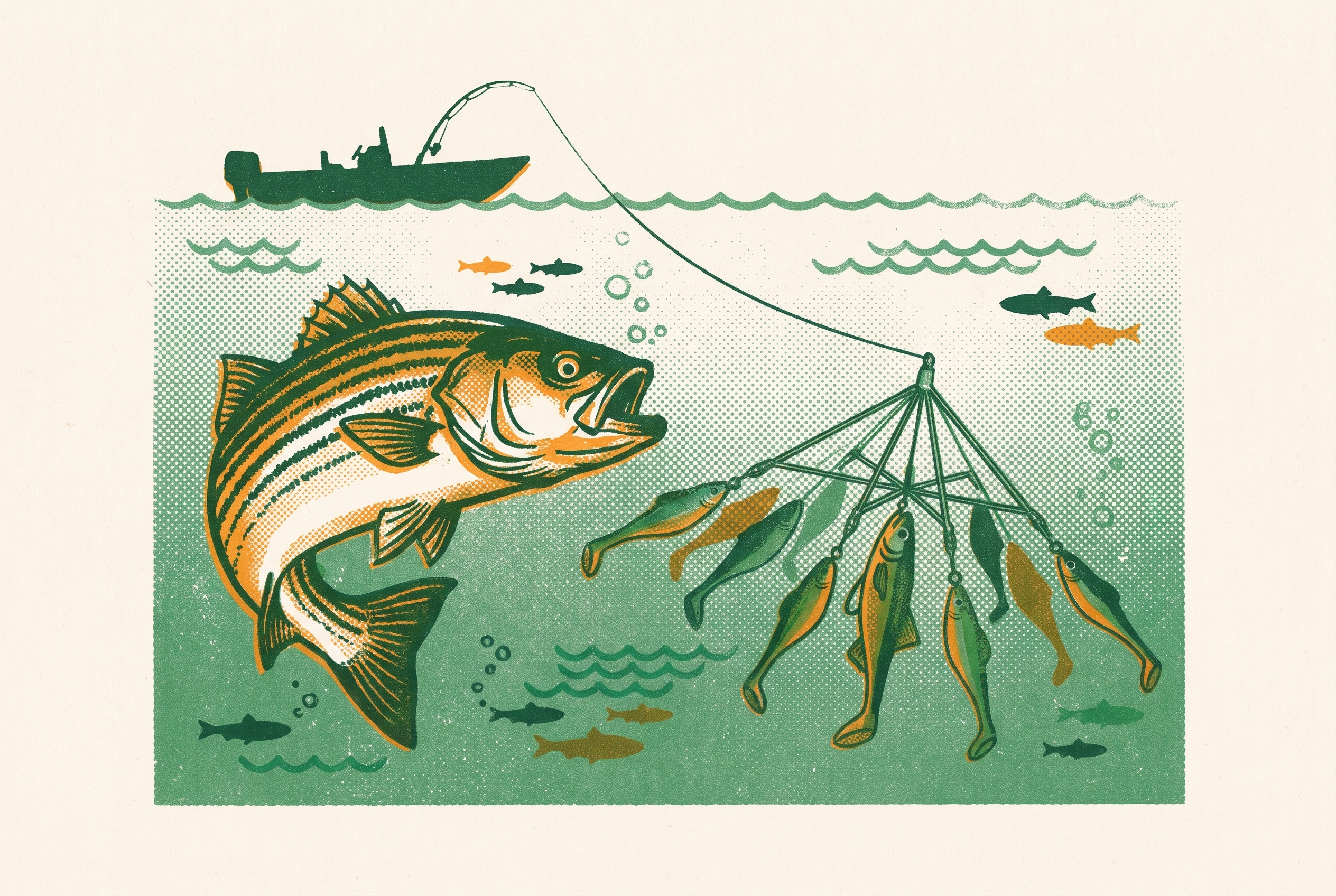
May 2026 catches at the Bay Bridge illustrate that range. In the same week, fish bit ¾-ounce heads with Electric Chicken tails, chartreuse BKDs on one-ounce heads, and white half-ounce bucktails with four-inch tails. No single combination accounted for all the action. Soft plastic paddletails on heads scaled to current also work for both casting and vertical presentations. Tail length offers another adjustment, with longer tails providing more action in slower current and shorter tails suiting faster flows.
Metal jigs and spoons serve the deeper vertical presentation. The Stingsilver is a leading metal jigging option for Chesapeake Bay bridge structure, while late-fall and winter spoon fishing at the Bay Bridge has produced fish in the 16 to 26-inch range around deeper structure. Examples from other bridges show what can work, though conditions may differ. In the Patuxent near Solomons in November 2025, the G-Eye Rain Minnow produced stripers and fat white perch in 60 to 80 feet near bridge structure.
A 6 to 7-foot, light-to-medium, fast-action rod is the standard recommendation for working these jigs. Fast action helps give the jig a good snap and set the hook quickly. Close structure also imposes a cost in tackle. Snags on pilings and rocky bottom are normal in strong current, including for experienced anglers, so carrying extra rigs belongs in the preparation rather than being treated as insurance against poor technique.
What live bait does that jigs can't, and when jigging is still the right call
Live spot outperform jigs at Bay Bridge pilings when they are available. Reports across multiple seasons show live-liners catching more fish and larger fish than jig anglers on the same water on the same day. That advantage deserves a direct acknowledgment. It does not make live bait a replacement for jigging across the season, because spot availability is seasonal and variable, and the practical demands of carrying bait do not suit every boat.
Jigging remains the reliable choice before spot arrive in numbers early in the season and for kayak or small-boat anglers for whom a live well or catching spot is impractical. It also works when rockfish chase artificials, especially when they feed hard in fall. Presentation can favor a jig as well. A falling, drifting, or vertically worked lure can address depth and current conditions that a live spot cannot replicate efficiently. Developing that control preserves productive early-season and fall opportunities that an angler dependent on live bait may miss.
Reading what's happening at the bridge on arrival and adjusting through the session
On arrival, read tide direction and speed before committing to a piling. Select a starting face on the down-current side, then choose a jig weight suited to the flow. Electronics should show how deep the fish are before the angler settles into a presentation. Fish tight to bottom in 50+ feet call for metal and vertical jigging, while fish suspended at 15 to 20 feet call for lighter jigheads and a casting drift.
Use the first drifts or drops to test that initial choice. Check both sides of the piling because a change in current angle may put fish on a particular corner. If a reasonable number of controlled presentations produces nothing, move to another piling instead of anchoring the session to the starting point.
Fish that follow without eating call for a different adjustment. Change color or tail size rather than assuming that the location is unproductive. In May 2026, chartreuse and white both worked during the same week, but the effective color on a particular day required experimentation. Continue separating a location problem from a presentation problem as the session develops. Consistent catches come from reading what the bridge is doing at that moment.
Current regulations every Bay Bridge jigger needs to know before launching
Maryland’s 2026 striped bass harvest season opened May 1 with a slot limit and a one-fish-per-person-per-day cap, a tighter framework than recent prior seasons. Maryland also kept spring gear restrictions in place through May 15, 2026. Those restrictions were specific to the spring framework. Stinger, or trailing, hooks were prohibited during spring catch-and-release fishing, and trolling required barbless hooks. Before keeping a fish, check the slot dimensions that apply, whether the season is open, and the gear rules.
The regulatory context is still changing. An interstate fisheries commission’s 2024 stock assessment update found that Atlantic striped bass remained overfished, although overfishing was no longer occurring. Maryland’s juvenile index has shown young-of-year counts well below average for eight years in a row. A coastwide benchmark assessment is underway, with peer review expected in mid-2027, and further management action could affect slot limits, bag limits, or gear rules mid-season or for 2027. Check Maryland DNR or the equivalent authority before every trip.
Notes
- Catch Striped Bass at The Chesapeake Bay Bridge
Supplied the guidance on how pilings, current and structure hold striped bass and how to approach them with jigs.
- Light Tackle Jigging
Informed the advice on jig weights, tail choices, rod action and tackle losses around structure.
- Light Tackle Jigging
Contributed basics on matching jighead weight to current and on lift-and-drop vertical jigging.
- Light Tackle Techniques for the Chesapeake Bay Bridge - Chesapeake Light Tackle
Provided the Bay Bridge specifics: H-piling crossbar depth, tide-phase positioning, seasonal depth and which pilings to fish.