Essay Rockfish Seasons
Winter Catch-and-Release Rockfish Season Rules
Maryland shifts its striped bass season to protect vulnerable young fish.
"Rockfish" covers two entirely distinct fish groups in U.S. regulation, and confusing them is the fastest way to misread every rule that follows. On the East Coast and throughout the Chesapeake Bay, "rockfish" is simply the local name for striped bass, Morone saxatilis, managed by state agencies working alongside the Atlantic States Marine Fisheries Commission. On the West Coast, the name belongs to Pacific rockfish, the genus Sebastes, which counts roughly 100 species worldwide and about 65 recognized in the northeast Pacific, regulated as a federal complex under NOAA in coordination with California, Oregon, and Washington.
These are not cousins with slightly different paperwork. The biology, the conservation pressures, the required gear, and the season structures diverge substantially between the two.
So the first move, before reading a single depth limit or bag limit, is to locate the reader's coast. Apply a Pacific depth restriction to Chesapeake waters, or a Bay slot limit to a West Coast trip, and the result is an unintentional violation. It's an unintentional violation, and fisheries officers on either coast are not inclined to treat the mix-up as a technicality.
Barotrauma in Pacific rockfish and its influence on West Coast regulations
Pacific rockfish live deep, often well beyond the point where a human diver would go without serious equipment, and that habitat is the reason West Coast rockfish regulation looks the way it does. When one of these fish is hooked and hauled up fast, the gas inside its swim bladder expands as pressure drops, and the fish can arrive at the surface with a distended body, a stomach pushed out through its mouth, and eyes bulging or clouded with crystallization. That's barotrauma, a common complication rather than a rare one. It's the default outcome of pulling a deep-dwelling Sebastes to the surface on a hook and line.
Because these fish cannot simply swim back down on their own once that has happened, releasing them at the surface after hook-and-line capture often means very high mortality, sometimes total mortality, even when the angler's intent was full release. A fish that looks alive and swims off is frequently a fish that will float back up dead within minutes, unable to overcome its own re-expanded swim bladder.
Descending devices exist to break that outcome. Clip the fish to the device, send it back down to depth before letting it go, and the same pressure that caused the injury on the way up now works in reverse, re-compressing the swim bladder and giving the fish a real chance to recover. Research from ODFW and Oregon State University found that even fish showing severe barotrauma symptoms can recover once returned to at least 66 feet. That single finding is the entire justification for treating descending devices as mandatory equipment in California, Oregon, and Washington rather than optional gear a conscientious angler might choose to carry. Shore-based anglers and divers largely sit outside these season and depth rules, because they can select individual fish without ever subjecting them to that hook-and-line pressure differential.
Maryland's 2026 season restructure: what the new catch-and-release calendar looks like
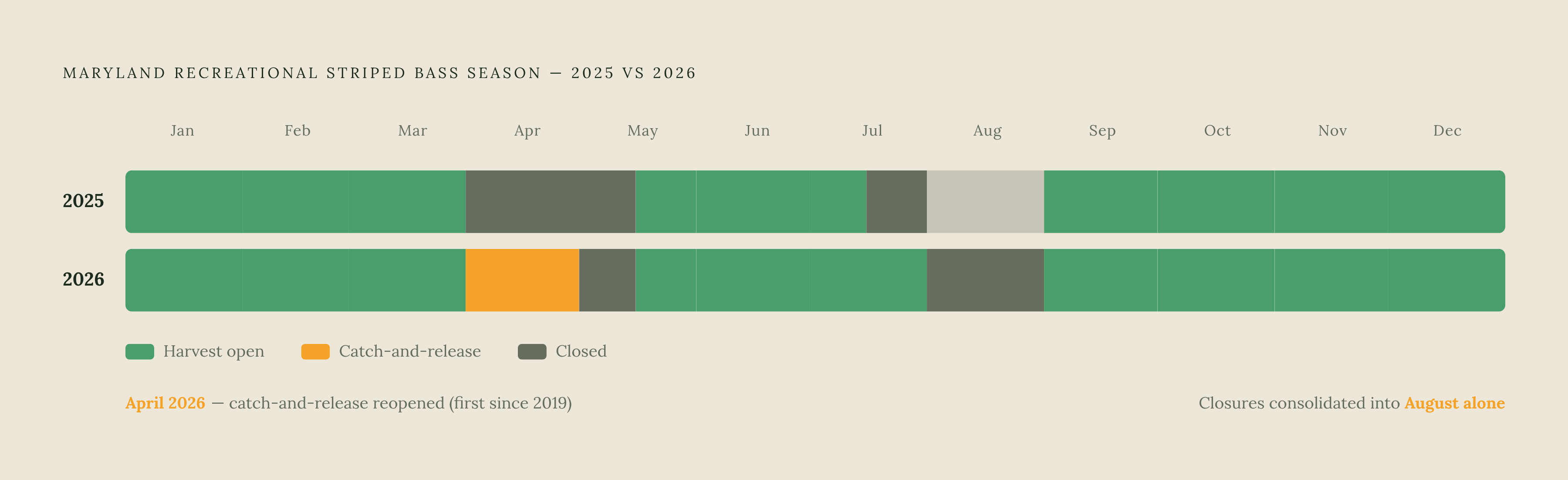
April is back for Chesapeake Bay striped bass anglers, and that alone marks the most significant change in Maryland's 2026 season. Maryland DNR adopted a new baseline striped bass season for 2026, formalized in the Maryland Register on March 20, 2026, after the ASMFC Striped Bass Board approved Addendum III to Amendment 7. From September 1 through December 5, the season again allows catch-and-release and harvest fishing under the same one-fish bag limit and 19"–24" slot limit. From December 6 through December 31, the fishery is restricted to catch-and-release only.
Set against the prior framework, the shift is substantial. Under the 2026 structure, total open days climb to 334, even as harvest days edge down slightly to 188, with the closed days consolidated into August. Practically, that means catch-and-release fishing returns to April for the first time since 2019, and harvest itself opens two weeks earlier than it did in 2025. The change didn't happen quietly: Maryland DNR fielded substantial public comment before adopting the new rules. Full 2026 Chesapeake Bay recreational striped bass season is now in effect. From May 1 through July 31, anglers may pursue catch-and-release and harvest fishing, with a one-fish-per-day bag limit and a 19"–24" slot limit.
The science behind Maryland's August closure and the safety of spring catch-and-release
Trading a familiar August fishery for a new April window looks, on its face, like a wash. It isn't, once the underlying mortality data are laid alongside each other.
August is the deadliest month of the year for Chesapeake Bay striped bass, and the danger falls hardest on younger, resident fish rather than the larger migratory adults passing through. Warm water alone stresses these fish to a point where even a textbook-careful catch-and-release, quick hook removal, minimal air exposure, immediate return to the water, can still end in death. Closing August entirely means no targeting, no catch-and-release, and no harvest are permitted that month.
Spring runs the opposite calculation. Maryland DNR's own research, the Lukacovic study, found that striped bass released into cooler spring water survive at a strikingly high rate. From January 1 through April 30, the season is catch-and-release only.
The stock picture backs this up without erasing the concern that prompted the closure. Spawning female biomass sat at roughly 80,000 metric tons in 2024, a number solid enough to give managers confidence in the adult population overall. But reproduction has faltered badly enough to crash the population of young resident fish, and August closure targets exactly that vulnerable cohort. Maryland DNR frames its own goal this way: the restructured calendar aims to maintain, or potentially reduce, overall fishing mortality while shifting angler access toward the periods where the science says the risk to fish is lowest.
So the first move, before reading a single depth limit or bag limit, is to locate the reader's coast.
Maryland's gear requirements during catch-and-release windows, and the spawning tributary closures that run alongside them
None of the calendar above changes what's in an angler's tackle box during catch-and-release periods, and Maryland's gear rules here are not suggestions. Stinger hooks are prohibited. Trolling is capped at six rods, barbless hooks are required while trolling, and anyone fishing with natural bait, whether that's fish, crabs, worms, or processed bait, in the Bay or its tidal tributaries must use non-offset circle hooks. These rules apply during March and carry through May 15. Those protected tributaries are the Choptank, Chester, Manokin, Nanticoke, Patuxent, Transquaking, and Wicomico rivers.
Handling matters just as much as hook choice. Maryland DNR emphasizes certain handling practices for anglers during catch-and-release periods. Spawning tributaries are closed to all striped bass targeting from March 1 through May 31, independent of the main Bay calendar.
The rule most likely to catch an angler off guard, however, is about geography. It's about geography. The upper Bay spawning grounds, including the Susquehanna Flats, fall under the same closure. That means an angler who sees April catch-and-release listed as open water and assumes the whole Bay is fair game has misread the map. The main Bay stem is legitimately open during that window, but the spawning tributaries are not, regardless of what the broader calendar says. The Potomac River is managed separately by the Potomac River Fisheries Commission, whose rules an angler needs to check independently. The calendar itself has gotten simpler this year, one consolidated closed month instead of two scattered ones, but the tributary layer that produces separate closures for those waters still applies regardless of the main calendar, and it's the detail most likely to turn a legal April outing into an accidental violation. The previous framework had 61 days entirely closed to fishing, split across spring (April 1–May 15) and summer (July 16–31), leaving 304 total days available (111 catch-and-release and 193 harvest days). The ocean fishery in Maryland coastal waters is separate, operating year-round with a 28"–31" slot limit and a one-fish daily bag limit.
California's winter closure for boat-based anglers and the 2026 depth-access restoration during the open season
For boat-based anglers searching for a winter catch-and-release rockfish season in California, the honest answer is that no such thing exists. The boat-based groundfish season runs April 1 through December 31 in most management areas, and closes entirely from January 1 through March 31 for spawning protection, a closure that covers catch-and-release along with harvest. The season is simply shut.
Shore-based anglers and divers are the exception, and they can fish year-round without the seasonal or depth restrictions that bind the boat fleet, a distinction that traces directly back to the barotrauma dynamics covered earlier: a diver selects individual fish without ever subjecting them to the pressure change that makes hook-and-line release from depth so lethal.
Once the season reopens in April, though, 2026 brings a genuine expansion for boat-based anglers. South of Point Conception, some trips still carry seasonal depth limits, and anglers there need to check the current CDFW bulletin before heading out, since the rules aren't uniform statewide. The 2026 aggregate daily bag limit is 10 fish across the RCG Complex, meaning rockfish, cabezon, and greenling combined, with species-specific caps nested inside that total: two canary rockfish, one copper rockfish, and a vermilion rockfish limit that varies by area. Quillback, cowcod, yelloweye, and bronzespotted rockfish carry zero retention: any one of them has to go back regardless of size or condition. California's rules move in-season more than most anglers expect, which puts the burden on the angler to check current regulations before every single trip rather than trusting last season's numbers. NOAA Amendment 33 establishes a rebuilding plan for California quillback rockfish and revises the allocation structure for shortspine thornyhead, and was implemented alongside the 2025–26 federal harvest specifications for groundfish. NOAA Fisheries announced on January 22, 2026, via an emergency rule effective January 21, 2026, that canary rockfish catch limits were raised for 2026 after new data showed the population is larger than previously estimated, with the change taking effect immediately and applying across West Coast fisheries.
California's mandatory descending device requirement as the core catch-and-release protection
California law doesn't leave the descending device as a recommendation buried in a pamphlet. No one may take or possess federal groundfish from a boat, or any other floating device, in ocean waters without a descending device in their possession, and that device has to be ready for immediate use, not stowed in a hatch somewhere out of reach. The requirement kicks in the moment an angler is taking or possessing federal groundfish from a boat in ocean waters, full stop.
What makes this rule the backbone of California's entire catch-and-release approach is that it applies even when a fish is being released rather than kept. A released rockfish hauled up from depth without recompression carries a real chance of dying anyway, and that death still counts against the fishery's overall quota regardless of the angler's intent to keep the fish. Carrying a working descending device, then, isn't a matter of good conscience so much as a functional requirement of the quota system itself: skip it, and the fish an angler thought was released for free is, statistically, still a fish removed from the population.
Oregon's year-round access, mandatory descending device use, and released fish counting against quotas
Oregon offers the most open access of the three West Coast states by a wide margin. General marine species, rockfish, cabezon, greenling, skates, and the rest, stay open at all depths year-round, with no winter depth restriction at all, a sharp contrast to California's hard seasonal closure. Lingcod sits outside the general bag entirely, with its own three-fish daily limit and a 22-inch minimum, also effective January 1, 2026. Yelloweye and quillback rockfish are prohibited outright, at all times, in all Oregon waters, no exceptions.
The access comes wrapped in a mechanism anglers frequently miss. Every dead fish counts against harvest limits, and that includes the estimated mortality of fish that were released rather than kept, wait: the counting rule specifically is that all dead fish, released or not, get counted toward the quota. Catch-and-release, in other words, counts against Oregon's quota accounting. It's the input that determines how the mortality math gets done. Beginning January 1, 2026, canary rockfish carry a 2-fish daily sub-bag limit per angler as part of the general marine bag limit. An Ocean Endorsement is required for anglers.
Fishery managers apply what they call survival credits, reduced mortality estimates used when calculating quota impact, specifically for yelloweye and canary rockfish, because research backs up higher survival after descending-device release for those two species; other species remain under study and don't yet carry the same credit. The practical effect is that using a descending device on canary and yelloweye rockfish stretches those species' quotas further, which in turn keeps the season open longer for the fish anglers are actually targeting, lingcod and black rockfish among them. Anyone who needs a device and doesn't own one can get one free through the Oregon Coalition for Educating Anglers, at oceaned.org. New 2026 bag limits have been set. Beginning January 1, 2026, general marine species are subject to a 4-fish daily bag limit per angler.
Notes
- Chesapeake Bay Angler Red Alert: New 2026 Rockfish Regs | FishTalk Magazine
Provided context on the 2026 Maryland striped bass season restructure, including the April catch-and-release opening and the August closure.
- New Rockfish Regs for Maryland in 2026? | FishTalk Magazine
Provided detail on the new Maryland 2026 striped bass regulations including the slot limit, gear requirements, and season calendar changes.
- Sport bottomfish seasons | Oregon Department of Fish & Wildlife
Provided Oregon's 2026 bottomfish season rules including bag limits, species-specific restrictions, and the canary rockfish sub-bag limit.
- 2026 Maryland Rockfish Season: Dates, Regulations & Slot Limits | The HdG Beacon
Provided the spawning female biomass figure and context on young resident fish population decline used in the stock assessment discussion.
- Rockfish Fishing | Oregon Dept of Fish & Wildlife
Provided Oregon-specific rockfish regulations including the yelloweye and quillback prohibition and the descending device and Ocean Endorsement requirements.
- Effects of Barotrauma on Four Species of Pacific Rockfishes (Sebastes Spp.)
Provided the research basis for barotrauma effects on Pacific rockfish and the effectiveness of descending devices for recovery.
- Rockfish Barotrauma and Recompression | NOAA Fisheries
Provided NOAA's guidance on barotrauma and the mandatory descending device requirement underpinning California and West Coast catch-and-release rules.
- Maryland’s 2026 Striped Bass Season Opens for Catch-and-Release Fishing in April
Provided the official Maryland DNR announcement of the April catch-and-release opening and the formalized 2026 season calendar.