
Essay Fishing Regulations
ASMFC Striped Bass Management Plan Explained
How slot limits, bag rules, and quota cuts work together to rebuild a depleted stock.
The ASMFC Striped Bass Management Plan is a layered system of biological targets, harvest controls, and amendments. Its structure explains both the restrictions anglers encounter and the disputes over rebuilding. The central distinction is that controlling fishing mortality and rebuilding the stock are related but different tasks, especially when weak juvenile production limits recovery.
What the ASMFC Striped Bass Management Plan actually is and what it governs
The Atlantic Striped Bass Interstate Fishery Management Plan is a coastwide interstate compact. It covers a species that migrates from Florida to Canada and supports commercial and recreational fisheries across more than a dozen jurisdictions. The Atlantic States Marine Fisheries Commission, or ASMFC, coordinates management among its member states. Those states must put the plan’s shared biological targets and harvest controls into effect through their own rules.
ASMFC’s Atlantic Striped Bass species page lists Amendment 7 as the framework now in use. Adopted in 2022, it consolidated Amendment 6 and its associated addenda into a single document. Within that structure, a base amendment establishes the framework, while addenda change specific measures without rewriting the whole plan.
How biological reference points set the plan’s core targets and define what “overfished” means
The plan measures stock condition through two categories of biological reference points, namely spawning stock biomass, or SSB, and fishing mortality, or F. Each has a threshold and a target, but those terms are not interchangeable. A threshold marks the boundary that triggers corrective action. A target is the condition managers aim for, with room to spare before the stock crosses a threshold.
For SSB, the threshold is a specific metric-ton benchmark below which the stock is designated overfished and rebuilding becomes mandatory. The SSB target is higher, at 247 million pounds, which the rebuilding plan requires the stock to reach by 2029. Female SSB in 2023 was estimated below both the threshold and the target.
Fishing mortality measures a different problem, which is the rate at which fishing removes fish from the population. The F threshold is 0.21, and exceeding it constitutes overfishing and triggers mandatory cuts. The F target is 0.17, the rate managers aim to hold fishing mortality at or below. The 2024 Stock Assessment Update found the stock overfished but no longer experiencing overfishing. Even after excessive fishing mortality ends, the stock must still be rebuilt, so rules must address more than whether the F threshold has been crossed.
The harvest control toolkit and how it translates biology into regulations anglers encounter
The plan applies different but parallel controls to recreational and commercial fishing, calibrated to the same biological targets. Addendum II to Amendment 7, approved in January 2024, established a 28-inch to 31-inch ocean recreational slot limit with a coastwide 1-fish bag limit. In the Chesapeake Bay recreational fishery, it established a 19-inch to 24-inch slot and a 1-fish bag limit. Unlike a minimum-size rule, a slot protects fish at both ends of the size range. Its upper boundary protects large, highly fecund females as well as excluding them from harvest.
Gear rules supplement those limits. Recreational anglers must use circle hooks when fishing with bait, and Amendment 7 added a prohibition on gaffing striped bass. For commercial fisheries, Addendum II reduced quotas in both the ocean and Chesapeake Bay sectors. State flexibility is also constrained through restrictions on conservation equivalency, or CE. CE once let states use other measures that cut mortality by the same amount, but Amendment 7 bars most recreational striped bass fisheries from using it when the stock is overfished.
The plan assumes that 9% of released fish die, making release mortality a significant component of total removals. Because recreational anglers catch and release very large numbers of striped bass, those deaths account for a substantial share of fishing mortality. A released fish is therefore not automatically absent from the assessment’s accounting. Total removals count both the fish that are harvested and those that die after release.
Why the recreational sector dominates both the fishery’s economic value and its management challenge
Recreational fishing dwarfs commercial fishing in the striped bass fishery’s economic scale. Commercial fishing brings in only a small share of what people spend on recreational fishing, which supports many jobs and businesses across the region. That economic weight has a biological counterpart. The recreational sector accounts for roughly 85% of total Atlantic striped bass removals by number of fish, divided between harvest and release mortality.
Consequently, the sector central to the fishery’s economic value is also central to its rebuilding challenge. With so many people who have a political stake in recreational fishing, cuts carry costs for communities and the economy that affect Board votes. The conflict is not simply between conservation and commerce, because the largest recreational interests depend on the same stock whose removals they dominate. These stakes help explain why people disagree over how much amendments and addenda should restrict fishing and when, even when they agree on the rebuilding goal.
How the plan evolves through amendments and addenda, from the 2019 overfished declaration through Addendum II
The 2019 Benchmark Stock Assessment changed the management picture by incorporating updated recreational catch estimates from MRIP. It found striped bass both overfished and experiencing overfishing. The overfished designation triggered a requirement to rebuild SSB to its target within 10 years, establishing the 2029 deadline. The Board responded with Addendum VI to Amendment 6, which targeted a reduction in F to the fishing mortality target by 2020.
Amendment 7 consolidated the framework in 2022, including the gear and CE restrictions described above. The abundant 2015 year class helped push 2022 harvest above target. On May 2, 2023, the Board approved an emergency 31-inch maximum size limit for all recreational fisheries coastwide. The action took effect immediately, with states required to comply by July 2, 2023, to protect those fish as they entered the harvestable slot.
Addendum II then converted the emergency response into a standing regulatory baseline in January 2024. It formalized the ocean and Bay slots and bag limits while also cutting commercial quotas. This sequence shows the distinct functions of assessments, amendments, emergency action, and addenda. Assessments show what is wrong with the stock, while the management documents set out how the fishery must respond. With Addendum II in place, the next dispute was over whether those rules would be enough to meet the rebuilding deadline.
ASMFC’s Atlantic Striped Bass species page lists Amendment 7 as the framework now in use.
The 2024–2025 regulatory debate and why the Board rejected harvest cuts
The 2024 Stock Assessment Update presented a mixed result. Overfishing had ended, but the stock remained overfished, and short-term projections anticipated rising F in 2025 as the above-average 2018 year class entered the ocean slot. On December 16, 2024, the Board voted 14-2 to pursue a full addendum process, deferring immediate 2025 cuts. A competing motion for immediate action failed 12-4. ASMFC’s December 2024 press release described the addendum as a vehicle for considering recreational and commercial reductions, with final action at the 2025 annual meeting.
People voiced sharply different views at public hearings in coastal states from Maine to Virginia in September 2025. But by the final vote, preliminary 2025 MRIP estimates through June showed that recreational removals were well below those for the same period in 2024. Those estimates undercut the forecast of increased mortality that had driven the proposed cuts. The Board also cited the American Sportfishing Association’s position that recent measures had already brought fishing mortality to a multi-decade low, well below the F target.
On October 29, 2025, in Dewey Beach, DE, the 16-member Board voted 13-3 for status quo, rejecting the reduction option and maintaining harvest controls through 2026. Final Addendum III nevertheless made substantive changes. It moved commercial tagging to the first point of landing and established straight-line total length measurement with the upper and lower forks of the tail squeezed together. That standard addressed inconsistent size-limit enforcement caused by the absence of a defined measurement method. It also allowed Maryland to change its Chesapeake Bay recreational season baseline. With those changes in place, the 2029 deadline was drawing near and the projected chance of rebuilding was still below half.
The recruitment failure in Chesapeake Bay that harvest controls alone cannot fix
The biological constraint beneath that debate is weak recruitment in Chesapeake Bay, the primary nursery for the coastal migratory stock. The Maryland Department of Natural Resources survey of juvenile fish recorded a slight improvement in 2025 over 2024, but juvenile production remained far below the long-term average. It was the seventh consecutive below-average year. Harvest controls can conserve fish already in the population, but they cannot by themselves replace missing recruits. This is a constraint the plan must adapt to, rather than evidence that regulating fishing has no value.
The 2018 year class is the only above-average recruit since 2015. Its passage into the harvestable slot drove expectations of higher fishing mortality in 2025–2026, even though preliminary catch estimates later challenged that forecast. After that cohort passes through, the weak year classes behind it will make up more of the population. The years after 2027 may therefore require lower removal rates than the current plan contemplates. The Technical Committee’s “very low recruitment” scenario illustrates how rebuilding can be delayed and remain fragile when biomass depends on a few strong year classes.
The Board’s Working Group will examine contributing factors, including warmer spawning waters, invasive blue catfish predation on juveniles, and the potential contribution of the Delaware and Hudson river systems. Supporters of status quo argue that fishing mortality is already below target and that more restrictions cannot make up for recruitment failure caused by environmental conditions. Their case places the emphasis on research and habitat action. That objection identifies a real limit to harvest management, but it does not remove its leverage. The Technical Committee’s projections show that a further moderate cut can improve the chance of rebuilding because removing biomass more slowly gives the stock time to recover naturally, even if the cut cannot make that recovery happen.
The benchmark stock assessment process and why 2027 is the next real decision point
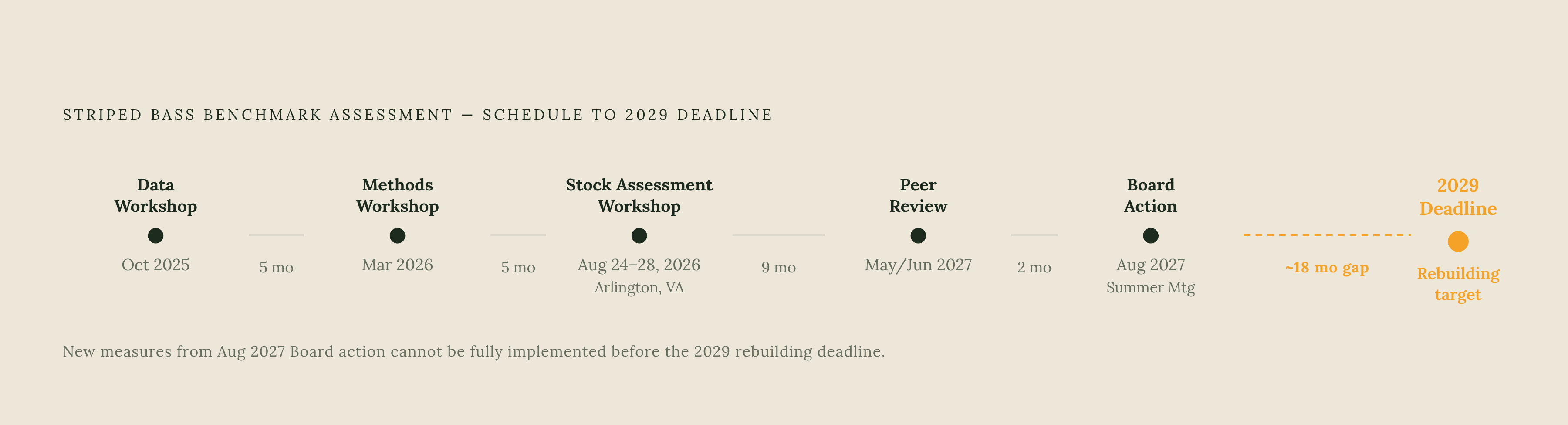
ASMFC’s benchmark assessment process will provide the next full basis for reconsidering stock status and rebuilding prospects. The Data Workshop was completed in October 2025, followed in the schedule by a Methods Workshop in March 2026. The Atlantic Striped Bass Stock Assessment Workshop is scheduled for August 24–28, 2026, at the Commission office in Arlington, VA. Peer review through the Northeast Regional Stock Assessment process is set for May or June 2027. The Management Board is then scheduled to consider the benchmark at the Commission’s Summer Meeting in August 2027.
The Working Group will address questions that reach beyond another adjustment to slots or quotas. Its reference-point review will include recruitment-sensitive, model-based approaches, while its review of hatchery stocking will examine both research and management uses, including costs. It will also evaluate other river systems’ contributions and the climate, environmental, and invasive-species factors affecting recruitment in the Chesapeake Bay, Delaware, and Hudson Rivers. Further work will look at how much large and small females each contribute to reproduction and ways to reduce catch-and-release discard mortality.
For anglers and stakeholders, 2026 regulations remain unchanged from 2025, and the next opportunity for the Board to act on harvest levels comes after the 2027 benchmark results. On that schedule, the 2029 rebuilding deadline will arrive before new management measures could be fully in place. The benchmark and Working Group therefore matter as the point where evidence can reset the terms of the rebuilding debate, including what “rebuilt” should mean after 2029. The plan’s next chapter is the alignment of biological reference points, assessments, and regulatory tools with a stock whose recruitment has become the central uncertainty.
Notes
- Atlantic Striped Bass Board Initiates Addendum to Consider 2026 Management Measures - Atlantic States Marine Fisheries Commission
Sourced the December 2024 Board vote details and the description of the addendum as a vehicle for considering recreational and commercial reductions.
- Atlantic Striped Bass Addendum III - Atlantic States Marine Fisheries Commission
Provided the 85% recreational removals figure and the 9% release mortality assumption central to the harvest accounting discussion.
- Atlantic Striped Bass Addendum III to Amendment 7 - October 2025 - Atlantic States Marine Fisheries Commission
Provided details on Addendum III's substantive changes, including the commercial tagging rule, straight-line total length measurement standard, and the October 29, 2025 Board vote.
- 2024 Atlantic Striped Bass Stock Assessment Update Report
Provided the 2024 Stock Assessment Update findings that the stock was overfished but no longer experiencing overfishing, and projections about rising F from the 2018 year class.
- addendum ii to amendment 7 to the interstate fishery ...
Sourced the specific details of Addendum II, including the ocean slot limit, Chesapeake Bay slot, bag limits, commercial quota cuts, and conservation equivalency restrictions.
- Atlantic Striped Bass - Atlantic States Marine Fisheries Commission
Identified Amendment 7 as the current management framework and provided the species-level overview of the management structure.