Essay Rockfish Seasons
Chesapeake Bay Rockfish Population Trends and Stock Assessments
Chesapeake Bay's record recruitment collapse threatens the entire Atlantic striped bass stock.
The Chesapeake Bay is the reproductive engine of the Atlantic striped bass population; it is not just one habitat among several it uses along the coast. Between 70% and the vast majority of the entire coastwide stock begins life in the Bay's tributaries, and managers and scientists on both sides of the current policy fight accept that dependency as a starting fact, not a point of argument. Striped bass range from Maine to the Carolinas as adults, but their origin story runs through a single estuary, so what happens in Chesapeake water sets the terms for what the whole coast will see later. Allison Colden, Maryland Executive Director of the Chesapeake Bay Foundation, said: "What happens here in the Chesapeake Bay is a crystal ball for what we see in the future" of the coastwide stock. That dependency carries a built-in delay. Juvenile fish spawned in the Bay take three to four years to reach the size anglers and commercial harvesters actually encounter, so a bad year in Maryland's rivers doesn't register as a coastwide problem until years later, and a management vote in Arlington or Dewey Beach about recreational slot limits amounts, beneath the paperwork, to a bet on what's happening right now in Chesapeake tributaries.
Juvenile surveys and the record poor-reproduction streak
The juvenile index, the annual count of young-of-year striped bass in Bay nurseries, is the earliest warning system available for the coastwide stock, and it has been flashing red for most of a decade. Maryland recorded six straight years of poor reproduction through 2024, Virginia recorded two consecutive years of the same, and by February 2026 some observers were citing seven straight years of record-low recruitment in the Bay. Striped bass reproduction naturally swings up and down from year to year depending on conditions, but scientists studying the Bay say a stretch this long and this low has no real precedent, and they don't have a confident explanation for it yet. The 2025 surveys brought a measure of relief: both Maryland and Virginia recorded slightly improved juvenile numbers compared to the prior years. But you should read that improvement carefully: preliminary results from William & Mary's Batten School and VIMS show Virginia's tributaries produced only an average year class in 2025, not a strong one capable of reversing the trend. Even that average class won't reach legally catchable size for three to four years, so it does nothing to relieve pressure on the stock before roughly 2028 to 2029. What makes the streak harder to explain away is that low spawning stock biomass by itself has never been sufficient to predict recruitment failure: 1993, 2015, and 2018 all produced strong year classes despite biomass levels significantly lower than today's. Something other than simple population math is suppressing reproduction in the Bay, and identifying that something is the real work ahead.
The overlapping stressors driving recruitment failure
Recruitment failure in the Bay isn't traceable to a single cause the way the overfishing crisis of the 1980s was. At least five stressors appear to be interacting at once, and that layering is what makes this crisis harder to fix than its predecessor, where cutting harvest was enough on its own. Fishing pressure and release mortality remain part of the picture: the 2024 Stock Assessment Update found the stock is not currently being overfished, but it still hasn't recovered from past overfishing, and recreational fishing accounts for the large majority of fishing mortality against roughly a tenth attributable to commercial fishing. ASMFC's technical experts estimate that about 9% of all striped bass caught and released die anyway, a rate that climbs well above that baseline when summer water temperatures in the Bay rise. Disease adds a second, less visible layer. A peer-reviewed study in Transactions of the American Fisheries Society found mycobacteriosis widespread in Maryland's Bay waters, and it measurably cut survival in severely infected fish, with disease prevalence tied to poor water quality and climate conditions. Commercial pound nets on the Rappahannock River have turned up high rates of dermal mycobacteriosis, and in the study's models, relative mortality for severely diseased fish doubled across the range of low-oxygen, high-temperature conditions examined. A third stressor swims in from outside the species entirely: invasive blue catfish have expanded sharply through juvenile striped bass habitat. Maryland's spring spawning stock survey caught very few blue catfish in 2014 and far greater numbers by 2022, and that growth raises real concern that predation and competition from an invasive species are suppressing juvenile survival in waters striped bass depend on. Weather and river conditions round out the list: a state natural resources agency has said winter conditions in recent years have not favored striped bass reproduction, and river flow, water temperature, and habitat quality all appear to influence how large a year class the Bay produces. None of this settles the argument over what to do about it. If climate and disease are doing most of the damage, tighter catch limits only address one piece of a five-part problem, so you have to ask whether cutting fishing hard enough can still pull the stock through to recovery on a fixed deadline.
The 2024 Stock Assessment's management trigger
The 2024 Stock Assessment Update gave regulators the formal findings they needed to act, and those findings left them little room to keep waiting. The assessment confirmed what the juvenile surveys had already suggested: the stock remains overfished relative to its targets, even though it is not currently experiencing overfishing, a distinction that matters because it determines which legal tools managers can reach for under the Interstate Fishery Management Plan. Compounding the problem, biologists had predicted a rise in fishing mortality for 2025, driven by the above-average 2018 year class moving into the recreational ocean slot limit, a bulge of legal-size fish that was expected to draw more anglers and more harvest. Preliminary 2025 data confirmed that prediction, and the uptick in catch pushed the odds of rebuilding the stock by the 2029 deadline to below 50%. ASMFC's technical committee went further, modeling a "very low recruitment" scenario in which the stock keeps declining after 2029 even with restrictions in place, the worst-case pathway in the assessment and the one that worries conservationists most. The 2029 deadline isn't just a conservation aspiration: ASMFC wrote it into its own Interstate Fishery Management Plan, so delay carries legal weight that costs more than ecology alone. The Chesapeake Bay Foundation raised a pointed objection to the assessment itself, noting that its projections did not factor in the six consecutive years of below-average Bay recruitment, and arguing that the assessment likely understated how much trouble the stock is actually in.
Recruitment failure in the Bay isn't traceable to a single cause the way the overfishing crisis of the 1980s was.
The sequence of management responses from December 2024 through October 2025
ASMFC's Atlantic Striped Bass Management Board moved through three distinct phases in less than a year, as it swung from delay to a proposed cut and back to the status quo. At a December 2024 special meeting, the Board considered acting immediately to reduce fishing mortality in 2025, but it chose instead to open an addendum process aimed at 2026 measures, citing the need for more time and a broader set of options. That decision drew thousands of public comments and was called "disappointing" by the Chesapeake Bay Foundation, which warned that delaying action pushed any real response to 2026 at the earliest. The Board was already operating under Addendum II going into this period, and that addendum had cut recreational anglers down to one striped bass per day from two and trimmed commercial quotas as well. Those measures survived a legal challenge when the U.S. Supreme Court rejected an emergency petition from the Delmarva Fisheries Association and the Maryland Charter Boat Association, which had argued the restrictions were "drastic, unwarranted, and illegal." By August 2025, the Board voted to move forward with a proposed cut, opening a public comment period that produced sharply divided input from anglers, charter operators, and conservation groups, with the process set to conclude at the October meeting in Dewey Beach, Delaware. That October meeting produced the most consequential reversal of the year: the Board decided not to move forward with the proposed reduction after all. Preliminary estimates showed 2025 recreational catch through June running lower than anticipated, so the models behind the proposed cut may have overestimated how much reduction was needed. Fishing limits for 2026 are unchanged from 2025. In place of a harvest reduction, the Board approved Addendum III, which standardizes how total length is measured for size limits, shifts the point of commercial tagging to the first point of landing, and allows Maryland to adjust its Chesapeake Bay recreational season baseline. These are administrative fixes, not cuts to how many fish come out of the water.
Why the October 2025 decision divided managers and conservationists
The October reversal split the room because both sides were arguing from real evidence, not from indifference to the stock's condition. Managers who voted against the proposed cut pointed to two things: the severe economic toll the reduction would have imposed, and preliminary data showing 2025 recreational catch running lower than projected through June, which they read as a sign the 12% cut target had been built on overestimated catch levels. The economic stakes behind that caution were concrete. Brian Hardman, head of the Maryland Charter Boat Association, reported that his members had already seen business fall by a very large margin after Addendum II took effect in 2024, which is the backdrop against which a further cut looked, to many operators, like a potentially terminal blow. Commercial harvesters face a parallel squeeze: a decade of repeated quota reductions has pushed some operators close to the point where targeting striped bass no longer pencils out economically, even though striped bass remain worth substantially more than the species harvesters might substitute for them. Conservationists argue that the economic case, however real, doesn't change the biological one. Allison Colden of the Chesapeake Bay Foundation warned that recent surveys show the stock "facing a looming disaster" and that the commission "must err on the side of conservation," a position she reiterated after the October vote went the other way. The technical committee's own "very low recruitment" scenario is the fact that gives her argument its force: that scenario projects continued decline after 2029 even with the restrictions the Board just voted down, so the baseline risk isn't a stock holding steady at current levels but one still losing ground. Both positions leave unresolved the harder structural question raised by the stressor analysis: if climate and disease are driving most of the recruitment failure, catch limits can only ever address part of the problem, and nobody currently knows whether cutting fishing mortality enough to let the other stressors resolve on their own is still achievable inside the 2029 timeline.
What the 2029 rebuilding deadline now realistically requires
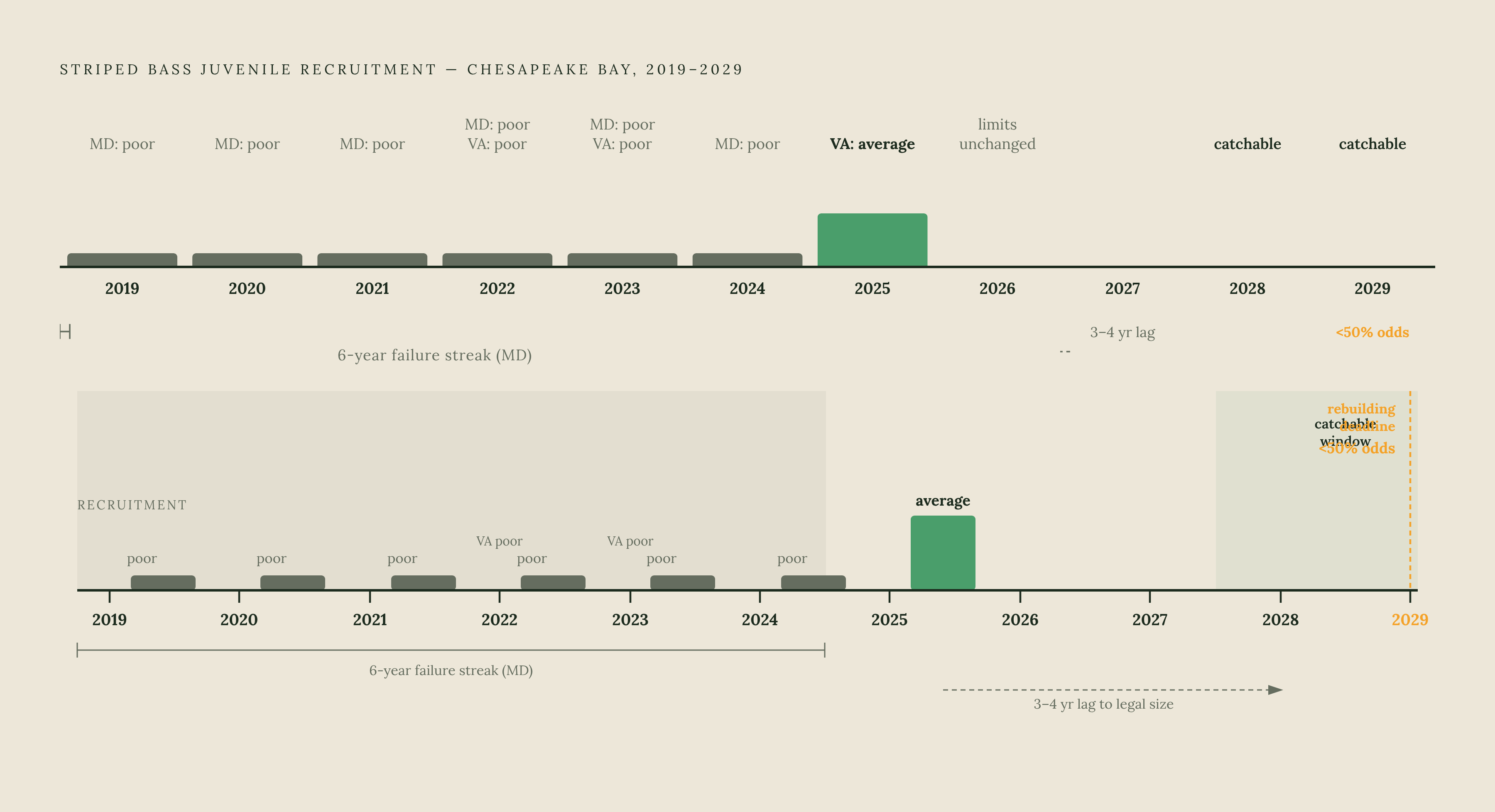
Fishing limits for 2026 will match 2025, and the only near-term recruitment signal you have is a single, average year class out of Virginia's 2025 survey, not the strong rebound the stock needs. So the rebuilding math now looks worse than it did even a year ago. Preliminary 2025 catch data had already pushed the odds of hitting the 2029 target below 50% before the October meeting, and if you hold harvest steady instead of cutting it, that number doesn't improve. The technical committee's "very low recruitment" scenario, which projects continued decline even under the restrictions the Board declined to impose, describes the trajectory the stock is on absent either a run of strong year classes or a harvest reduction larger than the one just rejected. Meeting the 2029 deadline now depends on variables nobody can set by vote: whether the Bay produces several consecutive strong year classes before the deadline arrives, whether disease prevalence and blue catfish predation ease rather than worsen, and whether river conditions in the next two or three winters favor spawning in a way they have not since before the current streak began. If you get no documented strong year class soon, and no harvest reduction beyond the one ASMFC just set aside, the 2029 target set by the Interstate Fishery Management Plan will carry a real risk of being missed, and the Board now carries the institutional and ecological cost of that outcome into 2026.
Notes
- Checking in on Chesapeake Bay Striped Bass
Provided background on the Chesapeake Bay's role as the primary spawning ground for Atlantic striped bass and on the juvenile index as an early warning system.
- 2025 MD-VA Chesapeake Bay Striped Bass Surveys - Chesapeake Bay News
Provided the 2025 Maryland and Virginia juvenile striped bass survey results showing a slightly improved but still only average year class.
- 2024 Atlantic Striped Bass Stock Assessment Update Report
Provided the formal findings of the 2024 Stock Assessment Update, including overfished status, fishing mortality estimates, and the 9% release mortality rate.
- Adult Spawning Stock Survey
Provided data from Maryland's adult spawning stock survey on blue catfish expansion through juvenile striped bass habitat between 2014 and 2022.
- State of the State Fish: What Marylanders Should Know About Striped Bass in 2025
Provided the Maryland DNR's statement that winter conditions in recent years have not favored striped bass reproduction.
- What Comes Next for Striped Bass? • Chesapeake Bay Foundation
Provided Allison Colden's quotes about the Chesapeake Bay as a crystal ball for the coastwide stock and the stock facing a looming disaster.
- Fishery Management Plan for Atlantic Striped Bass
Provided the specific measures of Addendum II, including the reduction to one striped bass per day for recreational anglers and commercial quota cuts.
- juvenile index
Provided Maryland DNR data on six consecutive years of poor striped bass reproduction through 2024.