Essay Rockfish Seasons
Chesapeake Bay Rockfish Season Dates by State
Maryland and Virginia manage the same fish stock under different season calendars.
Chesapeake Bay rockfish, the regional name anglers use for striped bass, answer to one interstate rulebook, yet Maryland and Virginia end up running noticeably different season calendars from that same document. The Atlantic States Marine Fisheries Commission administers the Interstate Fishery Management Plan for striped bass, and every East Coast state's regulations have to align with it. Alignment does not require identical dates. The plan sets a conservation ceiling, and each state decides how to stay under it, using its own mix of season structure, slot limits, bag limits, and gear rules, so two states sharing one body of water can post visibly different calendars while both satisfy the same federal plan. Maryland DNR reports that more than 70 percent of the entire Atlantic striped bass stock spawns in the Chesapeake Bay, so the stakes behind that flexibility are not small: the choices Maryland and Virginia make inside Bay waters ripple out to the whole coastwide population.
The stock's condition
Striped bass are a stock still working through a federally mandated rebuilding plan, and that single fact limits what either state can put on the table for anglers in 2026. The population was declared overfished in 2019 and carries a legal deadline to rebuild to its spawning stock biomass target by 2029. The 2024 Stock Assessment Update offers a mixed verdict: overfishing itself has stopped, with the current rate at which fish are being removed falling within acceptable bounds, but the stock has not yet recovered to a healthy population size. Compounding that, Maryland's juvenile striped bass survey has now logged seven consecutive years of poor recruitment in Bay waters through 2025, so young fish are not entering the population at the pace needed to rebuild it, even with plenty of large adult spawners still present. Season design has to account for more than how many fish anglers keep. Maryland DNR's most recent stock assessment data, published in 2022, shows that recreational dead discards, meaning fish that die after being caught and released, made up 21 percent of all fishing-related striped bass deaths in the Bay.
Maryland's 2026 season: a restructured calendar that trades a July partial closure for a clean August shutdown
Maryland's 2026 season represents the most significant restructuring of its Bay rules since 2019, built around one deliberate trade: open up more fishing in the cool-water months and close down hard in the month when released fish are most likely to die. The full 2026 calendar runs as follows: January 1 through April 30 is catch-and-release only; May 1 through July 31 is open for harvest, at one fish per person per day within a 19 to 24 inch slot; August 1 through 31 is closed entirely, with no targeting of striped bass permitted; September 1 through December 5 reopens for harvest under the same one-fish, 19-to-24-inch terms; and December 6 through 31 returns to catch-and-release only.
The August closure, meanwhile, is not a new restriction invented for 2026. Maryland first closed part of August back in 2020, originally covering only August 16 through 31, and the full-month version taking effect in 2026 simply extends and cleans up a tool that has already been tested across several seasons. Maryland's return to catch-and-release fishing in April marks the first time that window has been open since 2019, replacing the prior two years' rule that barred targeting striped bass entirely from April 1 through May 15. The logic traces straight back to water temperature and discard mortality: August is when released fish face the highest risk of dying from heat and stress, which is exactly the problem the dead-discard figure above describes, and shutting the month down entirely removes that risk rather than managing around it.
Gear rules apply across every open window. Circle hooks are required whenever anglers target striped bass, eels cannot be used as bait during the December catch-and-release period, and trolling anglers must use barbless hooks and avoid stinger hooks through May 15. Anglers planning to fish the Potomac River should note that its main stem falls under the Potomac River Fisheries Commission, a separate authority with its own rules worth checking independently before a trip. For the full spatial detail on where these rules apply, the Maryland DNR regulations maps page remains the authoritative reference. The change itself moved through a defined approval process: Maryland's Joint Committee on Administrative, Executive, and Legislative Review signed off on March 12, 2026, the rule was published in the Maryland Register on March 20, and it took effect April 1, 2026, made possible by ASMFC's prior approval of Addendum III to Amendment 7.
Virginia's 2026 season: two concentrated harvest windows with no August targeting ban
Virginia takes a different structural approach, concentrating Bay harvest into two defined windows separated by a long closure, which produces fewer total open days than Maryland's calendar without naming August as a dedicated conservation shutdown. The spring season runs May 16 through June 15, open at one fish per person per day within the same 19 to 24 inch total-length slot Maryland uses. The fall season runs October 4 through December 31, under identical terms. Every other stretch of the calendar, including all of January through May 15 and June 16 through October 3, keeps the Bay closed to striped bass fishing in Virginia.
Anglers fishing Virginia waters need to follow circle hook requirements when using natural bait, and gaffing striped bass is prohibited outright. One distinction deserves particular attention before any angler plans a trip: Virginia's Bay season is entirely separate from its coastal, or Atlantic Ocean, striped bass season, which runs on its own calendar, from January 1 through March 31 and again from May 16 through December 31, under a different 28 to 31 inch total-length slot and the same one-fish daily limit. Confusing the two fisheries is an easy mistake. An angler checking Bay dates and then fishing offshore under those same assumptions would be fishing an entirely different slot limit on an entirely different calendar.
The August closure, meanwhile, is not a new restriction invented for 2026.
Month-by-month comparison of the two state seasons for a Bay trip
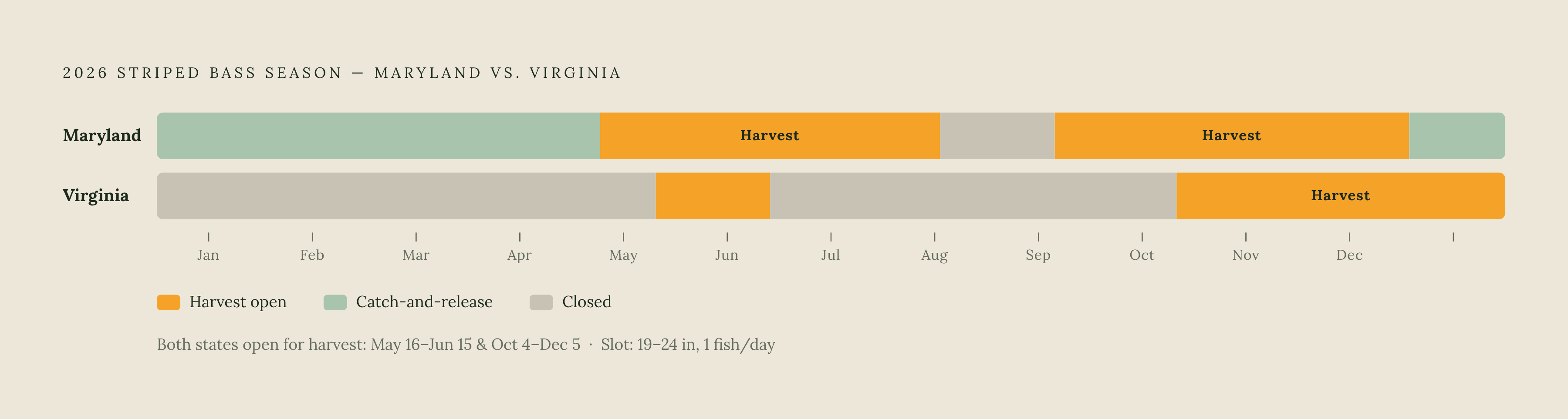
Maryland and Virginia agree on the harvest slot and the one-fish daily bag limit, but they diverge sharply on when harvest is actually legal and how much catch-and-release access anglers get along the way, which changes the planning math depending on the month in question. From January through April, Maryland keeps the Bay open for catch-and-release while Virginia's Bay stays closed entirely. In the first half of May, Maryland opens for harvest while Virginia remains closed until its spring season begins. From May 16 through June 15, both states align, with harvest open in both under the same one-fish, 19-to-24-inch terms. From June 16 through July 31, Maryland stays open for harvest while Virginia's Bay is closed. August brings both states to a full stop, Maryland under its named conservation closure and Virginia under its scheduled gap between seasons. From September 1 through October 3, Maryland reopens for harvest while Virginia remains closed. From October 4 through December 5, both states align again, open for harvest under matching terms. From December 6 through 31, Maryland drops back to catch-and-release only while Virginia's harvest season, at the same 19 to 24 inch slot, remains open through December 31.
Put together, the only stretches when both states allow harvest at the same time are the spring window of May 16 through June 15 and the fall window of October 4 through December 5. Maryland offers far more catch-and-release access across the calendar year than Virginia does, though Virginia's approach also avoids naming any single month as a conservation closure the way Maryland singles out August. An angler with only September available can fish Maryland's side of the Bay for harvest, while the same trip across the line into Virginia's Bay waters would find nothing but a closed season. Anyone planning a Bay trip around a specific month, rather than around the spring or fall windows both states share, needs to check both calendars individually rather than assuming one state's rules apply to the other.
Federal waters and the broader ASMFC process for anglers fishing either state
State season dates control fishing inside the Bay, but two further layers apply to every angler regardless of which state's rules they are otherwise following. Federal waters, defined as the zone from 3 to 200 nautical miles offshore, remain fully closed to possession of striped bass in 2026, a rule that applies the same way whether an angler departs from a Maryland port or a Virginia one. At the coastwide level, the ASMFC's Striped Bass Management Board made no changes to the overall management framework for 2026 at its most recent quarterly meeting, which leaves the state-level season structures detailed above as the primary tool currently being used to manage the stock. The Board also voted against a coastwide reduction in commercial and recreational removals, a decision Chesapeake Bay conservation advocates have pointed to as a setback for the stock's chances of meeting its 2029 rebuilding target. The flexibility behind Maryland's restructured season traces back to the same body: ASMFC's Addendum III to Amendment 7, approved in 2025, gave Maryland room to redesign its baseline Bay season but left the larger question of a coastwide harvest reduction unresolved. Anglers fishing either state's waters in 2026 are operating under state calendars built on that unresolved foundation.
Whether state-level season adjustments are enough to meet the 2029 rebuilding deadline
The ASMFC's own technical committee has projected that the stock is unlikely to hit its 2029 rebuilding target without a meaningful coastwide cut in fishing removals, and no amount of careful season design at the state level changes that underlying math. Conservation advocates point to data showing that recreational fishing pressure along the Mid-Atlantic coast ran higher than expected in 2024, a trend they argue has already reduced the odds of the stock reaching a healthy population by the 2029 deadline federal law requires. The fishing industry's position cuts the other way: further restrictions would cause real economic harm to small businesses and coastal communities built around this fishery, and industry advocates point to signs of improvement in the stock's trajectory as reason to hold off on deeper cuts.
Maryland's restructured season was built to be mortality-neutral. Fisheries scientists designed the shift from a fragmented spring and summer closure to a single clean August shutdown specifically so it would not add any additional striped bass deaths beyond what the previous calendar produced. Holding mortality steady is not the same as reducing it, and a season that avoids making the problem worse is not the same tool as one built to make it better. The recruitment data adds another layer of difficulty to any simple fix. Seven consecutive years of below-average juvenile numbers in the Bay, occurring even with a large population of adult spawners still present, points to environmental factors beyond fishing pressure affecting whether young fish survive their first years of life. That reality complicates the straightforward logic of "fish less, recover faster," because a stock can see reduced fishing mortality and still fail to rebuild if the fish being born are not surviving to adulthood in sufficient numbers. Maryland's and Virginia's 2026 seasons represent real, carefully calculated conservation tools, each shaped by the biology of discard mortality and the legal deadline both states are working against. Whether tools built at the state level can overcome a problem that the ASMFC's own scientists say requires coastwide action remains the question the 2029 deadline will ultimately answer.
Notes
- Maryland’s Summer Closure of Chesapeake Bay Striped Bass Fishing Begins August 1
Provided the statistic that recreational dead discards made up 21 percent of all fishing-related striped bass deaths in the Bay.
- Maryland Set to Adopt Changes to Chesapeake Bay Recreational Striped Bass Season
Provided details on Maryland's 2026 season restructuring, the 70 percent spawning stock figure, the rebuilding deadline, stock assessment findings, and the juvenile survey data.
- Maryland’s 2026 Striped Bass Season Opens for Catch-and-Release Fishing in April
Confirmed Maryland's return to catch-and-release fishing in April 2026 and the cool-water months rationale for the season structure.
- Maryland prepares for new rockfish fishing season, August closure
Provided context on Maryland's preparation for the new rockfish season and the August closure framework.
- Maryland Fishing - Striped Bass
Supplied the gear rule details including circle hook requirements, eel bait restrictions, and the barbless hook trolling deadline through May 15.
- Chesapeake Bay advocates disappointed by inaction on striped bass regulations
Provided the conservation advocates' perspective on the ASMFC vote against a coastwide harvest reduction and data on recreational fishing pressure in 2024.
- Stripers Season Virginia 2026: Dates by Region
Supplied Virginia's 2026 Bay season dates, slot limits, bag limits, and coastal season calendar used in the Virginia section.
- Atlantic States Marine Fisheries Commission ADDENDUM III TO AMENDMENT 7
Provided the basis for Maryland's season redesign authority under ASMFC Addendum III to Amendment 7, approved in 2025.