Essay Rockfish Seasons
Chesapeake Bay Rockfish Spawning Run Timing
Warming waters and changing flow patterns are weakening the Bay's striped bass recruitment.
The Chesapeake Bay is where most of the Atlantic coast's striped bass come from. Between 70 and 90 percent of the entire migratory stock spawns and recruits inside this one estuary. The timing of the Bay's spawning run therefore is not a regional curiosity; it determines how many rockfish appear along the wider migratory range in any given year. A fish that hatches in the Choptank or the Nanticoke this spring is the same fish an angler might catch off a distant stretch of coastline three summers from now.
Striped bass are anadromous: born in freshwater, they mature at sea and return to the same natal rivers to spawn, generation after generation. That single fact is why the run follows such a tight, predictable calendar rather than drifting randomly year to year. It also explains why the fish can grow so large and live so long, up to 30 years, five feet, and 77 pounds, and why the age spread among spawning females matters as much as their raw numbers. Older females don't spawn on the same schedule as younger ones, and that staggered timing acts as a kind of built-in shock absorber, spreading reproduction across a wider window so that no single year of bad weather can wipe out an entire generation. In Maryland alone, recreational fishing and boating generate an estimated $701.5 million a year in economic activity, from marinas and tackle shops to charter boats and seafood restaurants. Given how much rides on it, both ecologically and financially, here is how and when the run moves through the Bay.
Water temperature and the start of the spawning run
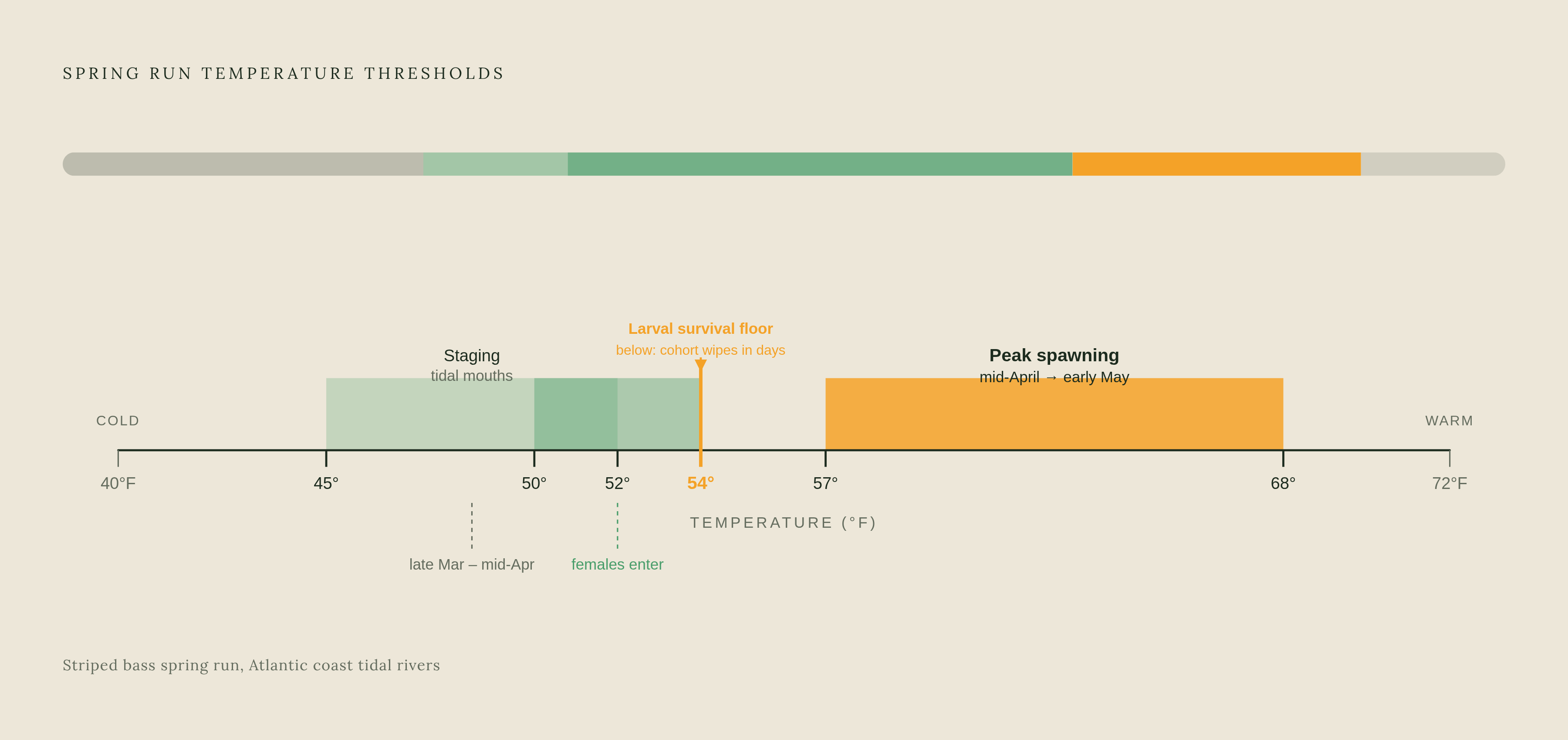
The run starts in March, when migratory fish leave the ocean and push back into the rivers where they were born. What triggers the migration isn't a calendar date, it's water temperature. Striped bass spawning is switched on by rising spring temperatures, and the biological sweet spot is between 57 and 68°F.
Before that window opens, though, there's a staging phase. Large females appear first at the mouths of tidal rivers and hold in the lower reaches once temperatures reach 45 to 52°F, which in Chesapeake tributaries usually occurs between late March and mid-April. The biggest females move earlier still, entering rivers just ahead of egg-laying when the water is between 50 and 54°F, typically late March into early April. These fish aren't just passing through. Before spawning, striped bass feed more aggressively than at almost any other point in their year. That is why staging fish are so easy to target and so easy to overexploit if regulations aren't careful about it.
The peak of the run, when most spawning actually happens, lands mid-April through early May, squarely inside that 57 to 68°F range. Below that range sits a hard biological floor, closer to a wall than a soft preference: larvae cannot survive their first weeks of life if water temperature drops under 54°F. That's not a soft preference, it's closer to a wall. A late cold snap that pushes river temperatures back below that threshold after spawning has already occurred can wipe out an entire cohort of larvae in a matter of days.
Age plays into this too. Females are believed to start migrating to spawn only after they turn five, and once they do, older fish spawn on a more dispersed schedule than younger ones. That means the "spawning season" was never really a single date to circle on a calendar; it's a range, shaped by how many age classes of females are present and how spread out their individual spawning windows are. Once temperature flips the switch, the run doesn't move through the Bay all at once. It moves river by river, in a sequence that's been documented closely enough to predict.
The river-by-river progression of the spawning run across the Bay
Fishery managers concentrate their annual survey work on four major spawning areas, the Choptank River, the Nanticoke River, the Potomac River, and the upper Chesapeake Bay, and sample 22 sites total.
The upper Bay run centers on the Susquehanna Flats, just below Conowingo Dam. Because the dam sits across the river, it concentrates the run below it rather than allowing fish to disperse upstream. Fish stage and spawn below the dam and across the Flats. The result is one of the most productive and best-known striper fisheries on the entire East Coast, and it draws heavy angling pressure every spring for exactly that reason.
The Patuxent River has some of the best-documented egg and larval distribution data of any Bay tributary. Research published in Estuaries and Coasts found that eggs and larvae concentrate almost entirely above the salt front, in water where conductivity runs at or below 800 μmhos per centimeter, and that egg production shows three distinct peaks over the season.
Virginia's tributaries run on the same coordinated system. The VIMS Juvenile Striped Bass Seine Survey samples 18 index sites across the Rappahannock, York, and James River systems, tracking the southern half of the same spawning geography that plays out in Maryland's rivers to the north.
Because these tributaries matter so much to overall reproduction, Maryland's 2026 regulations close them outright from March 1 through May 31, with no fishing at all: the Choptank, Chester, Manokin, Nanticoke, Patuxent, Transquaking, and Wicomico rivers, plus the Upper Bay spawning area including the Susquehanna Flats. Once spawning wraps up, adults head back toward the ocean and start moving north along the coast, and by summer some of them have reached as far as Maine and Canada. The Bay's spawning geography, in other words, is the starting line for a migration that plays out along the whole coastal range the stock travels.
Winter conditions, freshwater flow, and run quality
None of this timing is fixed from year to year. Cold winters push the run later, but they don't necessarily hurt it. In fact, research on the Chesapeake has found that cold winters paired with high freshwater flow often produce strong year classes of juvenile fish, largely because flow determines where eggs and larvae end up relative to the salt front.
Warm, dry winters are the opposite story. Scientists point to warmer winters and reduced spring flow as the driving forces behind several consecutive years of weak spawning success, and the mechanism isn't about adult fish failing to show up or spawn, it's about larvae facing worse survival odds once they hatch.
One alternative explanation has already been ruled out. One line of investigation has examined whether food availability could explain recent weak year classes. If young fish were starving because of a mismatch with zooplankton availability, that would appear in diet data. Research into the question found that food availability did not appear to explain the recent pattern of weak year classes. DNR biologist Jim Uphoff summed up where that leaves the science: "The big drivers are water flow and temperature. More and more, it's looking like a temperature issue here, related to climate change. By process of elimination, that's the next place to look." If temperature and flow are the annual levers, the next question is what's happening to those variables over the long run, and that's where the data get harder to look away from.
The scientific record on changes to the spawning season
DNR fisheries biologist Angela Giuliano published a study in Marine and Coastal Fisheries that examined exactly this question: is warming water changing when the spawning season starts, ends, or how long it runs. 15, Issue 6, December 2023) that examined exactly this question: is warming water changing when the spawning season starts, ends, or how long it runs. The study drew on spawning stock survey data from 1985 to 2020 out of the Potomac River and upper Bay, plus an ichthyoplankton survey spanning 1954 to 2021 from the Nanticoke and Choptank rivers.
The finding was specific, and it cuts against the assumption that warming simply moves everything earlier. The end of the spawning season has shifted, detectably, but the start hasn't. Water temperatures haven't risen consistently enough, early enough in the year, to reliably trigger an earlier spawn, even though temperatures recorded during the spawning stock survey have run noticeably higher since the 2000s compared to the 1980s and 1990s.
That asymmetry affects how much room the season has to shift further, since a season that starts on schedule but ends early is being compressed rather than moved, and climate projections suggest the compression could worsen. A season that starts on schedule but ends early is a season that's getting compressed, not shifted, and climate projections suggest the compression has room to get worse: Chesapeake Bay water temperatures are projected to rise by another 2 to 6°C by the end of the century, depending on the scenario. A shorter window inside the 57 to 68°F range means less room for the age-structured dispersal that normally spreads spawning across weeks rather than days, and it leaves larvae more exposed to an early cold snap that can drop conditions below the 54°F survival floor right after an abbreviated warm spell. That's not an abstract risk. It appears directly in seven straight years of weak juvenile numbers.
Seven consecutive years of poor juvenile recruitment
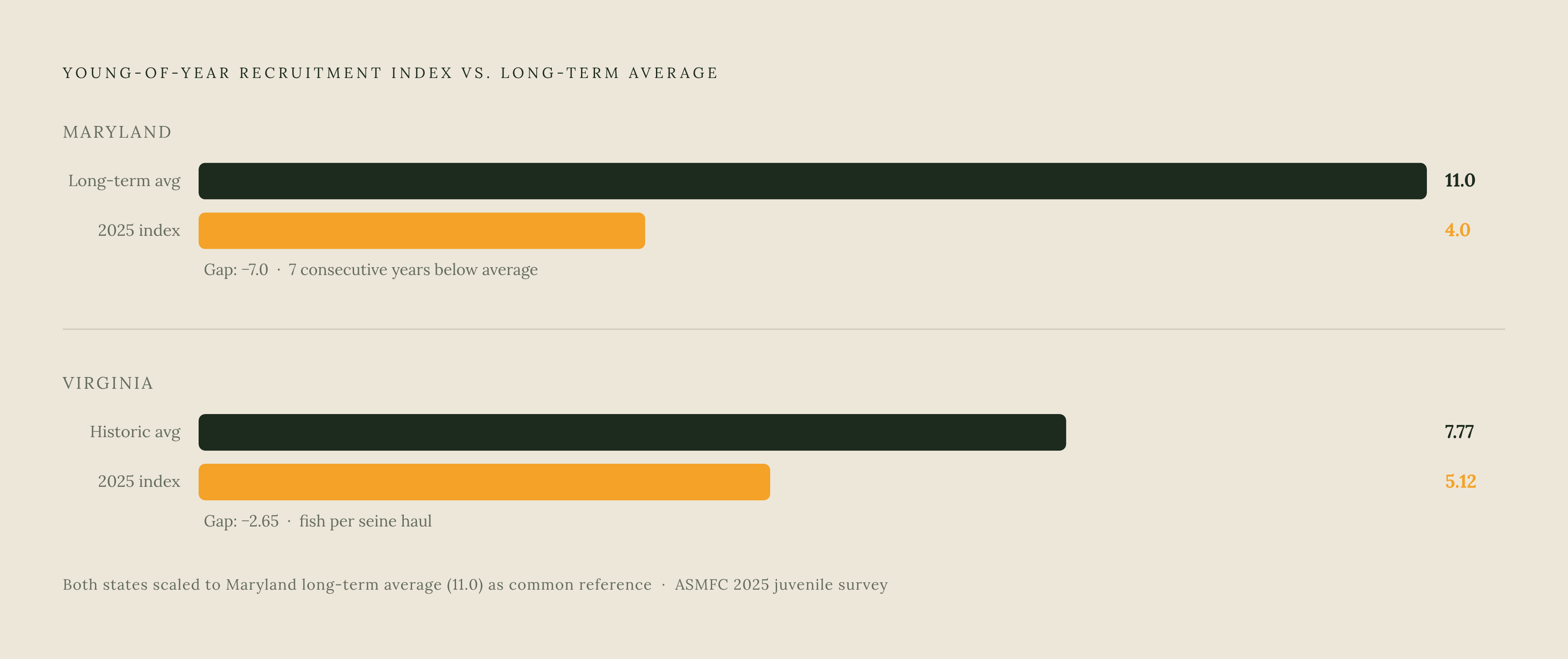
Maryland's method for tracking juvenile striped bass hasn't changed in decades: biologists pull two sweeps with a 100-foot beach seine at each survey site, then average the number of young-of-year fish, three inches or smaller, caught per sweep. That average is the young-of-year index, and it's the single best early warning signal fishery managers have for what a given spawn actually produced.
The 2025 index came in at 4.0. That remains well below the long-term survey average of 11. It marks the seventh consecutive year of below-average spawning success in Maryland, based on DNR's survey results. Virginia's numbers tell a similar story with a slightly better tilt: the Batten School and VIMS Juvenile Striped Bass Seine Survey recorded a mean of 5.12 fish per seine haul across its 18 index sites in the Rappahannock, York, and James systems, below Virginia's historic average of 7.77.
Maryland DNR Director Lynn Fegley said: "Management actions taken over the last decade have resulted in a healthy population of spawning-age striped bass. However, continued low numbers of striped bass entering the population is a threat to this progress as there are fewer juveniles growing into spawning adults." There's a complicating wrinkle here too. Any above-average year-class produced during the recent period of weak recruitment would by now be approaching harvestable size, which could affect fishing mortality in the near term. The underlying seven-year juvenile deficit remains a concern for the adult population going forward. That recruitment picture is shaping how far regulators are willing to let anglers go during the spring run itself.
2026 Maryland regulations on spring run access and spawning protection
Maryland's 2026 season, effective April 1, breaks the year into six distinct stretches. January 1 through April 30 is catch-and-release only. May 1 through July 31 opens for harvest, one fish per person per day, within a 19-to-24-inch slot. August closes entirely, no targeting of striped bass at all. September 1 through December 5 reopens for harvest under the same bag limit and slot, and December 6 through 31 reverts to catch-and-release.
The headline change for 2026 is that April catch-and-release returns to the Bay's main stem for the first time since 2019. In both 2024 and 2025, all striped bass targeting was banned from April 1 through May 15. The spawning tributaries themselves stay fully closed, no fishing of any kind including catch-and-release, from March 1 through May 31: the Choptank, Chester, Manokin, Nanticoke, Patuxent, Transquaking, and Wicomico rivers, along with the Upper Bay spawning area and the Susquehanna Flats. Gear restrictions run through May 15 to hold release mortality down: stinger hooks are banned, trolling is limited to six rods, and barbless hooks are required while trolling.
The logic behind closing August instead of April comes down to water temperature and its effect on release survival. DNR's reasoning holds that catch-and-release in April, when water runs cooler, is generally safe, while the most recent stock assessment, published in 2022, found that recreational dead discards made up 21 percent of all fishing-related striped bass deaths in the Bay. Moving the closure to August, when heat stresses released fish the hardest, targets the period where discard mortality actually peaks.
Not every scientist reads the spring risk the same way. Reid Nelson of George Mason University estimated spring release mortality at 6.8 percent, against 11 percent in summer, numbers that support DNR's April reopening. But some researchers have raised a separate concern: handling a fecund female mid-spawn is energetically costly, and it's plausible that stress could affect her spawning success even if she survives the release. No completed study has measured that behavioral effect yet, so it remains an open question rather than a settled one. Maryland's season change moved forward under ASMFC's Addendum III to Amendment 7 of the Interstate Fishery Management Plan for Atlantic Striped Bass, approved in 2025. The Potomac River sits outside this framework entirely, managed separately by the Potomac River Fisheries Commission, so anglers fishing there need to check that commission's rules on their own. All of this regulatory fine-tuning happens against a much larger backdrop: a stock that is still, by NOAA's own numbers, a long way from rebuilt.
The stock's rebuilding status
Atlantic striped bass were declared officially overfished in 2019, and the rebuilding plan attached to that declaration requires the stock to hit its spawning stock biomass target by 2029. Current biomass is roughly 191 million pounds, against a target of 247 million pounds needed to exit overfished status, a gap that isn't close to closing on its own.
There's a genuine silver lining buried in the most recent stock assessment: the stock is overfished. Total removals in 2025 came in at an estimated 3.0 million fish, a 25 percent drop from 2024 and a 55 percent drop from the recent peak in 2022. The recreational sector accounted for roughly 82 percent of those removals by number, with the commercial sector responsible for the remaining 18 percent.
Management, though, hasn't kept pace with the biology. In August 2025, the ASMFC's striped bass management board voted to advance a proposed 12 percent cut to the 2026 catch for public comment, then reversed course and rejected that same reduction at its October 2025 annual meeting. The Chesapeake Bay Foundation expressed disappointment that managers had not taken stronger action to keep the 2029 rebuilding deadline within reach.
What's missing isn't spawning capacity. The adult population is large enough, and diverse enough across age classes, to produce a strong year class whenever conditions cooperate. What's been missing is a run of consecutive years where temperature and freshwater flow line up well enough for larvae to actually survive. DNR scientists have been direct about what comes next: the effects of seven years of weak juvenile production will keep becoming more visible as those thin cohorts fail to mature into spawning adults over the coming seasons. The Chesapeake's spawning calendar, March arrival, staging in the low 50s, peak activity falling inside that narrow temperature band, remains as precise and predictable as it has ever been. Whether that precision keeps producing enough fish to rebuild the stock depends less on the calendar itself than on whether the water inside it keeps getting warmer.
Notes
- Maryland Set to Adopt Changes to Chesapeake Bay Recreational Striped Bass Season
Provided the $701.5 million economic activity figure and the 21 percent recreational dead discard statistic cited in the regulations section.
- Maryland’s 2026 Striped Bass Season Opens for Catch-and-Release Fishing in April
Provided details on Maryland's 2026 striped bass season structure, including the April catch-and-release opening and tributary closures.
- Maryland plan to lift fishing ban on spawning striped bass stirs debate - Maryland Matters
Provided Reid Nelson's spring and summer release mortality estimates and context on the debate over reopening April fishing.
- https://news.maryland.gov/dnr/2025/10/15/chesapeake-bay-2025-young-of-year-striped-bass-survey-results/
Provided the 2025 young-of-year index value of 4.0 and context on seven consecutive years of below-average spawning success.
- Climate effects on the timing of Maryland Striped Bass spawning runs | Marine and Coastal Fisheries | Oxford Academic
Provided the findings of Angela Giuliano's study on climate effects on striped bass spawning run timing, including the asymmetric shift in season end versus season start.
- https://news.maryland.gov/dnr/2026/02/17/striped-bass-spawning-success-not-limited-by-zooplankton-dnr-study-suggests/
Provided the DNR study finding that zooplankton food availability did not explain recent weak year classes, and the Jim Uphoff quote on temperature and flow as the key drivers.
- https://www.mdsg.umd.edu/news/warming-waters-may-change-timing-striped-bass-migrations
Provided context on how warming waters are projected to change striped bass migration and spawning timing in the Chesapeake Bay.
- https://onlinelibrary.wiley.com/doi/10.1002/mcf2.10274
Provided the peer-reviewed source for the Giuliano study on climate effects on striped bass spawning run timing published in Marine and Coastal Fisheries.