Essay Rockfish Tackle
Rockfish Chum and Chunk Fishing in the Bay
How to anchor, set a slick, and stagger baits for Bay stripers.
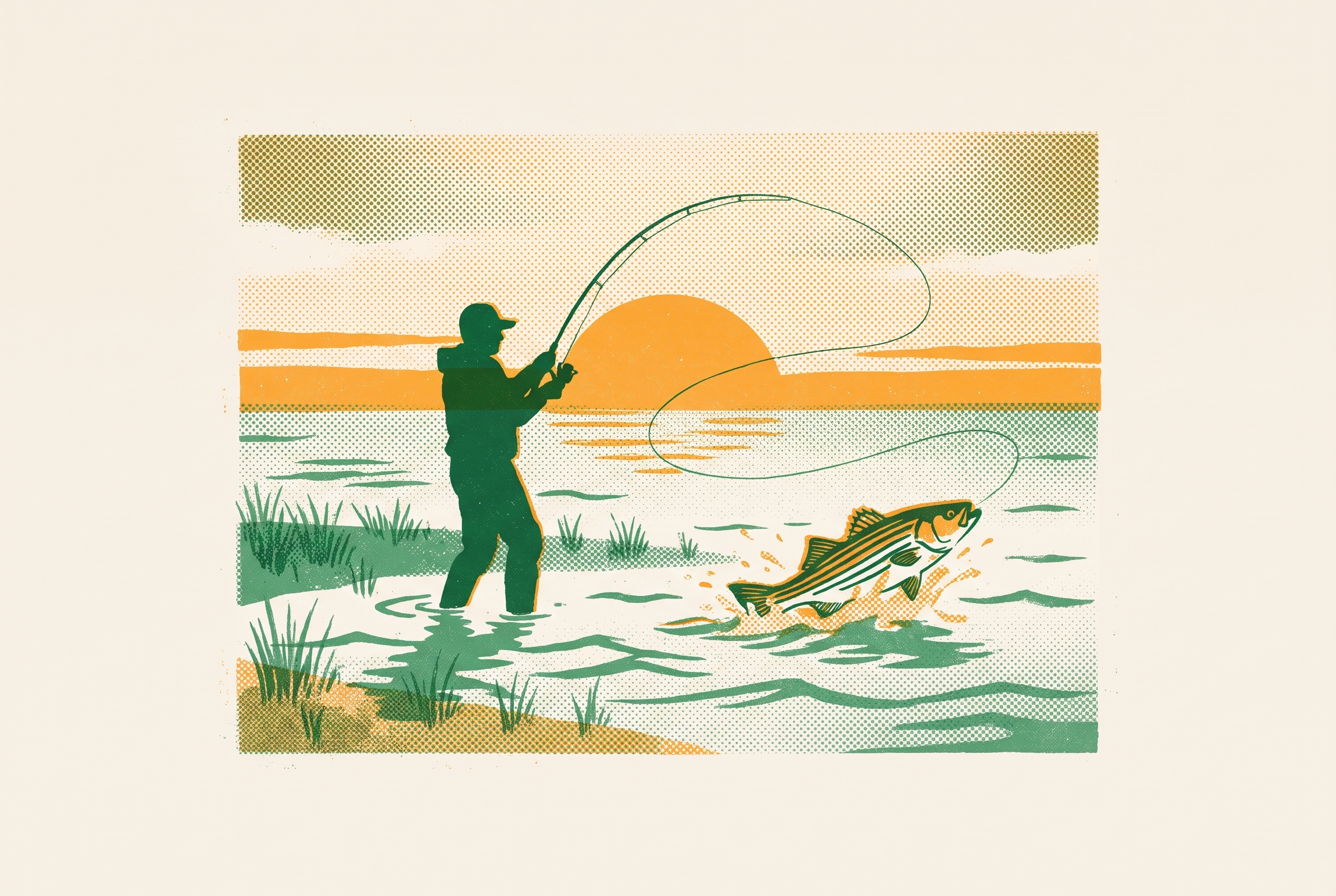
Chumming and chunking for Chesapeake Bay rockfish is an anchored, scent-driven system. Structure sets where the boat sits, the current carries the chum, and fresh chunks at several depths give fish something to eat as they approach.
Why chumming and chunking works as a system for Bay rockfish
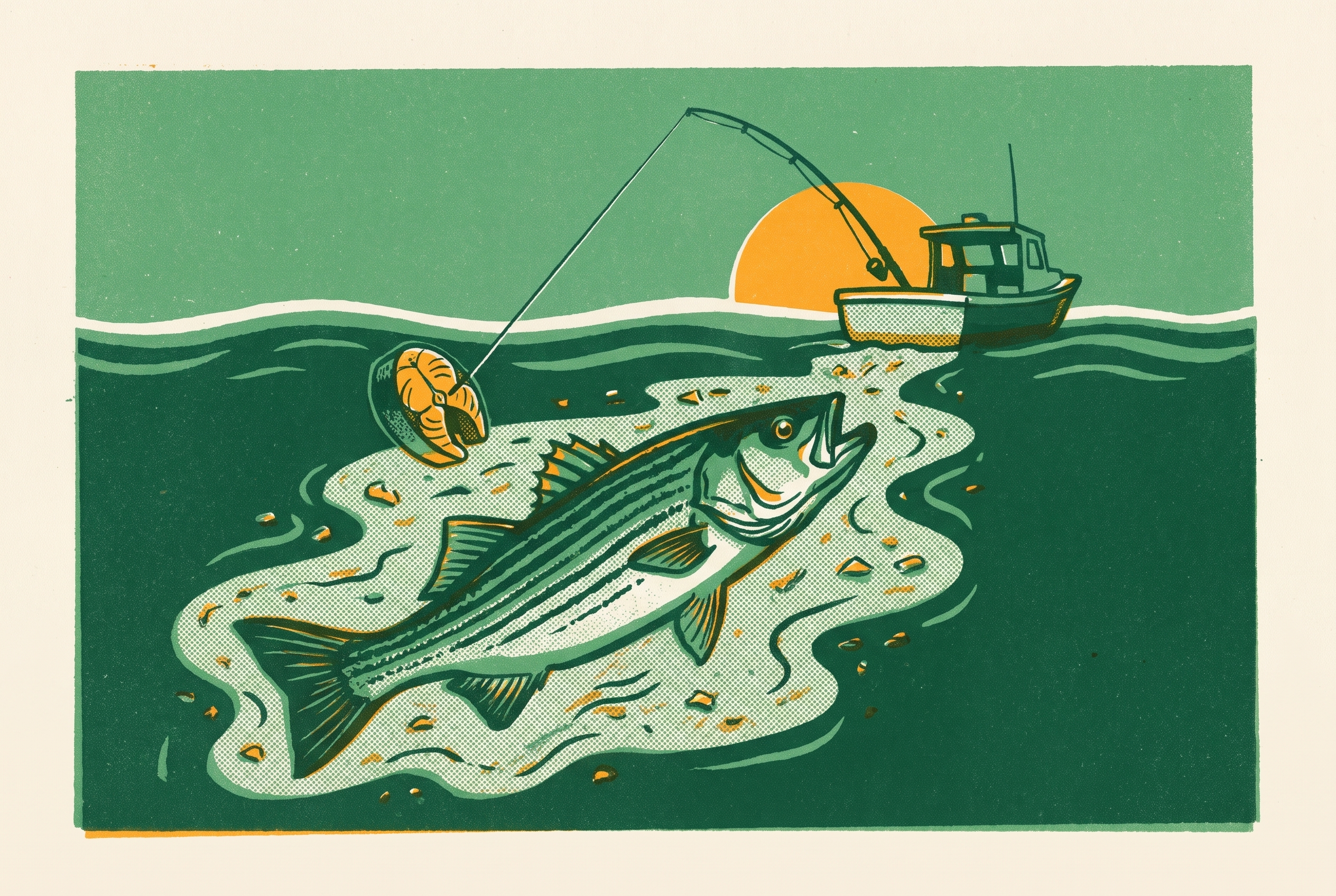
Ground menhaden and cut chunks serve different purposes. The ground bait releases oils into an attractant cloud that draws rockfish from a distance, while the chunks place a hookable meal inside that cloud. Menhaden fits both roles because Bay rockfish feed heavily on it. The tide supplies the delivery, moving scent away from an anchored boat and through the water where fish are holding.
When one rockfish begins feeding, its activity signals the school, so a few interested fish can develop into an active bite. Drawing fish toward the boat is only half the job if the chunks are outside the water those fish are following.
Unlike trolling or jigging, this method does not depend on continually covering water. Once the boat is positioned, the angler works the slick. The remaining decisions concern its flow, the condition of the bait, and the depths at which fish encounter it.
Choosing where to anchor: structure, current, and position on the tide
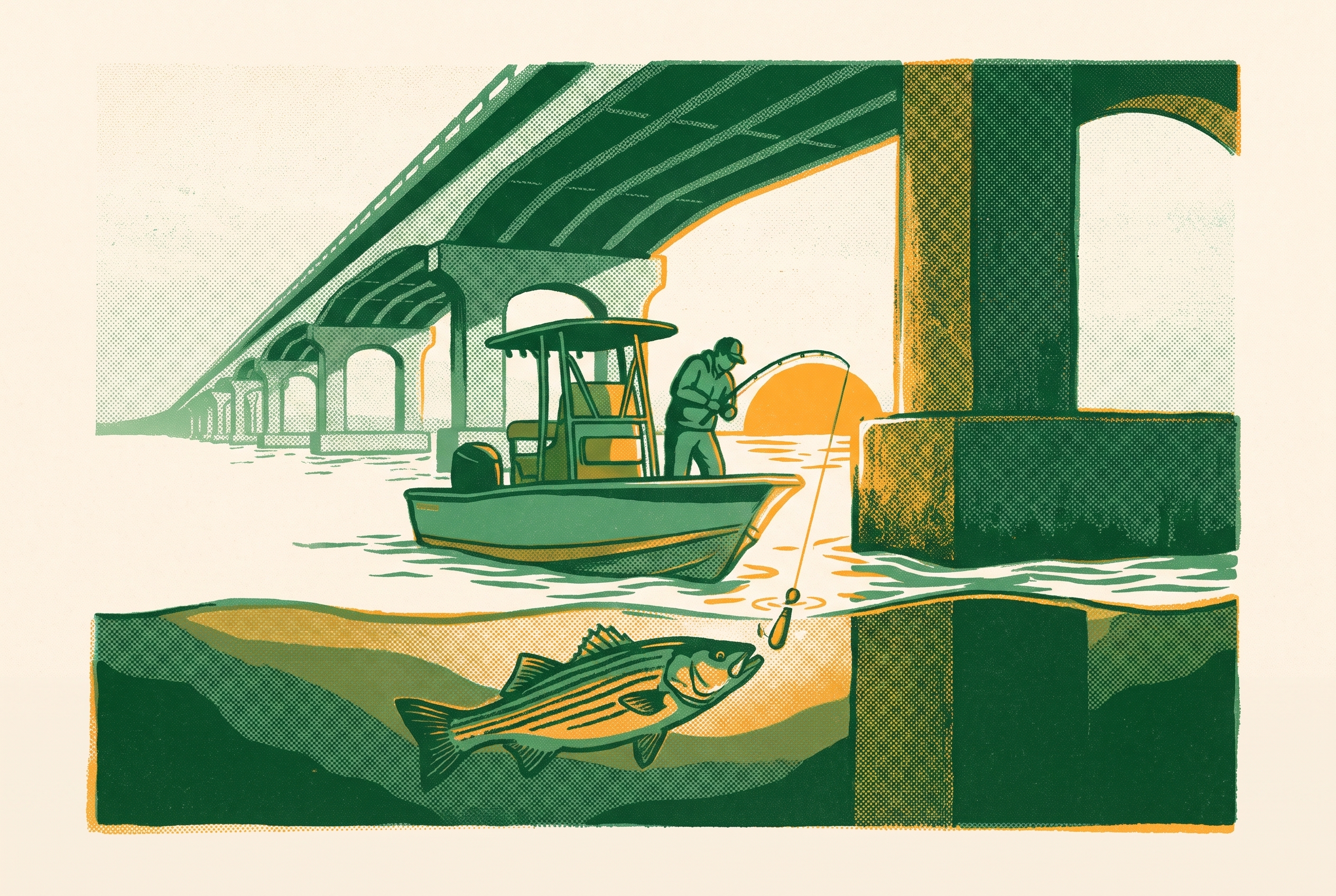
The anchor position must put the boat up-current of the structure being fished. From there, the tide can sweep the chum line over and around the holding water. Humps, ledges, troughs, and bars concentrate baitfish and give schoolie stripers cover to hold tight to.
Anchoring immediately down-current of a pack of boats puts a new slick in competition with those already flowing through the area. That is a poor starting position. Arriving before sunrise gives the angler time to set up before the fleet gathers. Another option is to anchor down-current at the tail end of the combined slick, where the boat can use the fleet’s flow without competing within it.
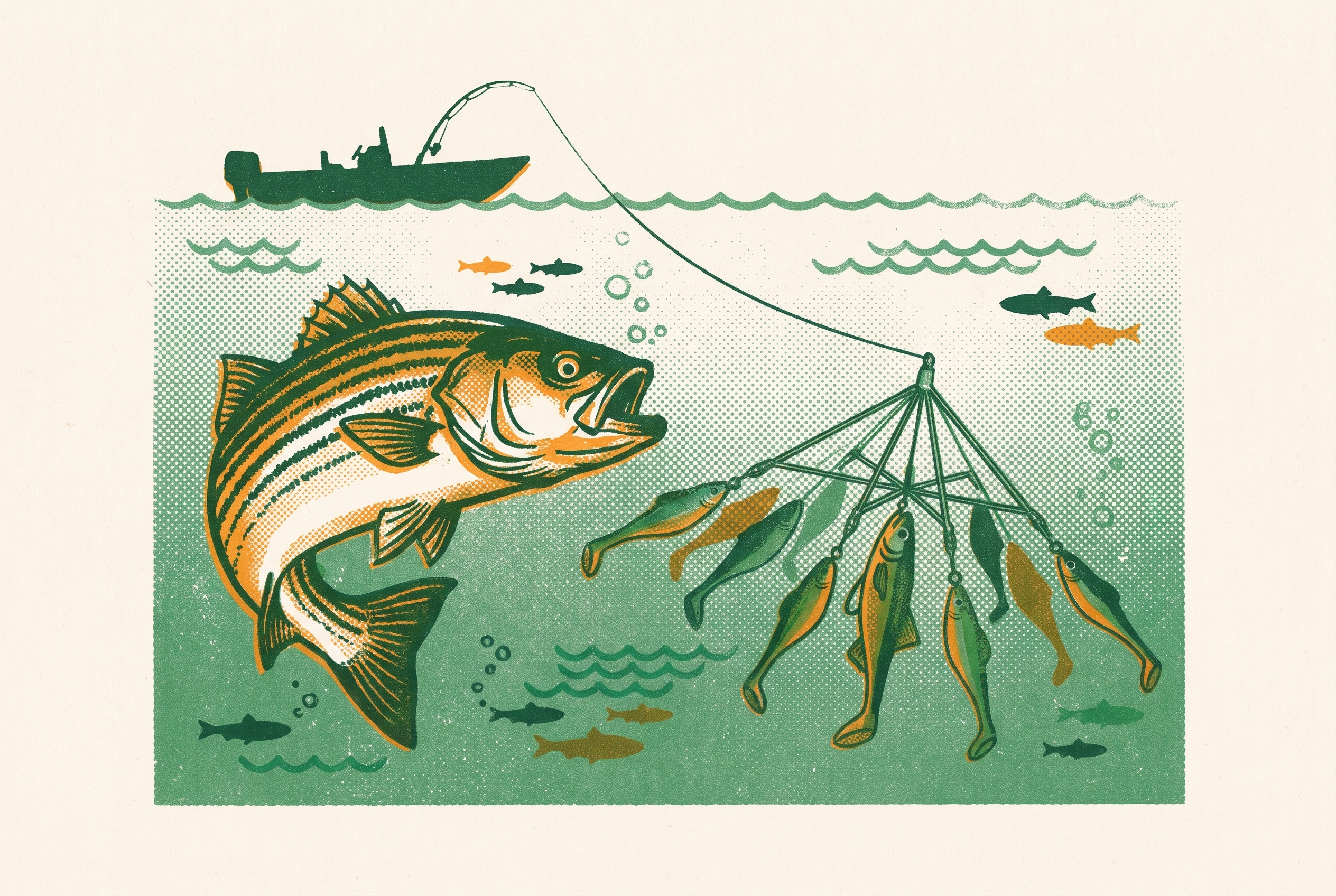
In October 2025, productive Middle Bay water included Eastern Bay, Poplar Island, Thomas Point, the West River, and the mouth of the Patuxent River. Lower Bay rockfish were also active around the Potomac River and Tangier Sound. Channel edges there yielded fish on live-lined spot and umbrella rigs, showing that fish held there, though those catches did not all come from a chum-and-chunk setup.
Setting the chum slick: menhaden, bags, and keeping the cloud flowing
With the boat positioned, the first task is establishing an uninterrupted flow of ground menhaden. A slick that keeps stopping and starting can lose fish already on their way toward the boat. Continuity is the working requirement of the attractant layer.
Standard commercial chum bags often have mesh too fine to release larger pieces, limiting the material that washes into the slick. Cutting extra holes about an inch wide in the bottom lets those pieces out and helps build the attractant cloud.
Bag placement also needs to work with the current. Holding the bag out of that flow restricts the tide’s role in washing chum into the water. A few tugs on the bag rope release a fresh pulse of material and can trigger renewed bites. That pulse supplements the steady slick.
Cutting and rigging chunks: which cuts to use, how to hook them, and when to change bait
Fresh cut menhaden, also called bunker, provides the meal within the attractant cloud. The head is especially prized for large stripers, while all body parts except the tail are fishable. Cut selection therefore offers options, but freshness governs the scent available from each piece. A chunk releases oil as it fishes. Once most of that scent has washed out, regular bait changes keep the presentation effective.
Keep bunker cold but dry, rather than in direct contact with ice, which can leach out its oils. The aim is to preserve what makes the chunk useful in the slick. A cold piece of bait that has lost much of its oil does not offer the same scent contribution as a fresh, properly stored cut.
Hook choice is also a legal requirement for this method. Non-offset, or inline, circle hooks must be used in all Chesapeake Bay tidal tributaries when fishing for striped bass with cut or whole natural bait. Their use calls for slow, steady pressure on the bite. Let the hook set itself as the fish moves away. That approach suits chumming because rockfish often mouth the bait and move with it before the angler reacts.
Braid’s lack of stretch can let a striper feel resistance and drop the chunk. Monofilament, or a mono leader, absorbs the initial run. Sensitivity alone is not the objective in this presentation.
When one rockfish begins feeding, its activity signals the school, so a few interested fish can develop into an active bite.
Fishing multiple depths in the slick: placing rods from surface to bottom
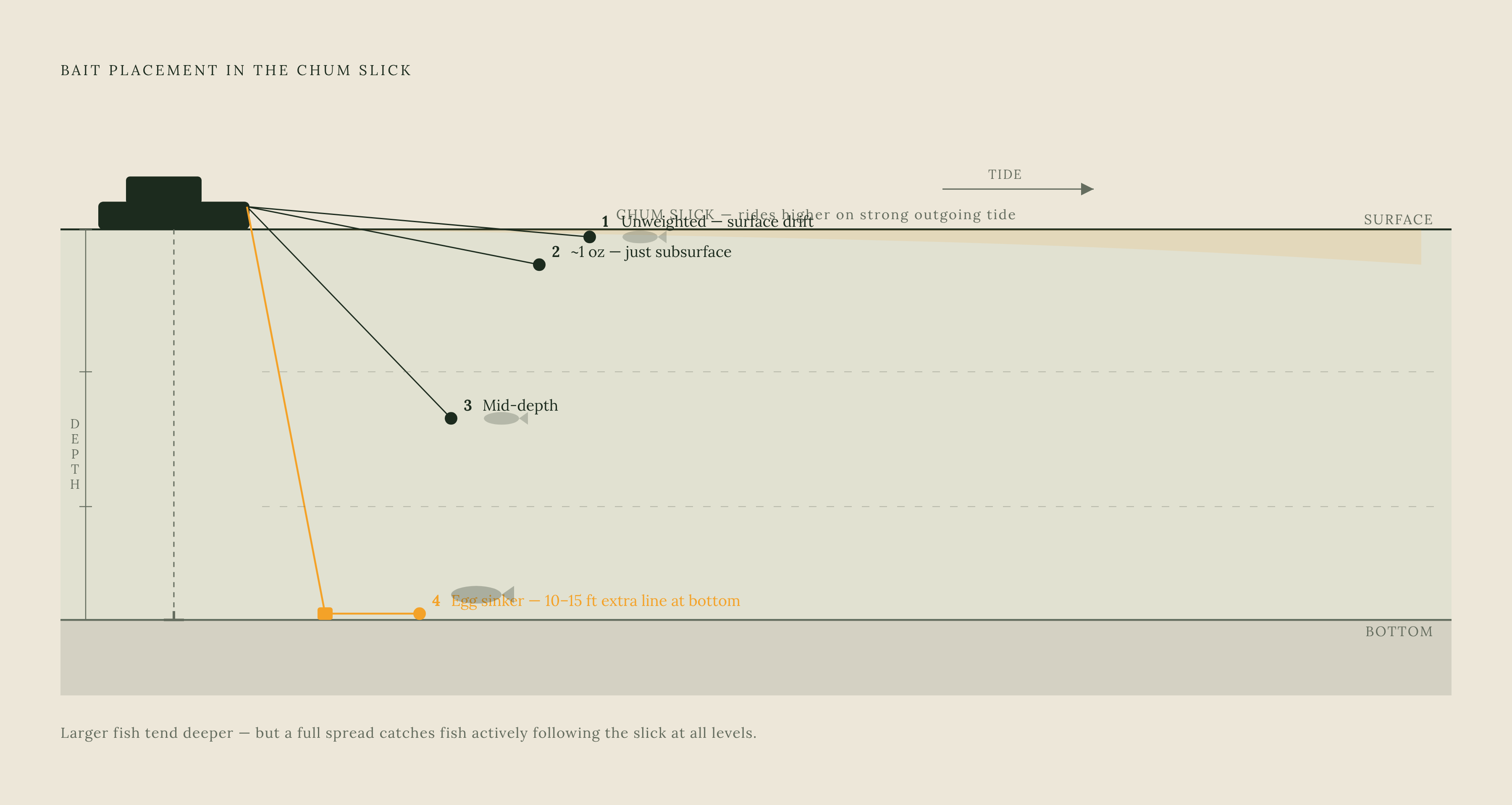
Rockfish do not occupy one fixed level within a chum slick. Baits set at several depths at once can reach fish that are holding or feeding at different heights. Begin with an unweighted bait that drifts freely in the chum cloud, then place a lightly weighted bait just below the surface. An ounce or so serves the mid-depth presentation. A heavier weight takes another bait near the bottom.
The surface presentation requires attention to the line itself. Rather than leaving the rod in a holder and waiting for it to load, keep the reel in freespool and let the chunk drift naturally back inside the cloud. Watch the slack line for a change in direction. That movement can reveal a fish taking the bait before the rod supplies an obvious signal, allowing the slow application of pressure required by the circle hook.
Use an egg sinker or fishfinder rig with a weight heavier than needed to hold bottom. After the weight touches down, feed 10–15 extra feet of line through the sinker. The added slack lets a fish run before it feels resistance.
Larger fish do tend to come from deeper presentations. However, fishing only the bottom excludes rockfish actively following the slick higher in the water column. This becomes especially important on a strong outgoing tide, when the chum rides higher and mid-depth baits remain part of the productive spread.
Reading the tide: when the slick fires and when to wait it out
A moving tide disperses chum and gives the hook baits their natural drift. Slack water interrupts both functions. Instead of extending away from the boat, the chum concentrates beneath it, while baits set at distance lose the drift that made their placement useful. Even good structure can yield few bites while the water is slack.
The transition out of slack often changes the bite. Bites consistently cluster during the first hour of a moving tide after slack, as the current begins delivering scent and moving bait again. That makes the transition a meaningful period to distinguish from the inactive water before it. The same anchor position and rig can perform differently because the delivery system has resumed working.
A ledge or bar that breaks current on a flooding tide may be unproductive on an ebb. Finding the feature is therefore only part of understanding the location. Knowing which phase activates it gives the anchor position a useful time dimension.
When the tide goes slack, the practical adjustment is to reduce weight on bottom rigs and tighten the spread. Leaving chunks stationary at distance preserves a layout whose drift has disappeared. A closer spread suits the contracted slick while the angler waits for moving water to restore the longer presentation.
Seasonal timing and what the Bay's fall calendar means for chumming
The Bay’s chumming and chunking season clusters around the fall rockfish run. The Middle Bay is most active in October, while the lower Bay and channel edges produce into November. In late October 2025, the Middle Bay had the most activity, with fish on shallow structure and channel edges. The seasonal picture therefore includes both kinds of water. It does not support treating fall rockfish as exclusively a deep-water target from the outset.
As the season progresses into November, fish push lower in the Bay and shift toward deeper channel edges. Cut bunker still works, but fishing it deeper matters more. The boat still needs a position that lets the tide connect the chum with the water fish are using.
Birds can help the angler find that water before anchoring. Gulls working the surface are a reliable sign of actively feeding fish and can confirm that bait is concentrated in an area. Gannets provide a more specific late-fall signal. They feed almost exclusively on large baitfish such as menhaden and are rarely seen on the Bay until November. Their presence points to large bait concentrations and the bigger rockfish that feed on them.
A concentration of bait identifies an area of interest, while structure and the direction of flow determine how an anchored slick can reach it.
Maryland and Potomac River regulations that directly govern this method
Maryland’s 2026 season structure and the Potomac River Fisheries Commission’s rules govern where and when this system can be used. Natural bait brings the inline circle-hook requirement directly into the rigging decision. Maryland also explicitly prohibits using striped bass as bait in 2026. Menhaden and rockfish are not interchangeable bait choices under those rules.
Maryland’s 2026 bag limit is one striped bass per person per day, with a 19-to-24-inch slot limit. April is catch-and-release only. August is closed to targeting striped bass entirely, so releasing every fish does not make an August chum-and-chunk trip for rockfish permissible.
The commission’s 2026 blue sheet sets a different schedule for the Potomac River. Its catch-and-release season runs January 1 through May 15, and fish can be kept starting May 16. A no-targeting closure applies July 7–August 20, followed by reopening August 21–December 31. Those dates must be treated as Potomac rules rather than substituted for Maryland’s Bay schedule.
Summer closures are tied to how well fish survive after release. Warm surface water elevates post-release mortality, an acute concern where a heavily fished chumming fleet encounters many rockfish. A coastwide benchmark stock assessment is also underway, with peer review expected in mid-2027, in May or June. Its findings could tighten or loosen future chumming seasons. For the present system, legal timing is as concrete a constraint as the tide that moves the slick.
Notes
- Chesapeake Bay Fishing Report - October 24th, 2025! < Anglers Sport Center
Supplied the late-October 2025 picture of where Middle and Lower Bay rockfish were active and how they were being caught.
- Fishing for Chesapeake Bay School Rockfish
Informed the chumming and chunking technique, including bag modification, bunker handling, rod depths, tide timing and bird signs.
- Fishing for Chesapeake Bay Trophy Striped Bass (Rockfish)
Contributed details on fishing deeper for larger fish, bunker heads as bait, and late-fall gannet and channel-edge patterns.
- Maryland Set to Adopt Changes to Chesapeake Bay Recreational Striped Bass Season
Provided Maryland's 2026 season structure, slot limit, closures, circle-hook rule and the bait prohibition on striped bass.