Long read Features
Live Lining Spot for Big Chesapeake Stripers
Learn where big stripers hold and what bait triggers strikes.
Chesapeake striped bass fishing runs on one hard fact: seven straight years of below-average juvenile recruitment, tracked by Maryland DNR and a regional fisheries management body, mean fewer young fish are coming up behind the current adult stock. The 2025 ASMFC vote to hold status quo tells you the fishery isn't collapsing, but it isn't rebuilding either. That tension is why finding the right spot and working it well, legally, with a fish that survives release, matters more this year than it did a decade ago. This piece breaks down where the big stripers hold on the Bay in 2026, what bait actually gets them to eat, and how to rig it so a strike turns into a fish in the net.
2026 Maryland regulations every live liner must know before launching
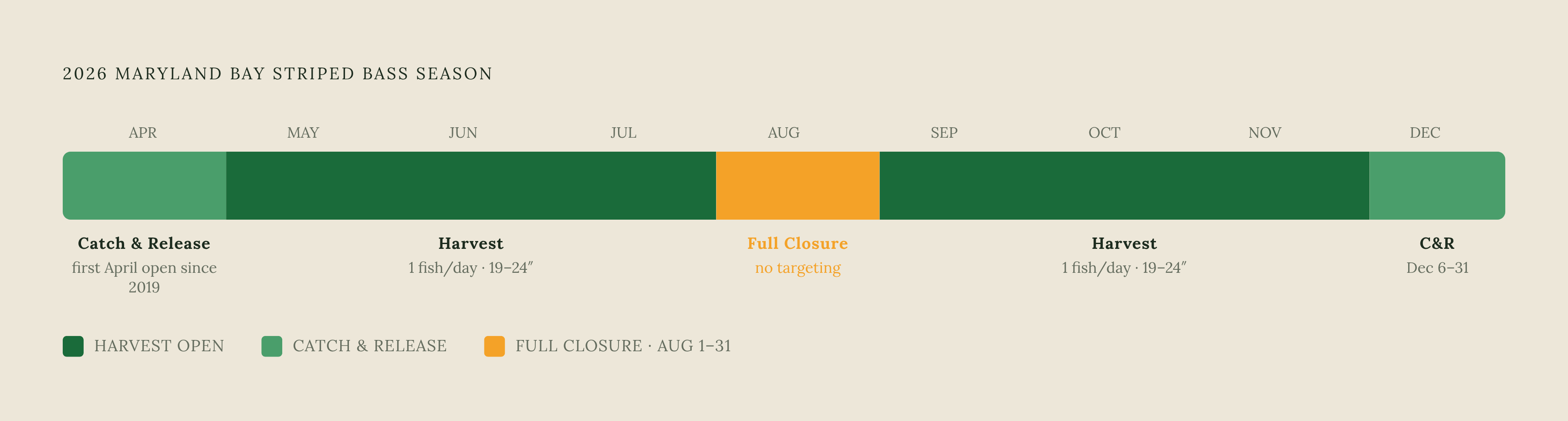
Maryland's 2026 season looks different from years past, and the differences aren't cosmetic. April opens for catch-and-release only, the first time April has been open at all since 2019. That runs April 1 through April 30. Then May 1 through July 31 brings harvest season back, one fish per person per day, with a 19-to-24-inch slot.
August shuts down completely. No targeting striped bass at all, a change from prior years when the closed period covered pieces of April, May, and late July instead. Regulators moved the closure to August specifically to cut down on dead discards during the hottest water of the year, when a released fish's odds of survival drop fast. September 1 through December 5 brings harvest back on the same one-fish, 19-to-24-inch terms, and December 6 through the end of the year reverts to catch-and-release.
Spawning rivers close entirely from March 1 through May 31: the Choptank, Chester, Manokin, Nanticoke, Patuxent, Transquaking, and Wicomico, plus the Upper Bay spawning grounds around Susquehanna Flats. DNR maps these boundaries on its website, and checking them before running up a tributary in spring isn't optional homework, it's what separates a legal trip from a citation.
The ocean side of the fishery runs on its own clock: open all year, 28-to-31-inch slot, one fish a day. That matters for anyone fishing the Bay mouth or near the Bridge-Tunnel, where Bay rules and ocean rules can apply within sight of each other.
Circle hooks aren't a suggestion for live liners. Maryland requires a non-offset circle hook for live lining and chumming in Bay waters, full stop. During April and through May 15, gear rules tighten further: no stinger hooks, trolling capped at six rods, and barbless hooks required while trolling, restrictions tied to a 2022 stock assessment finding that recreational dead discards made up 21% of all fishing-related striped bass deaths in the Bay. These aren't arbitrary. The most recent stock assessment, published in 2022, found that recreational dead discards made up 21% of all fishing-related striped bass deaths in the Bay, underscoring the case for tighter gear rules and seasonal closures alike.
One more note: the Potomac River's main stem falls under the Potomac River Fisheries Commission, a separate body from Maryland DNR. Anyone planning to fish the Potomac needs to confirm those rules independently before launching.
Choosing the right live bait: spot, bunker, and herring ranked by what big fish eat
Spot is the everyday bait, and for good reason. It's hardy and has soft flesh that stripers key in on. A fish is less likely to reject it on the first mouthful. Yearling spot under six inches is the size to target: small enough that cownose rays and schoolie bass can't easily inhale them, but still substantial enough to draw interest from something much bigger.
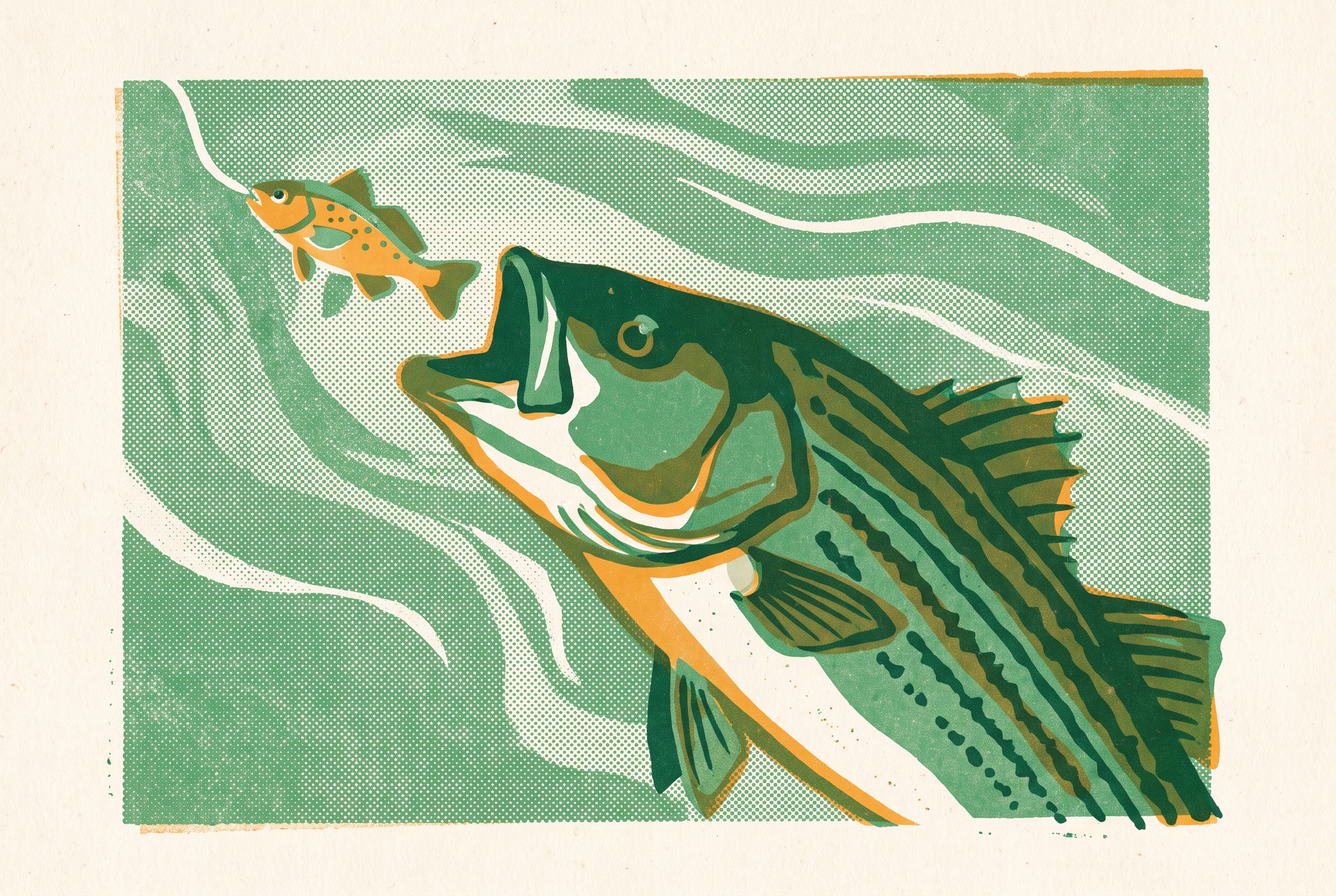
Menhaden, known locally as bunker, is the trophy bait. Among experienced Bay anglers, bunker has a strong reputation as a top striper bait. If spot is the reliable snack, bunker is the meal a big fish will cross open water for.
Peanut bunker, the young-of-year menhaden running roughly 3 to 5 inches, is the standout bait of fall. Stripers stage at tributary mouths specifically waiting for the mass exodus of peanuts out of the creeks and coves where they spent the summer. That migration is predictable enough that experienced anglers plan their whole fall calendar around it.
Blueback herring and alewife are excellent big-fish baits when they're around, but the window is short. Both species tend to disappear from the Bay by early June, so treat them as a spring-only tool rather than something to count on later in the season.
Terminal setup matters as much as bait choice. Line choice matters for live lining, and monofilament is a widely used option for this style of fishing. Pairing that with a baitrunner-style reel lets a striper take line freely the moment it grabs the bait, without feeling the drag click in prematurely.
Finding and keeping live bait
Catching your own bait is the whole game. Spot show up reliably in front of Chesapeake Beach and behind Black Walnut Point on Tilghman Island, and bloodworm or artificial bloodworm rigs take them consistently.
Bunker is trickier in spring and summer, when adult menhaden school in water too deep for a cast net to reach efficiently. Bunker snaggers, large weighted treble hooks dragged through a school, work as a fallback, but they tear up the bait badly and produce significant die-off before the livewell even fills.
Fall flips that problem on its head. Peanut bunker move into shallow creeks and along tributary edges in numbers dense enough that a single cast-net throw can fill a livewell. A 6- or 8-foot net covers the basics for most situations.
Timing the trip counts too. Launch before sunrise, because peanut bunker swarm around lighted piers and bridges in the dark, and the surface gives them away with small flips and dimples. Approach slow and quiet to keep the school from breaking up before the net is ready.
Livewell management is where a lot of otherwise good trips fall apart. Bait needs a steady flow of circulating raw water, and overcrowding the well is one of the fastest ways to kill an entire supply before the first line even goes out. Herring, when they're around in spring, require careful handling and a well that isn't packed too tight to stay lively.
Upper Bay locations: Bay Bridge, Pooles Island, Love Point, and the Magothy mouth in spring and early summer
The Bay Bridge holds fish on the shaded sides of its pilings, in water running roughly 15 to 40 feet deep. The bite there is tide-driven above almost everything else. Light tackle can work in the first hour of light, but once the sun climbs, a live-lined spot fished slow near the pilings becomes the most consistent producer.
The Magothy River mouth is one of the most dependable spots in the entire upper Bay. Stripers chase peanut bunker just outside the river mouth north of Podickery, and inside the river near Dobbins Island close to the green No. 1 marker, where the bottom drops to about 12 to 14 feet. That drop is the key structural feature, an edge that concentrates bait and gives predators a place to ambush from below.
Pooles Island lumps, Tolchester Channel, and Love Point round out the upper Bay's productive water, and all three are close enough together to run in sequence on a single outing. The Patapsco River's shipping docks have held stripers consistently, because the combination of hard structure and current stacks bait and predators in the same place.
On the Water's 2026 playbook notes that in late spring 2025, the upper Bay hosted a reliable bite of 20- to 30-inch stripers on live spot. Local anglers expect that pattern to hold again in 2026. Across the whole upper Bay, the rule that experienced locals treat as gospel is simple: fish sunrise or sunset, on a moving tide. Not a preference. A pattern that holds up trip after trip.
No targeting striped bass at all, a change from prior years when the closed period covered pieces of April, May, and late July instead.
Middle Bay locations: channel edges, hard bottom, and the Eastern Bay shoals through summer and early fall
Summer in the middle Bay is a game of finding channel edges. Hacketts Bar, the Gum Thickets, Clay Banks, Thomas Point, Sharps Island Light, the Diamonds, and False Channel all hold fish through the season, and a depth finder isn't optional here, it's the tool that finds the exact drop-off rather than the general neighborhood.
Guides who've fished this stretch for years describe live lining spot over hard bottom, in moving water, as about as good as it gets in the mid-Bay. Hard bottom holds crabs and small baitfish, and that combination pulls stripers in behind it.
Eastern Bay has been productive water for generations of Bay anglers. Shoals there create sharp depth transitions that give stripers exactly the structure they need to pin sand eels and menhaden against.
As summer turns to fall, the bite shifts and concentrates. Rockfish gather around Thomas Point, the Severn River, Eastern Bay, and the mouth of the Choptank, feeding hardest during low light and while the tide is moving. Live lining works here alongside jigging soft plastics over structure and casting topwater along the shorelines, three approaches that all target the same fish from different angles.
As summer turns to fall, bait-driven staging concentrates stripers around Thomas Point, Eastern Bay, and the mouth of the Choptank, and that pattern tends to repeat close to the same calendar dates each year.
Lower Bay and river mouths: where the fall migration concentrates the biggest fish
On the Water's 2026 playbook found that early October 2025 saw the lower Potomac and Patuxent rivers become the main destinations. The channel edge running from the Route 301 bridge south past St. Georges Island produced consistently on live bait, and the same pattern held on the Patuxent below the Route 4 bridge.
As fall deepens, stripers push further into the Potomac and Choptank proper, following baitfish that are themselves chasing warmer, shallower water. Live lining in this window means following the bait, not anchoring on a fixed piece of structure and waiting.
Near the Bay mouth, the water around the Chesapeake Bay Bridge-Tunnel pulls in big schools of baitfish and the hungry stripers behind them, especially as the fall migration builds. It's a well-known staging area for large migratory fish moving toward the ocean.
Winter fishing belongs to a different stretch. From January through February, the water from Chesapeake Beach south to the mouth of the Potomac has been the most consistent zone for big migratory stripers feeding on open-water bunker schools. It's the coldest and least comfortable live-lining window on the calendar, and it rewards anglers willing to fish through rough conditions when most boats stay tied to the dock.
Peanut bunker live-lined at river mouths in fall draws stripers in the 14-to-26-inch range, fish that push into the mouths as bunker migrate out of the creeks behind them. The approach here is to drift channel edges and humps in at least 10 feet of water and stay mobile, moving the boat until a school actually shows up on the finder rather than committing to one spot and hoping. The timing of that bunker migration shifts from year to year, so local fishing reports and the bait itself are the real signal, more reliable than any calendar date.
Rigging and presentation: the specific tackle setup that keeps bait alive and converts strikes
Spot get a rig built around 3 to 5 feet of fluorocarbon leader, on the heavier end of the pound-test range, a swivel on one end and an 8/0 or larger circle hook on the other. Spot's body can carry that heavier hook without the bait's swimming action suffering.
Bunker need the opposite treatment. A roughly 4-foot fluorocarbon leader, lighter pound-test, a snap swivel, and a 4/0 to 6/0 thin-wire circle hook. The thin wire isn't a compromise, it's deliberate: a heavier hook restricts how naturally the bunker can swim and shortens how long it survives on the line.
Hooking placement decides how long that bait stays lively. Bunker should be hooked through the nose, in one side and out the other, which lets the fish keep its mouth open and breathe normally, extending its life on the hook considerably compared to a jaw-hooked bait. Never run the hook lower jaw to upper jaw on a bunker; it closes the mouth and the bait suffocates fast. Spot are often hooked behind the dorsal fin, but the hook doing that job needs to be a single circle hook. Treble hooks gut-hook fish routinely and make a clean release close to impossible.
Depth coverage is where a lot of anglers leave fish on the table. Run at least one bait weight-free near the surface, one down near bottom, and one at mid-depth, then let the strike zone tell you where the fish are actually feeding that day. Once a pattern shows itself, adjust the other lines to match it.
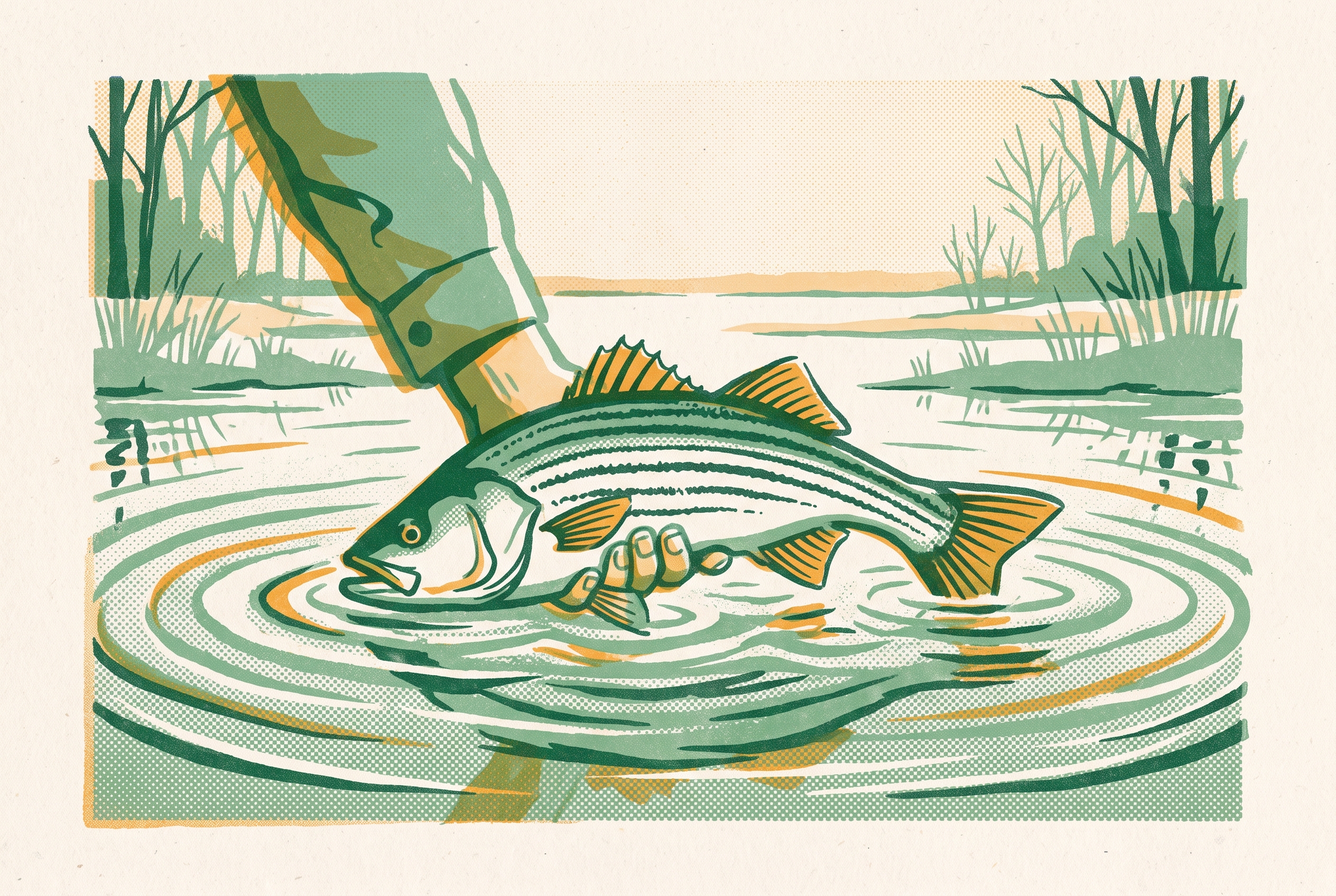
Free-spool discipline matters just as much as the rig itself. Keep the reel in free-spool, or use a baitrunner-style reel, so a striper that grabs the bait can move off with it before any hook-set pressure hits the line. Stripers commonly grab a bait, swim a short distance, and turn it in their mouth before swallowing, and setting the hook too early pulls the bait away before that process finishes. When the circle hook does its job, don't strike hard. Let the fish load the rod and sweep the hook into place on its own; circle hooks are built to find the corner of the jaw without a forceful hookset, and Maryland law requires them for exactly this reason.
Even how the bait hits the water matters. Toss bunker gently when free-lining, because a hard splashdown can stun it, and a stunned bait floating limp on the surface draws far fewer strikes than one that's swimming and struggling like it's trying to escape.
Reading tides, time of day, and structure to put all the location knowledge to work
Every location named in this piece shares one trait: moving water. The Bay Bridge bite, the edges at Gum Thickets, the water around Thomas Point, the river mouths in fall, all of it turns on and off with the tide. Slack water tends to shut the bite down almost completely, regardless of how good the spot looks on paper.
Low light does the same kind of heavy lifting across the upper and middle Bay. Sunrise and sunset are the prime windows, and once the sun gets high, the fish don't necessarily leave, they just go deeper and get harder to reach with a surface-run bait.
Structure ties it together. Bridge pilings with shade on one side, channel edges where the bottom composition changes abruptly, shoals that drop into deep water fast, lighthouse pilings, tributary mouths where creeks empty into the main Bay. The thread connecting all of them is current pushing bait past a spot where a predator can wait in ambush without expending much energy.
A depth finder earns its cost here. Channel edges at places like Hacketts Bar and Clay Banks aren't visible from the surface, and a finder that shows bottom composition, not just a number in feet, is what separates anglers who find the exact lane fish are feeding in from anglers circling the general area and wondering why nothing's biting.
Weather throws all of this off eventually. The 2025 season saw increased wind and rain late in spring disrupt the usual patterns across much of the Bay. When that happens, the move is toward protected tidal creeks and river mouths, where current still pushes bait around but the surface stays calm enough to fish safely and read what's happening below.
Notes
- 2026 Playbook for Chesapeake Bay Stripers, Bluefish, & Red Drum
Provided location-specific details used in the article, including the upper Bay late-spring 2025 bite of 20- to 30-inch stripers on live spot and the early October 2025 lower Potomac and Patuxent river patterns.
- Maryland Set to Adopt Changes to Chesapeake Bay Recreational Striped Bass Season
Sourced the statistic that recreational dead discards made up 21% of all fishing-related striped bass deaths in the Bay, cited directly in the regulations section.
- Fishing for Striped Bass With Live Bait | Salt Water Sportsman
Informed the article's advice on live bait selection, hooking techniques, and terminal tackle setups for striped bass.
- http://www.chesapeakebayfishing.net/live-lining-for-chesapeake-bay-striped-bass.htm
Provided Chesapeake Bay-specific live-lining location details and tactics, including information on spot size, tide-driven bites, and Bay structure.
- https://bayweekly.com/live-lining-for-stripers/
Contributed details on live-lining techniques for Chesapeake Bay stripers, including bait management and hooking placement advice.
- https://www.fishtalkmag.com/blog/how-live-line-spot-part-ii
Informed the article's specific rigging details for live-lining spot, including leader length, hook size, and free-spool discipline.
- https://www.fishtalkmag.com/blog/how-live-line-spot-part-i
Provided foundational live-lining spot technique advice used throughout the rigging and presentation section.
- striped_bass
Supplied official Maryland DNR regulatory details on the 2026 striped bass season windows, closed rivers, and gear requirements referenced throughout the regulations section.