Essay Rockfish Seasons
Summer Rockfish Locations in Deep Bay Channels
Thermal squeeze from heat and hypoxia concentrates summer rockfish in narrow mid-depth bands.
The common shorthand among anglers is that rockfish "go deep" once summer heat sets in, and it isn't wrong so much as it's incomplete. What actually happens is more precise and more interesting: the water column itself narrows the range of places a rockfish can survive, squeezing the population into a mid-depth band rather than releasing it toward the bottom. Warm surface water pushes cold-preferring Sebastes downward, toward the channel floors and canyon walls they favor in summer. But the floor is not always waiting for them. In many bay channels, the deep water that would otherwise offer refuge has lost enough dissolved oxygen that it can no longer support the fish. The descent has a hard limit long before it reaches bottom. Understanding this changes where an angler should be looking, and the mechanism behind it lays out in full before turning to specific waters.
Thermal Stratification and Dissolved Oxygen in the Livable Zone
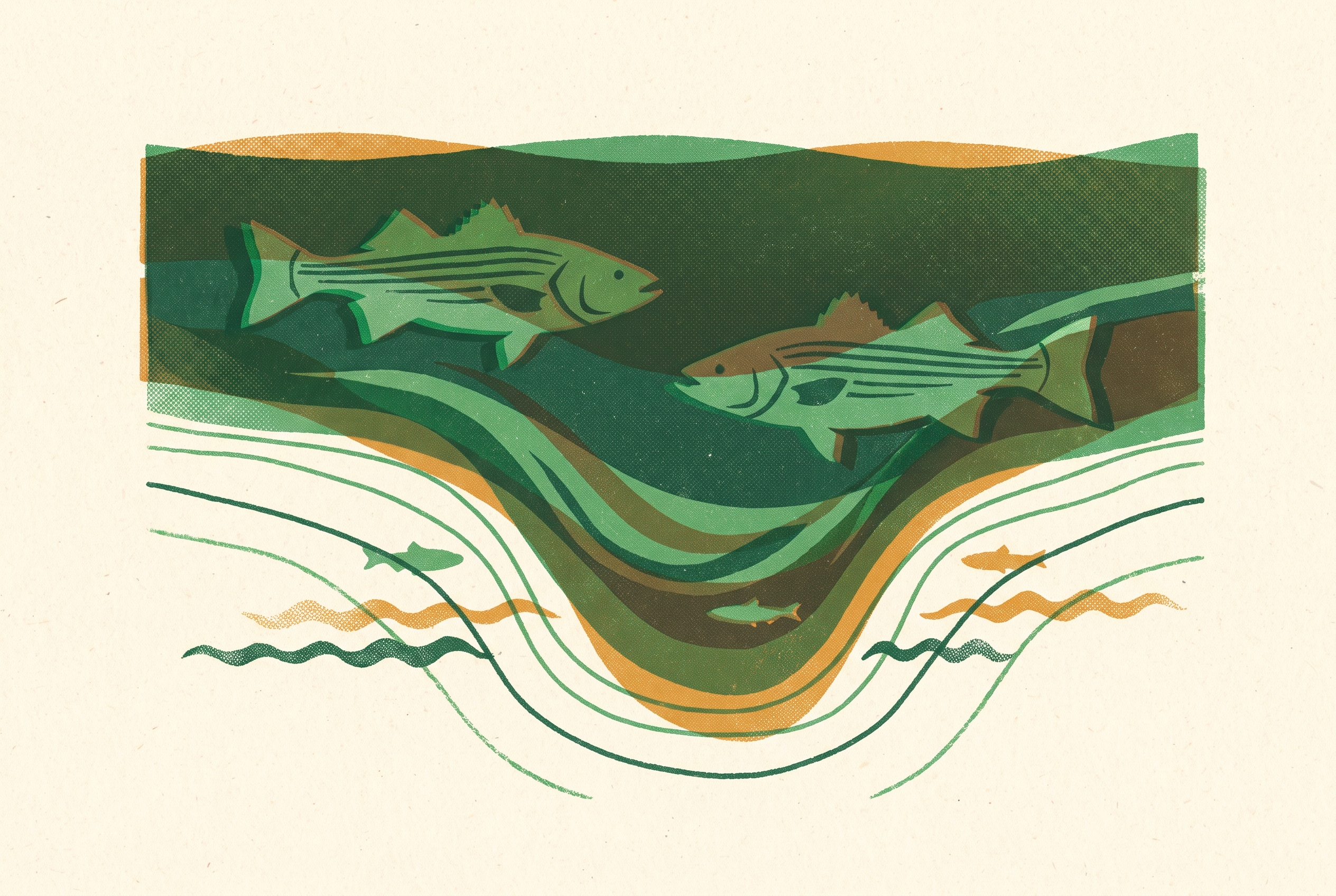
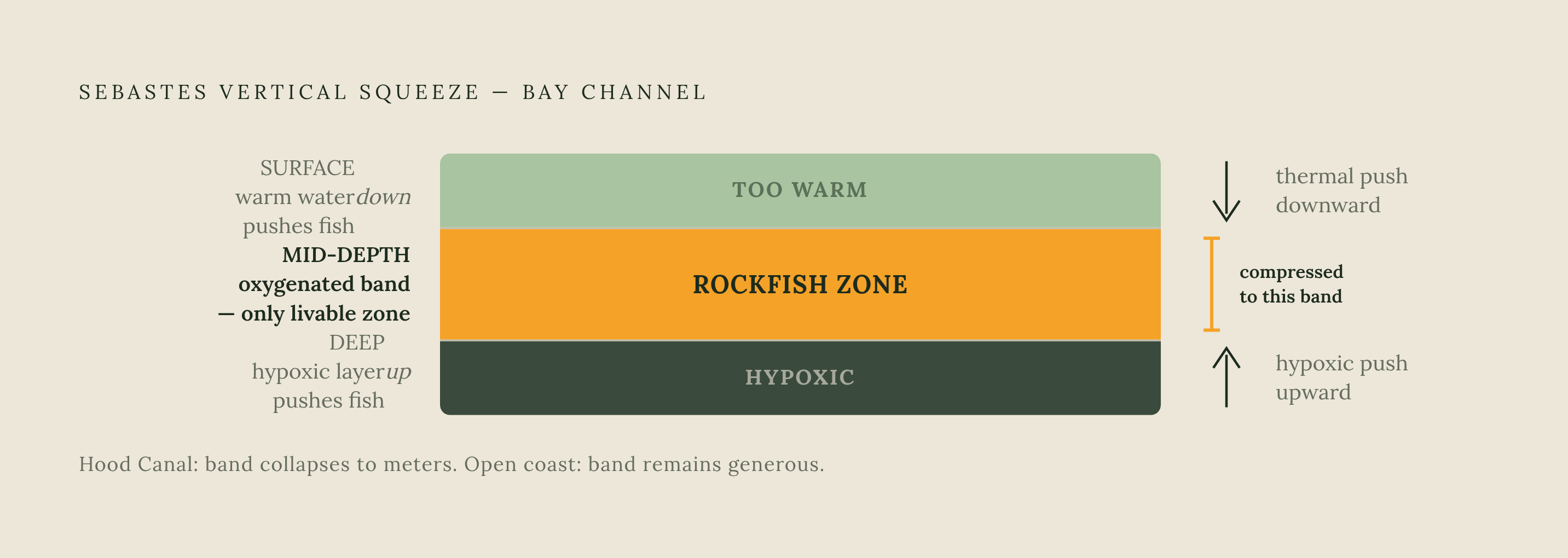
Thermal stratification and summer hypoxia are not two separate seasonal inconveniences that happen to overlap. They are mechanically linked, and the link is what produces the squeeze. Warm surface water is lighter than the cold water beneath it, so it resists mixing downward, and the longer that resistance holds, the more isolated the deep water becomes. Isolated deep water stops exchanging oxygen with the surface, and biological oxygen demand, the steady consumption of oxygen by decomposition and respiration in the water column, strips what dissolved oxygen remains. For a bottom-associated, cold-preferring genus like Sebastes, this produces two simultaneous forces acting in opposite directions: the thermal gradient above pushes the fish down, and the hypoxic layer below pushes them back up, leaving them to occupy whatever oxygenated middle layer remains between the two.
That middle layer can be wide or vanishingly narrow depending on how well a given body of water flushes. In a channel with strong tidal exchange and open connection to the coast, the thermocline and the hypoxic zone may sit far apart vertically, leaving rockfish a generous band to work with. In an enclosed or semi-enclosed bay with poor circulation, the two boundaries converge, and the livable water collapses into a narrow strip running along the channel edges rather than spreading across the open bottom. The consequences of that collapse are not just spatial. Hypoxic conditions expanding during the brooding season carry a reproductive cost as well, since brooding female Sebastes carry oxygen demands of their own, and a shrinking oxygenated layer raises the stakes for reproduction at exactly the time of year fish are most concentrated. The squeeze is a constraint that operates on population viability as directly as it operates on where a jig should be dropped.
Hood Canal and the mid-Chesapeake as documented cases of the squeeze in bay channels
The squeeze is not a model confined to journal papers. The squeeze is not a theoretical model; it has produced documented fish kill events and population declines in two of North America's most-studied bay-channel systems.
A glacier-carved fjord forming the westernmost edge of Puget Sound, its enclosed geometry and poor flushing make it a natural laboratory for studying bay-channel hypoxia. The southern half of the canal regularly turns hypoxic in mid- to late summer, which is what the squeeze model predicts for a poorly flushed system. Documented fish kills in 2003 and 2006 showed that the squeeze does not strike every species equally: copper rockfish dominated the 2003 mortality event, while lingcod bore the brunt in 2006, a difference that points to species-specific depth preferences determining which fish encounter the worst of the oxygen-starved water first. A 2025 trend study covering Puget Sound from 2009 to 2023, published in Frontiers in Marine Science, found a geographically selective decline in copper rockfish concentrated at Hood Canal sites specifically, occurring despite a standing fishing moratorium, a pattern that points toward habitat degradation rather than harvest pressure as the underlying cause. The same study also found dozens of rockfish species present across Washington waters, with a substantial share in the Salish Sea, and recorded higher adult counts and diversity in summer and autumn than in winter and spring, confirming that the squeeze compresses the population into a smaller space without driving it out of the channel system altogether.
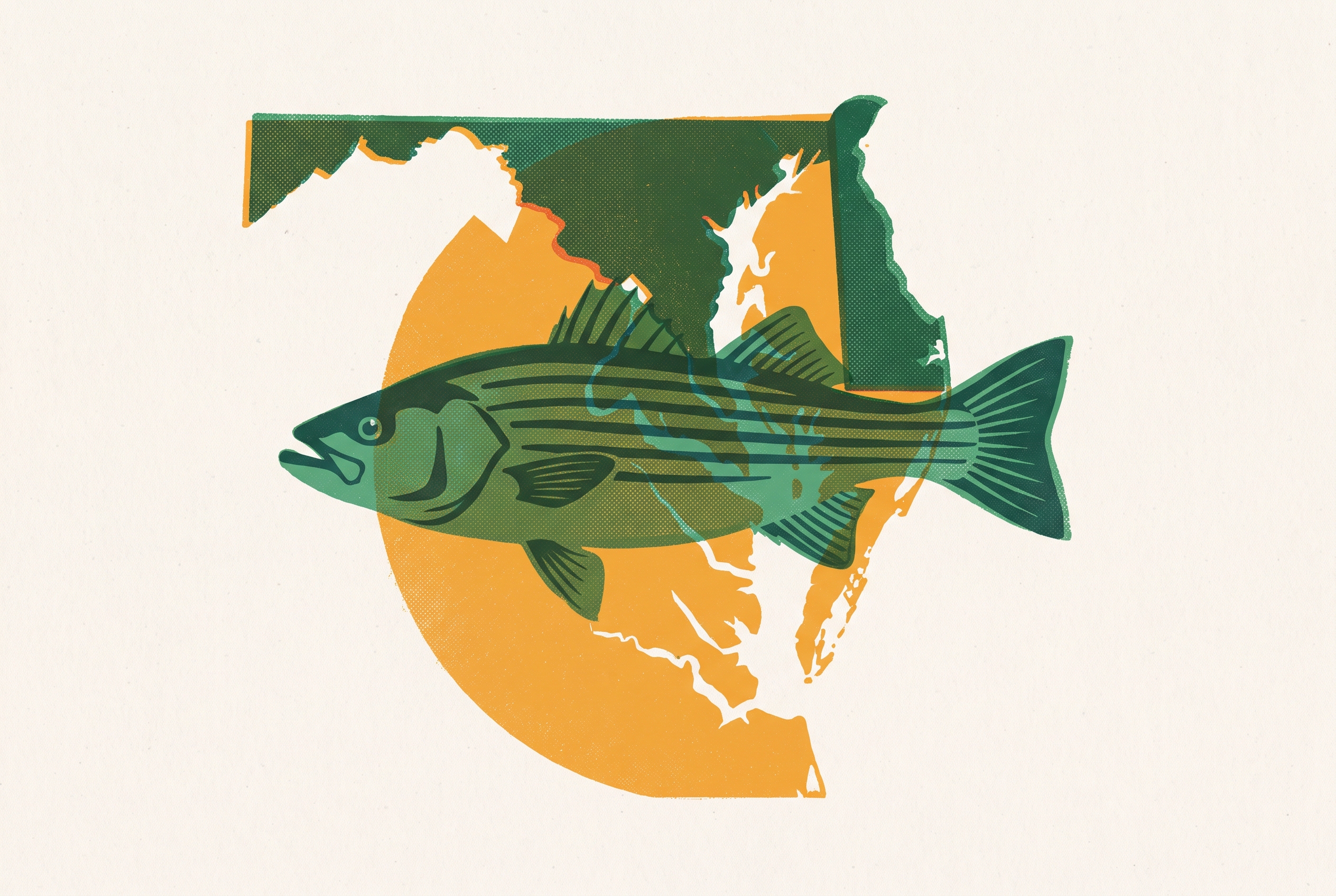
The mid-Chesapeake tells a structurally similar story even though the species involved, striped bass rather than true Sebastes, sit outside the genus this piece otherwise focuses on. The mid-Chesapeake channel, like Hood Canal, is semi-enclosed with limited flushing, and it develops a documented summer dead zone in its deepest water. Where Hood Canal's record shows up in species-specific kill events, the Chesapeake's shows up in spatial redistribution and, as later sections make clear, in the regulatory response built directly around the seasonal timing of that hypoxia. Both systems share the same enclosed geometry and the same summer oxygen collapse, and both reveal, in their own way, a population being pressed into a shrinking livable volume rather than simply retreating to depth.
Species-Specific Depth Ranges and the Squeeze
The squeeze does not treat every rockfish species the same way, because the baseline depth a species prefers in the first place determines how much the shrinking livable band actually constrains it. A species that has never lived near the deep channel floor has little to lose when that floor turns hypoxic, while a species built around deep structure has nowhere else to go.
Shallower-water species, including blue, black, and olive rockfish, typically hold in roughly 30 to 150 feet of water. During July and August, warming water can push some of these fish even shallower within that range, but the shift is modest in consequence, because their habitat was never the deep channel floor to begin with. Deep-water species face a different calculus. Vermilion and bocaccio operate across a much wider range, roughly 150 to 600 feet, and peak summer fishing for large vermilion and bocaccio continues reliably in the 250 to 400 foot zone. That depth sits below the thermocline but above the worst of the hypoxia in open-coast bay channels that flush well, which is precisely the mid-depth sweet spot the squeeze model predicts. Morro Bay illustrates the interaction concretely: vermilion, blue, and copper rockfish gather around rocky reefs and structure there, with the best success reported at 180 to 360 feet, a range that brackets the thermal-oxygen squeeze zone on the central California coast.
The scientific literature backs the species-specific pattern rather than a single blanket rule. Research on rocky-reef-associated fish documented substantial vertical shifts in distribution tied to low dissolved-oxygen events, but the magnitude and direction of those shifts varied by species, undercutting any notion of a uniform "summer depth" that applies across the genus. Depth is the outcome of a species' underlying biology meeting the particular thermal and oxygen conditions of a given channel in a given summer.
That middle layer can be wide or vanishingly narrow depending on how well a given body of water flushes.
The structural features within deep channels that concentrate fish in the squeeze zone
Knowing the livable mid-depth band exists is only half the picture, because within that band rockfish do not spread out evenly. They gather on specific structural features that combine oxygenated water with current, forage, and hard bottom, and those features are what turn an oceanographic concept into an actual fishing spot.
Rocky channel walls, pinnacles, and current-swept drop-offs are the consistent concentrators on both coasts, because oxygenated water tends to keep moving along a channel wall rather than settling and stagnating the way it does across a flat, open bottom. Not every rockfish sits directly on the structure itself. Many suspend well above it, so the productive water inside the squeeze band extends upward from the wall or pinnacle top through a meaningful slice of the mid-water column. Locating fish often means working that column vertically rather than assuming they're glued to the bottom. Current plays as large a role as depth in where fish actually hold. Tidal currents squeezing through channel constrictions, such as Bloody Point at the entrance to Eastern Bay where it meets the Chesapeake Bay, or the narrows within Hood Canal, create feeding stations where baitfish concentrate and rockfish hold position without burning energy fighting the flow.
Scale matters too. Smaller, isolated structures are harder to stay positioned over at the depths where rockfish typically hold, roughly 120 to 360 feet, especially once wind or current complicates the drift, which makes large continuous channel walls and major drop-offs more dependable summer targets than small, isolated pinnacles. On the Pacific coast, seasonal upwelling compounds the pattern by intensifying near-bottom hypoxia across broad stretches of the continental shelf, pushing rockfish off open bottom entirely and tightening their hold on channel walls and structure where oxygenated water continues to circulate. The channel wall, in short, is where the abstract squeeze becomes a place an angler can actually mark on a chart.
What the squeeze means for fishing tactics in summer channel conditions
Every tactical adjustment that follows from the squeeze traces back to the same physical argument: the fish are not on the bottom, and they are not necessarily where a summer chart or last season's memory says they should be. Depth has to be found by observation in the moment rather than assumed in advance.
Depth selection illustrates this directly. In open-coast bay channels with adequate flushing, the 300 to 400 foot zone can hold the biggest vermilion and bocaccio of the season, but in an enclosed system like Hood Canal that same depth may be fully hypoxic on a given day, and the only way to know which condition applies is to check the water rather than trust the number on a chart. That same logic argues for presenting bait by suspending it over structure rather than pinning everything to a dead-bottom rig, since suspended presentations match where compressed rockfish populations are actually sitting in the water column rather than where they're assumed to sit. Working the column vertically, reaching bottom and then reeling up through the depth range in stages, locates fish that a static bottom rig would miss entirely, because the squeeze can place a school anywhere between the channel wall and well above it. Position matters as much as depth. Current-swept walls and channel constrictions produce far more consistent action than open, flat channel bottom, and holding position over the wall edge, whether by anchoring or careful drifting, is worth the extra effort at these depths.
Handling the catch responsibly is part of fishing this zone. The deeper a fish is caught within the squeeze, the greater its risk of swim-bladder over-expansion on the way up, and several Pacific coast management areas now require descending devices as a result, a rule that functions as a direct conservation obligation tied to deep-channel fishing rather than a bureaucratic afterthought. On the water, live sardines and anchovies remain confirmed producers for channel rockfish on the Pacific coast, and bottom fishing with a vertical presentation near structure remains the standard approach from the San Francisco offshore fishery inward to the bay channels themselves.
Coastal Regulations and the Summer Squeeze
Fishery managers on both coasts have built rules around the same underlying biology, even though the resulting seasonal structures look almost opposite to each other.
Maryland's 2026 regulations establish a complete closure across August, running August 1 through August 31, 2026, with no harvest, no catch-and-release, and no targeting of striped bass permitted during that window. The reasoning tracks the squeeze argument directly: August is when water temperature and hypoxia in the main Bay channel peak at the same time, and under those conditions even a fish released promptly after catch often doesn't survive the stress. The surrounding season reflects the same logic in reverse. The 2026 harvest season runs May 1 through July 31 and again September 1 through December 5, with a one-fish daily bag limit inside a 19-to-24-inch slot. Spring catch-and-release, from January 1 through April 30, is permitted because water temperatures at or below 59 degrees produce very low release mortality, and the absence of stratification in spring is what makes that window safe for the fish. Spawning tributary protections, including the Susquehanna Flats, remain in force from March 1 through May 31 regardless of the broader seasonal calendar.
California's Pacific Sebastes fishery is built around a different structural reality. Emergency regulations adopted at the California Fish and Game Commission's August 2025 meeting, effective August 28, 2025, restored all-depth access in state waters north of Point Conception from April 1 through December 31, with those emergency provisions set to expire February 25, 2026 absent readoption, and regular rulemaking has since carried the same provisions forward with a potential effective date of May 26, 2026. The 2026 framework layers species-specific limits on top of that all-depth access: canary rockfish reopened with a 2-fish sub-bag limit, quillback rockfish held at zero retention, copper rockfish reduced to a 1-fish sub-bag limit, and vermilion and sunset rockfish managed under a combined sub-bag limit for the species-unit. Oregon's approach is simpler still, keeping rockfish open at all depths year-round in 2026 with no seasonal depth restriction at all. The Pacific coast can sustain this kind of open access because its ocean-facing channels generally flush well enough to keep oxygenated water available at depth, so the squeeze narrows the livable band without shutting the fishery down the way the enclosed Chesapeake channel does for the whole of August.
The regulatory picture on both coasts is responding to a condition that is not standing still. Near-bottom oxygen maps stretching back to 1950 show a steady decline across the Pacific Northwest shelf, and rockfish populations in Puget Sound have been falling since the 1970s despite a standing fishing moratorium that removed harvest as a variable entirely. The squeeze described throughout this piece is tightening over time, and the regulations calibrated to today's conditions are responding to a baseline that continues to shift under them.