Essay Rockfish Tackle
Chesapeake Bay Rockfish Fishing From Shore
Shore anglers get the structure, season, and rules for Bay rockfish.
Shore fishing for Chesapeake Bay rockfish remains accessible and rewarding, but productive trips now depend on more than finding fish. Anglers need to match structure, season, and technique to rules designed for a stock under sustained pressure.
Why rockfish matter so much to the Chesapeake — and why that makes the current moment consequential
The Chesapeake Bay produces the overwhelming majority of the Atlantic striped bass population through spawning and nursery habitat in its tributary rivers. Decisions about seasons, fishing gear, and forage inside the Bay affect the coastwide stock from Maine to North Carolina. Protecting reproduction here is therefore central to rebuilding the larger population.
Locally called rockfish, striped bass is Maryland’s state fish and anchors the Bay’s recreational identity. Shore access is part of that identity. Bridges, piers, bulkheads, and tidal river banks put anglers on structure the fish use without requiring a boat. The current management pressure reaches an accessible fishery.
What eight straight years of poor recruitment actually means for the fish anglers find today
Maryland DNR’s juvenile striped bass survey found young-of-year numbers well below average for eight years in a row, including a 2026 index of 5.5. Those weak year classes leave fewer fish to replenish the adult population as they mature. The effects do not arrive all at once. Virginia Institute of Marine Science’s 2026 survey offered a modest counterpoint, identifying an average year class, slightly above the historical average and improved from 2025. That local improvement does not erase the broader recruitment deficit.
The stock was declared overfished in 2019. Although overfishing has since stopped, spawning stock biomass remains below its rebuilding target, with a legal deadline of 2029. Forage depletion threatens food supply, while warming water and summer hypoxia compress suitable habitat. Recreational dead discards add mortality even when anglers release their catch.
How Maryland's 2026 season structure works, and what changed from previous years
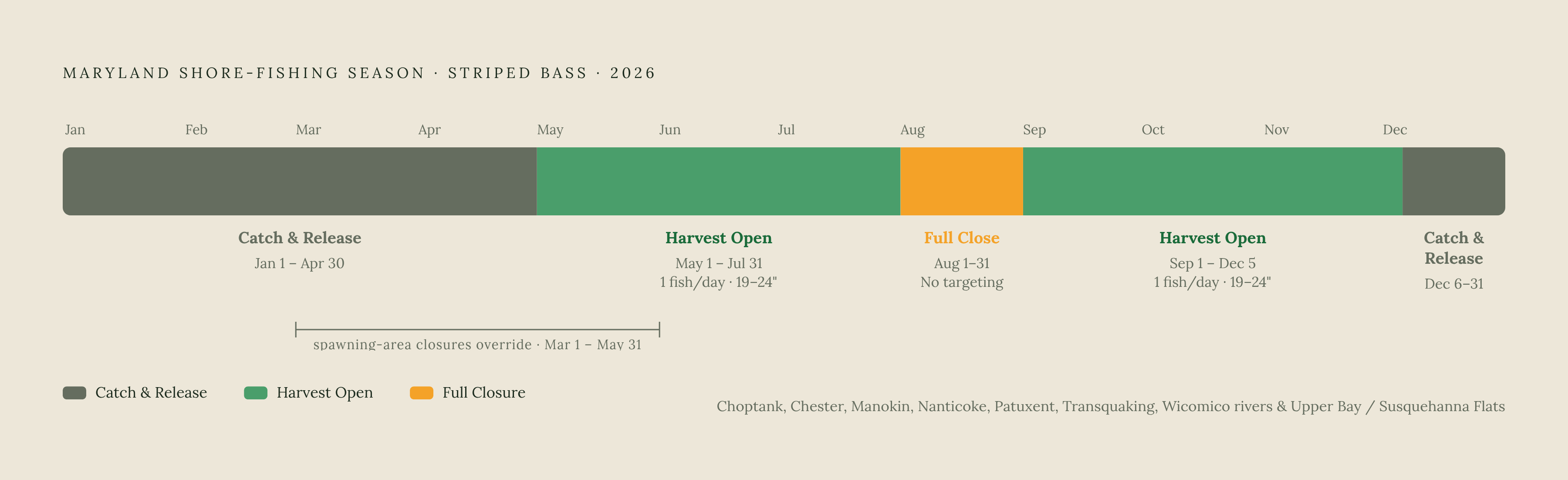
Maryland DNR’s March 2026 announcement establishes January 1–April 30 as catch-and-release, May 1–July 31 as harvest, and August 1–31 as closed entirely. Harvest resumes September 1–December 5, followed by catch-and-release December 6–31. During harvest periods, the limit is one fish per person per day, with a minimum of 19 inches and maximum of 24 inches. April access returns for the first time since 2019. The trade is a full August closure to targeting rockfish.
Spawning closures override those general season dates. The Choptank, Chester, Manokin, Nanticoke, Patuxent, Transquaking, and Wicomico rivers, plus the Upper Bay spawning area including the Susquehanna Flats, are closed to targeting from March 1 through May 31. DNR’s website has regulation maps that show those boundaries. April catch-and-release gear restrictions extend through May 15 and prohibit stinger hooks, limit trolling to six rods, and require barbless hooks while trolling.
The Potomac River Fisheries Commission manages the Potomac River main stem separately, so its rules require an independent check. Maryland’s ocean recreational fishery is also distinct from the Bay fishery, allowing one fish per day in a 28–31-inch slot, year-round. ASMFC Addendum III to Amendment 7, approved in 2025, authorized Maryland’s season reset. Fisheries scientists found that the restructuring does not increase overall striped bass mortality.
Virginia's rockfish calendar on the same Bay, and why the two states look so different
Virginia’s open windows are narrower and less spring-focused than Maryland’s, despite the shared water. The ASMFC plan sets conservation limits. States can use different mixes of seasons, slots, and closures to meet those limits. Consequently, a Maryland fishing date cannot establish whether targeting or keeping rockfish is legal on a Virginia shoreline.
Before fishing, anglers should check the year’s Virginia dates and limits directly with Virginia DGIF. Location determines which rules govern the trip. This is especially important when fishing both sides of the Bay or tributaries that cross state lines. Federal waters, 3–200 nautical miles offshore, remain fully closed to possession of striped bass in 2026, a separate jurisdictional restriction relevant near the Bay mouth.
Why the August closure and circle-hook requirement exist, and what they ask of the angler who releases fish
Maryland DNR’s 2022 research found that recreational dead discards accounted for 21 percent of fishing-related striped bass deaths in the Chesapeake Bay. Releasing a fish does not guarantee survival. Hot August air and water increase post-release risk, particularly for young resident fish that have not joined the coastal stock. The closure aims to let those fish grow into the size range at which they leave the Bay.
Required when fishing with bait, they are designed to hook fish in the corner of the mouth and reduce hooking deep in the throat. That reduces internal injury and improves release survival. DNR also encourages minimal handling, limited air exposure, and keeping fish in the water where possible. For shore anglers already fishing high-low bottom rigs with inline circle hooks, the requirement confirms a common setup.
The forage debate — whether restricting anglers addresses the right variable
The Chesapeake Bay Foundation argues that angler restrictions cannot restore rockfish without adequate menhaden forage. A late-2025 menhaden assessment found coastwide biomass lower than previously thought, but did not determine regional distribution within or north of the Bay. That distinction limits what the assessment establishes locally. Warming-driven northward shifts also complicate the question of how much forage remains available to Bay rockfish.
The foundation’s Will Poston called the board’s decision “nothing more than a performative nod to ecosystem-based fisheries management,” saying ASMFC “failed to fully respond to the science.” The foundation argues that the quota reduction offered little additional protection because 2025 harvest was already below the new 2026 limit. Lower permitted harvest alone may therefore leave rockfish without adequate menhaden forage. This dispute concerns the strength of forage protection, and angling rules still apply. Management must address both food supply and fishing mortality, while the adequacy of that balance remains contested.
Locally called rockfish, striped bass is Maryland’s state fish and anchors the Bay’s recreational identity.
Where shore anglers find rockfish in the Bay — the structure-based logic and confirmed locations
Rockfish use structure, making shoreline features more useful than a place name alone. Bridges concentrate bait through shadows and disrupted current. Channel edges are places where the depth changes, while oyster bars and rip-rap give fish places to ambush prey. Dock pilings and bulkheads serve similar functions in tidal rivers. Creek mouths and submerged grassbed edges also become good places to find fish as they shift from summer to fall patterns.
DNR’s September 2026 fishing report describes mixed striped bass and white perch action at Kent Narrows, including productive jigging and live-lining spot. It also identifies early-morning and late-evening casting near bulkheads, piers, and bridge piers. Swan Point is not named in that report’s Kent Narrows context. Treating the two locations as equally documented would obscure the actual evidence.
Anglers can wade-fish at Calvert Cliffs on the western shore. Elsewhere along the western shore, anglers can also find bridge catwalks and piers. Solomons Island has a public fishing pier and boat ramp at the Governor Thomas Johnson Bridge, with access to the Patuxent River and open Bay. Pooles Island’s lumps and Love Point appear as productive Upper Bay areas in May 2026 reports, but productive water does not establish pedestrian access.
Seasonal windows that shore anglers should actually plan around
January through April offers Maryland catch-and-release fishing as large coastal spawners return and stage in lower and mid-Bay waters before spawning. Cooler water keeps release mortality low. From March onward, however, spawning-area closures restrict where anglers can target them. The practical spring window is therefore defined by the statewide calendar, fish movement and DNR’s mapped boundaries.
May through July is the main early season for harvest. Spot arrive and become the main live bait, while rockfish settle into summer holding areas around structure by June. Early-morning and overcast topwater fishing can produce, as can jigging pilings. Fish outside the harvest slot must be released. As summer water warms, those releases call for more care even before the August closure begins.
August removes rockfish targeting from Maryland’s available options. Red drum, bluefish, and other summer residents offer alternative targets. September then brings cooling water, more active feeding, and fish chasing bait around structure, channel edges, and rip-rap. Fall harvest runs through December 5, after which fishing becomes catch-and-release as large migratory fish return. Cold water improves release conditions, but does not remove the need for careful handling.
Techniques and rigs that work from land at Bay structure
Jigging suits the pilings and current breaks that hold fish from May through July and into fall. May 2026 reports describe ¾-oz jig heads with Electric Chicken paddle-tail swimbaits, one-oz heads with chartreuse BKDs, and half-oz white bucktails with four-inch tails. The working targets are shadows and downtide current seams. Reported productive depths were 10–25 feet at the Bay Bridge and 10–40 feet for swimbaits in the Patapsco corridor. These depth references describe fish-holding water, with casting access from land still to be established.
Topwater fishing fits shallow shoreline water during low light. Bone-colored spooks, poppers, and paddletails produced during early mornings and overcast conditions, with the bite typically fading as sunlight and warmth increased. Kent Narrows provides a specific fall setting for poppers and paddletails near accessible structure. Fall shore reports also identify hard-bodied plugs and paddle-tail swimbaits as productive. As water cools, fish become more aggressive and stay less close to any one piece of structure, so anglers can reach them from more casting angles.
At Kent Narrows, live-lining spot was productive in September, while high-low bottom rigs with inline circle hooks suit the established shore-fishing setup. Outgoing water concentrates bait at creek mouths and around structure. Incoming water pushes fish onto shallow flats and rip-rap. Early morning and late evening are still good times to fish with any of these methods.
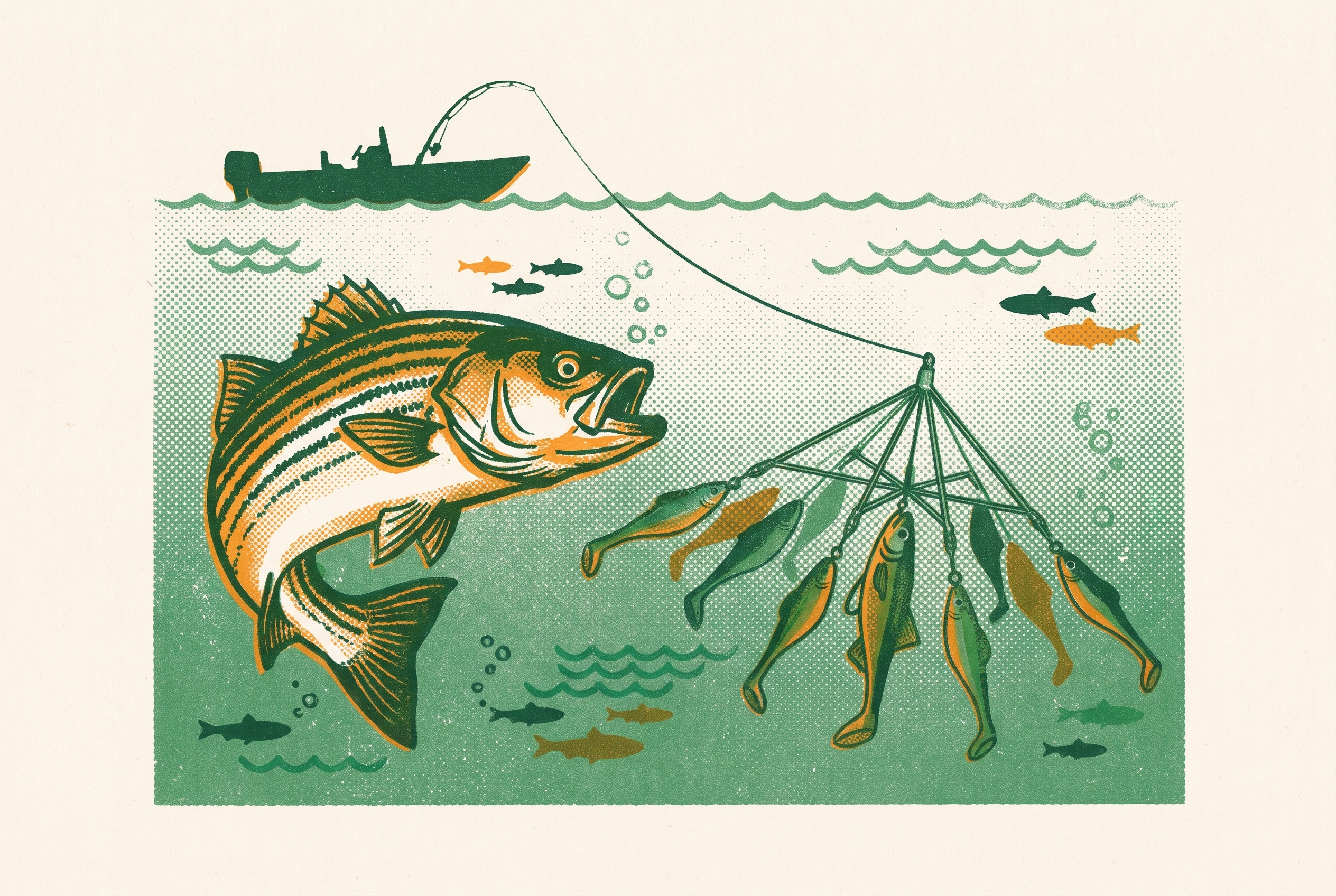
Catwalk and pier fishing depends on suitable access. Where bridge catwalk access permits the approach, the notes identify trolling six-inch shad tandems and umbrella rigs with four-ounce inline sinkers in adjacent 25–50-foot water columns. That specialized option remains subject to applicable trolling restrictions, including the spring rod and hook rules.
What the angler who catches and releases fish owes the fish — and the fishery
Release technique is an investment in future fishing. DNR’s guidance is to wet hands before handling, support the fish horizontally, avoid squeezing its belly, and keep it in the water where possible. Air exposure should be brief. Return the fish headfirst into current and watch for it to swim away strongly before moving on. Voluntary use of barbless hooks outside the required trolling period can also reduce injury and speed release.
ASMFC representative Grout’s warning is that recovery under catch limits depends on released fish surviving, connecting management directly to the angler’s actions. An average dead-discard estimate does not predetermine the outcome of every release, and careful handling can improve the odds. Under repeated recruitment failure, protecting a fish already present in the population is a concrete contribution to the fishery’s future.
What to expect as regulations continue to evolve through 2027 and beyond
ASMFC’s coastwide benchmark stock assessment is expected to complete peer review in spring 2027 and inform further management decisions before the 2029 rebuilding deadline. The current framework is not a settled endpoint. In October 2026, the striped bass board declined to advance a proposed reduction in removals after preliminary data through mid-2025 showed recreational catch below expectations. That decision remained contingent on the full assessment. Menhaden protection also remains unresolved, with quota reviews planned for 2027 and 2028.
Fish spawned in 2026 will take three to four years to reach fishable size, so catches in the next few years will still depend on the weak earlier cohorts. Anglers should check Maryland DNR and Virginia DGIF regulations before each season as the framework changes. Shore anglers can fish tidal bulkheads, public piers and bridge structure. The angler who understands their timing, access, and biological limits is better positioned to use them well.
Notes
- Maryland’s 2026 Striped Bass Season Opens for Catch-and-Release Fishing in April
Supplied the 2026 Maryland season dates, size and creel limits, spawning closures, and April gear restrictions.
- Maryland Set to Adopt Changes to Chesapeake Bay Recreational Striped Bass Season
Provided the rationale for the season changes, including the dead-discard share of fishing-related mortality and the August closure.
- Juvenile striped bass maintaining average abundance in Virginia waters in 2026
Supported the point that Virginia's 2026 juvenile survey showed an average year class, improved from 2025.